Quick Facts
Fastest check: Turn the carpet over — a genuine hand-knotted piece shows the full design on the back, never a printed grid.
The fringe: On an authentic carpet the fringe is the warp itself, an extension of the foundation — not a strip sewn on afterwards.
Knots matter: Look for slightly irregular, hand-tied knots; perfectly uniform machine knots are the giveaway of a power-loom copy.
Honest pricing: At Al Malakia, entry-level Afghan hand-knotted pieces start from AED 800, while fine Qum silk begins around AED 8,000.
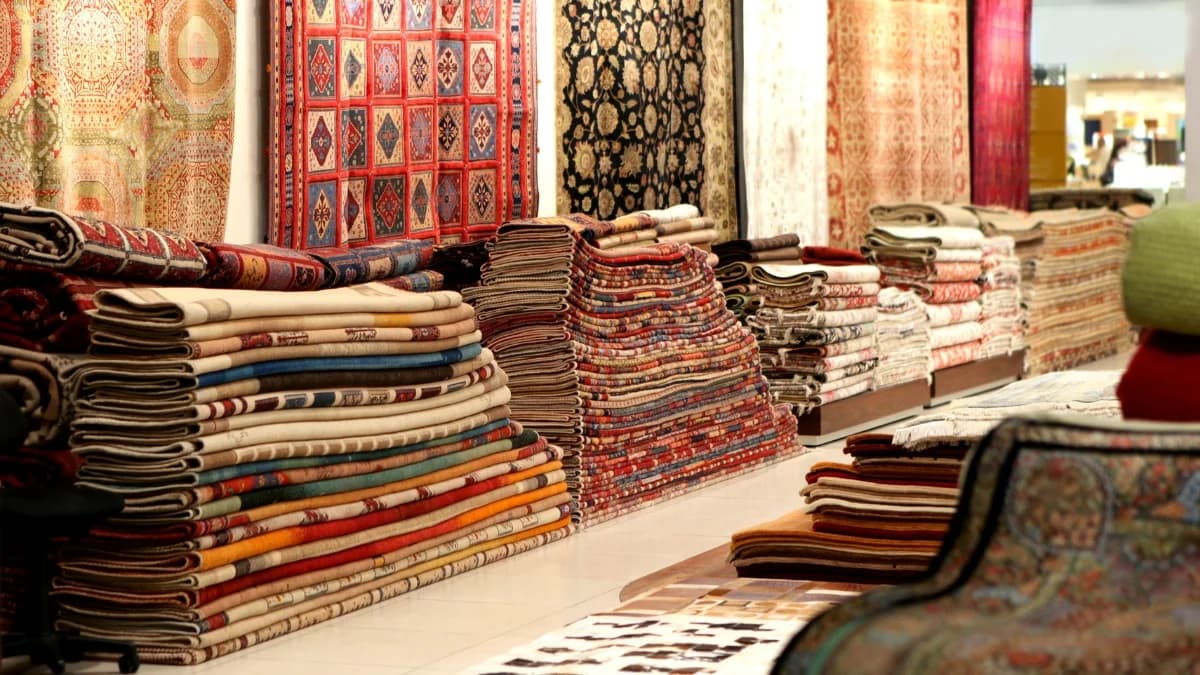
Where to verify in person: Shop 45–48, Central Souq Block 3 (Blue Souk), King Faisal Road, Sharjah — 500+ pieces you can inspect and compare.
Free Dubai transfer: Complimentary door-to-door pick-up from Dubai hotels and homes so you can examine carpets without pressure.
You have found a carpet you love and the seller assures you it is a genuine, hand-knotted Persian piece. But how do you actually know? The market — in Dubai, Sharjah and online — is full of machine-made copies, chemically washed imitations and carpets sold under the wrong origin. The good news is that you do not need to be an expert to verify authenticity. A few honest, repeatable checks — ones you can do in minutes on the showroom floor — will tell you most of what you need to know.
This guide walks you through every practical test we use ourselves at about Al Malakia, from the back of the carpet to the chemistry of the dyes, so you can buy with confidence anywhere in the UAE.
1. Start With the Back of the Carpet
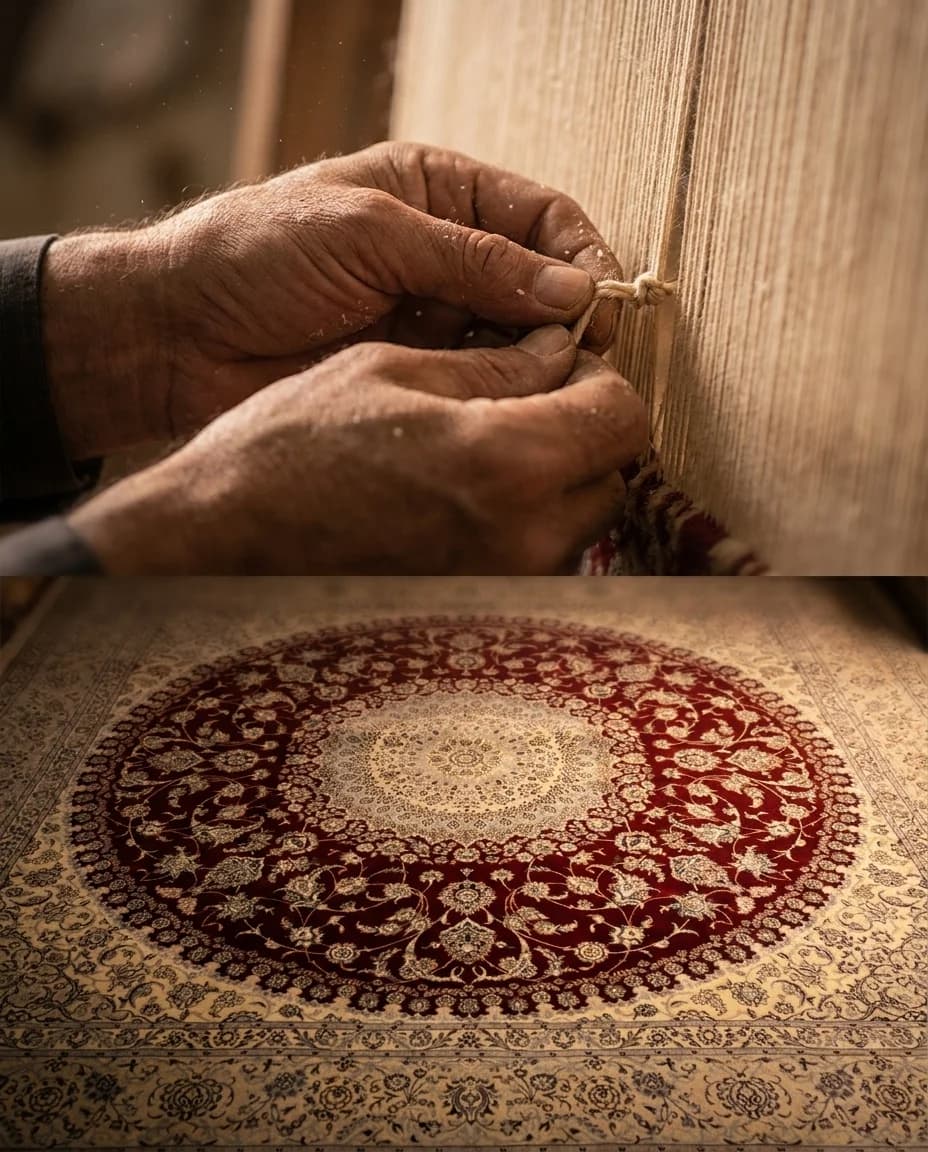
The single most revealing test takes two seconds: flip the carpet over. On a genuine hand-knotted Persian carpet, the pattern is fully visible on the reverse, mirroring the front almost exactly, because every knot is tied by hand through the foundation. The colours may look slightly softer on the back, but the design, the curves of the medallion, and the individual knots are all there.
A machine-made or printed carpet behaves differently. Power-loomed pieces show a stiff, perfectly even grid on the back, often with a layer of latex or glue holding the pile in place. Printed imitations — increasingly common online — have a blurry, faded ghost of the design on the reverse, or no pattern at all. If the back does not clearly reproduce the front, the carpet is not hand-knotted.
There is one more thing the back will tell you: the sharpness of the curves. Hand-knotting allows a skilled weaver to draw smooth, flowing arabesques and rounded medallions, because each knot can be placed independently. On a machine carpet, curves are reduced to small stepped blocks — you will see a faint staircase effect along any diagonal or curved line. Run your finger along a curved part of the design on the back; if it feels and looks stepped rather than fluid, be cautious. This single observation separates many convincing imitations from the real thing.
Reading the knots
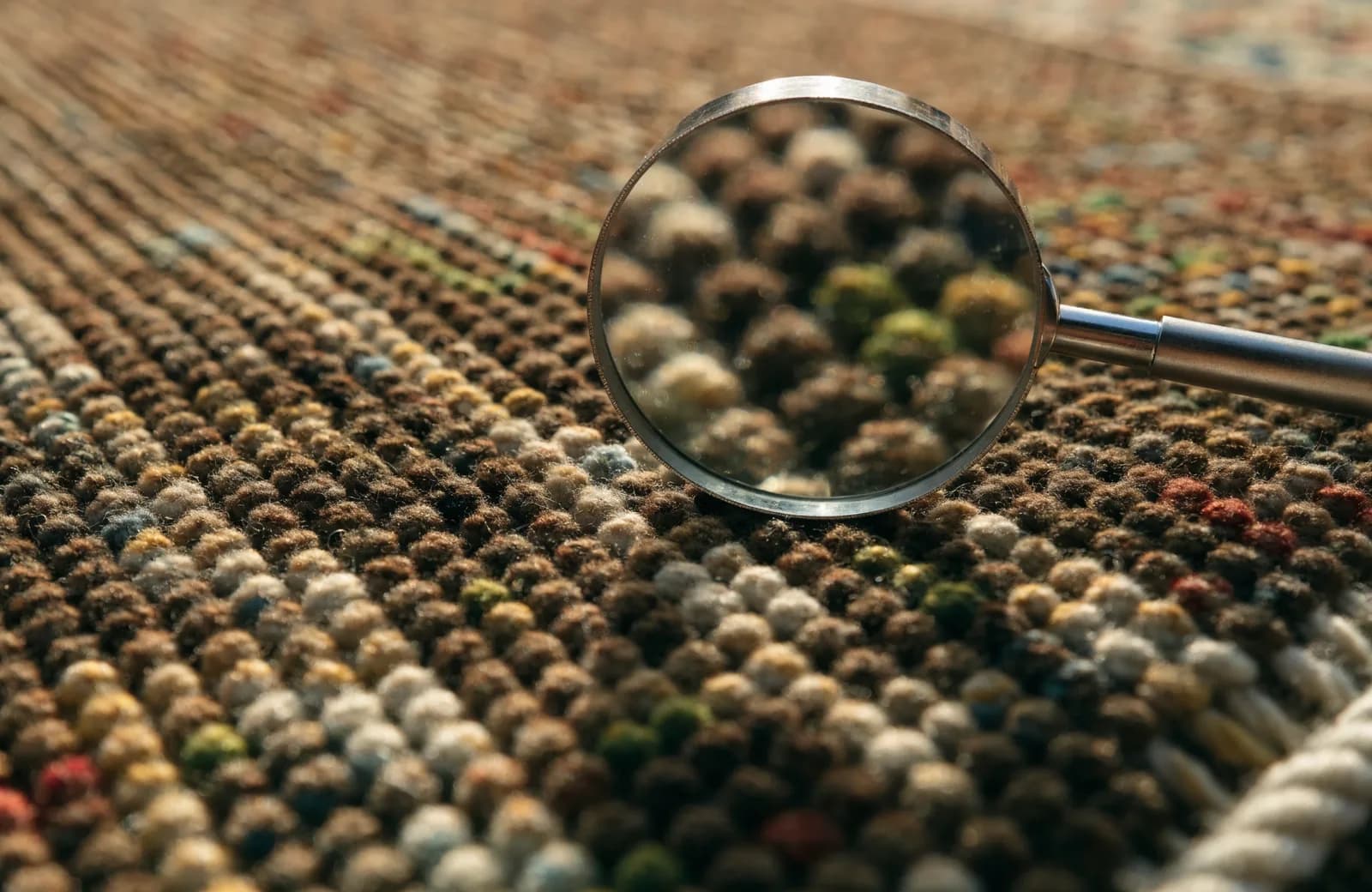
Look closely at the individual knots on the back. Hand-tied knots are slightly irregular — tiny variations in size and tension that prove a human hand made them. Machine knots are mechanically uniform, identical row after row. The density of those knots also tells you about quality, which is measured in knots per square inch. If you want the full explanation, see What Is KPSI (Knots Per Square Inch).
2. Examine the Fringe
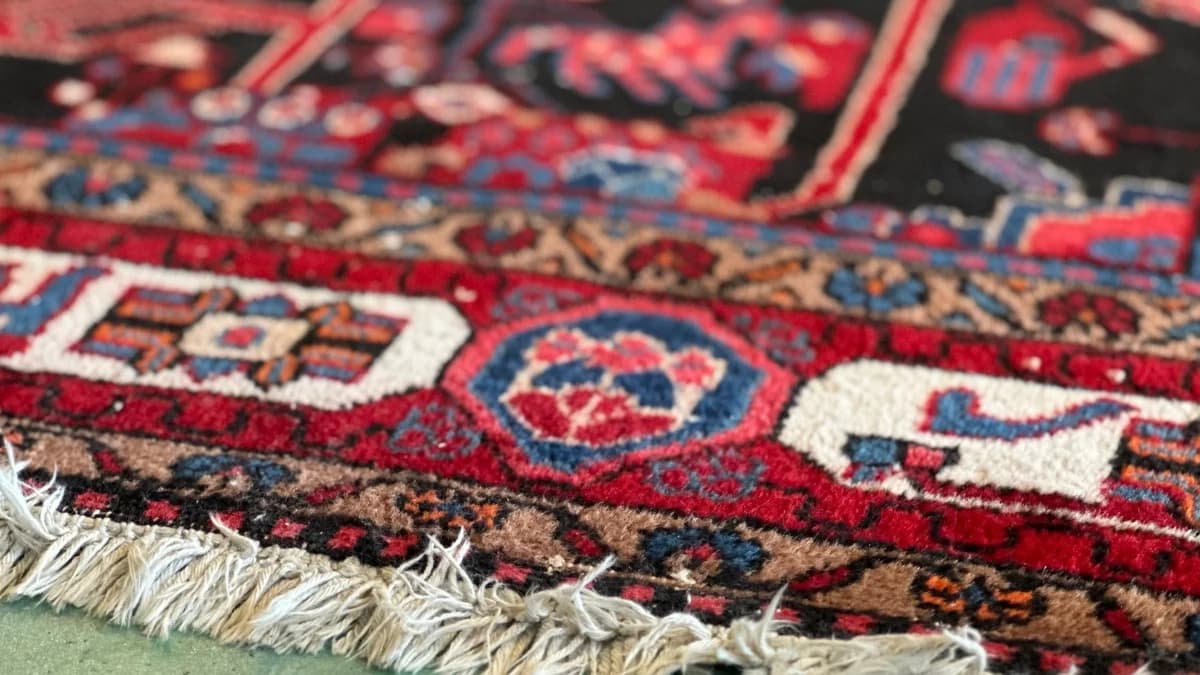
The fringe is one of the most reliable authenticity signals, and one of the easiest to fake badly. On a real hand-knotted carpet, the fringe is not a decorative add-on — it is the warp, the vertical foundation threads that run the entire length of the carpet. The weaver knots the pile around these threads, and at each end the warp simply continues as the fringe.
This means the fringe is structurally part of the carpet and cannot be removed without unravelling it. On many machine-made carpets, by contrast, the fringe is a separate strip sewn or glued onto the ends after the carpet is finished. Gently fold the end back and look at where the fringe meets the body: if it is stitched on as a seam, the carpet is not authentic.
3. Test the Materials
Authentic Persian carpets are made from natural fibres — wool, silk, or cotton — never plastic. Synthetic carpets use polypropylene, nylon or polyester, and these feel and behave completely differently.
- The touch test: Natural wool feels warm, slightly greasy from its natural lanolin, and springs back when you press it. Synthetics feel cool, slick or squeaky.
- The burn test: A reputable seller will let you singe a single fibre from the edge. Wool and silk smell like burnt hair and turn to brittle ash; synthetics smell of burnt plastic and melt into a hard bead. Never do this without permission.
- Silk versus mercerised cotton: True silk is warm to the touch and its colour shifts as you change your viewing angle. "Art silk" (artificial silk, usually mercerised cotton or viscose) looks glossy but stays cool and flat. Genuine fine silk pieces, such as the Qum carpets in our collection, command their price for good reason.
4. Investigate the Dyes
Colour is where a great deal of deception happens. Traditional Persian carpets are coloured with natural dyes — madder root for reds, indigo for blues, walnut husk and pomegranate for browns and yellows. Natural dyes age beautifully and produce a subtle, living variation in tone called abrash, where a single colour shifts gently across the carpet because different batches of hand-spun wool absorbed the dye slightly differently.
Synthetic and chemical dyes, by contrast, are flat and unnaturally uniform. Worse, some imitations are chemically washed to fake the mellow patina of age, which damages the fibres and causes colours to bleed. To test for bleeding, press a damp white cloth firmly onto a coloured area; a tiny amount of transfer can be normal on a new carpet, but heavy colour release is a warning sign. For a deeper look at this subject, read Natural vs Synthetic Dyes in Persian Carpets.
5. Confirm the Origin and Provenance
"Persian" has a specific meaning: woven in Iran. Many carpets sold as Persian are actually made in other countries, or are Persian-style designs woven elsewhere. The great Persian weaving centres each have recognisable characteristics:
| Origin | Typical material | Known for | Knot density |
|---|---|---|---|
| Qum | Silk | Fine detail, jewel colours, very high value | Very high |
| Tabriz | Wool / silk highlights | Crisp medallions, durable structure | High |
| Isfahan | Wool on silk foundation | Elegant curvilinear designs, ivory grounds | Very high |
| Kashan | Wool | Classic medallions, deep reds and blues | Medium–high |
| Nain | Wool with silk | Soft palettes, fine drawing | High |
A trustworthy seller will tell you exactly where a carpet was woven and roughly when, and will not bristle at the question. At Al Malakia we source directly from weavers in Qum, Tabriz, Isfahan, Kashan and Nain, with no intermediaries — which is precisely what allows us to vouch for provenance. If a seller is vague about origin, treat it as a red flag and read How to Spot a Fake Persian Carpet before committing.
It is worth understanding why origin affects both authenticity and price. A genuine Qum silk carpet, with its extremely high knot density and shimmering surface, is a fundamentally different object from a coarse Afghan village rug, even though both can be entirely authentic and hand-knotted. Confusing the two — or selling one as the other — is one of the most common ways buyers in the UAE overpay. When you know that Qum means fine silk, Nain means soft wool-and-silk palettes, and Kashan means robust wool medallions, a seller's claims become much easier to test against the carpet in front of you. Persian-style rugs woven in other countries are not necessarily bad value — many are well made and attractive — but they should never be priced or described as Iranian Persian pieces.
6. Look for the Honest Signs of Handmade Work
Counter-intuitively, small imperfections are proof of authenticity, not flaws. A hand-knotted carpet is the work of one or more weavers over months or years, and that human effort leaves honest traces:
- Slightly uneven edges or a carpet that is not a perfectly geometric rectangle.
- Abrash — the gentle colour banding described above.
- Tiny asymmetries in the pattern, where a motif on the left differs by a stitch or two from its partner on the right.
- A back that is never perfectly flat, with the texture of individual knots.
A carpet that is flawlessly symmetrical, perfectly rectangular and mechanically even is almost certainly machine-made. Perfection, in this craft, is the opposite of authenticity.
7. Consider Age, Condition and Value
Authenticity and value are related but separate questions. A genuine new carpet and a genuine antique are both authentic, but they hold and grow value differently. Antique pieces — generally those over a hundred years old — carry historical and collector value, while a well-chosen new carpet from a top workshop can appreciate as it matures. Understanding this difference protects you from overpaying for false age claims. We explore it fully in Antique vs New Persian Carpets: Which Holds Value?.
In the UAE's climate, condition matters too. Persian carpets are remarkably durable — many are designed to last generations — but check for moth damage, dry rot in the foundation, clumsy repairs, and over-aggressive chemical washing. A small, honest restoration is acceptable; hidden damage disguised as character is not. In Sharjah and Dubai homes, the main practical risks are sun fade near floor-to-ceiling windows and dampness from over-watering near a carpet, so a genuine merchant should also be able to advise you honestly on placement and care, not just close a sale.
8. Buy From a Seller Who Welcomes Scrutiny
Ultimately, the most reliable authenticity check is the seller themselves. A genuine merchant invites every question, lets you turn the carpet over, encourages the burn test, explains the origin and dyes, and gives you a clear written description of material, origin and knot count. A seller who rushes you, blocks inspection, or gives evasive answers is telling you something important.
This is why buying in person still matters. At our Blue Souk showroom in Sharjah you can lay carpets side by side, compare a AED 800 Afghan piece against an AED 8,000 Qum silk, feel the difference in the wool, and ask as many questions as you like. If you are in Dubai, our free door-to-door transfer brings you to the showroom and back, so there is never pressure to decide on the spot. When you are ready, simply contact us to arrange a viewing.
Why Visit Al Malakia Persian Carpets?
- Direct sourcing: Purchased from weavers in Qum, Tabriz, Isfahan, Kashan, and Nain — no intermediaries, transparent provenance.
- Scale of stock: 500+ hand-knotted pieces in the showroom, across sizes from 60×90 cm to 4×6 m.
- Free Dubai transfer: Complimentary door-to-door pick-up from Dubai hotels and homes.
- Family expertise: Founded in 2008 by Eid Al Salam, a second-generation Persian carpet merchant.
- Blue Souk location: Shop 45–48, Central Souq Block 3, King Faisal Road, Sharjah. Open Saturday–Thursday 10:00–22:00, Friday 14:00–22:00.
Contact us or WhatsApp +971 50 537 2997 to arrange your visit or request a consultation.