Quick Facts
Wool is for living: resilient, warm underfoot and forgiving — the right choice for floors that get daily traffic in a UAE home.
Silk is for showing: luminous, ultra-fine and detailed — best as a wall hanging, a feature piece or a low-traffic majlis centrepiece.
Price gap is real: good Afghan and Persian wool pieces start from AED 800 at Al Malakia, while fine Qum silk begins around AED 8,000 and room-sized silk can pass AED 200,000.
Knot density differs: silk Qum carpets routinely reach 600–1,000+ KPSI; most wool village rugs sit between 120 and 400 KPSI.
Both are hand-knotted: every piece in our Sharjah showroom is genuinely hand-tied, sourced directly from weavers in Qum, Tabriz, Isfahan, Kashan and Nain.
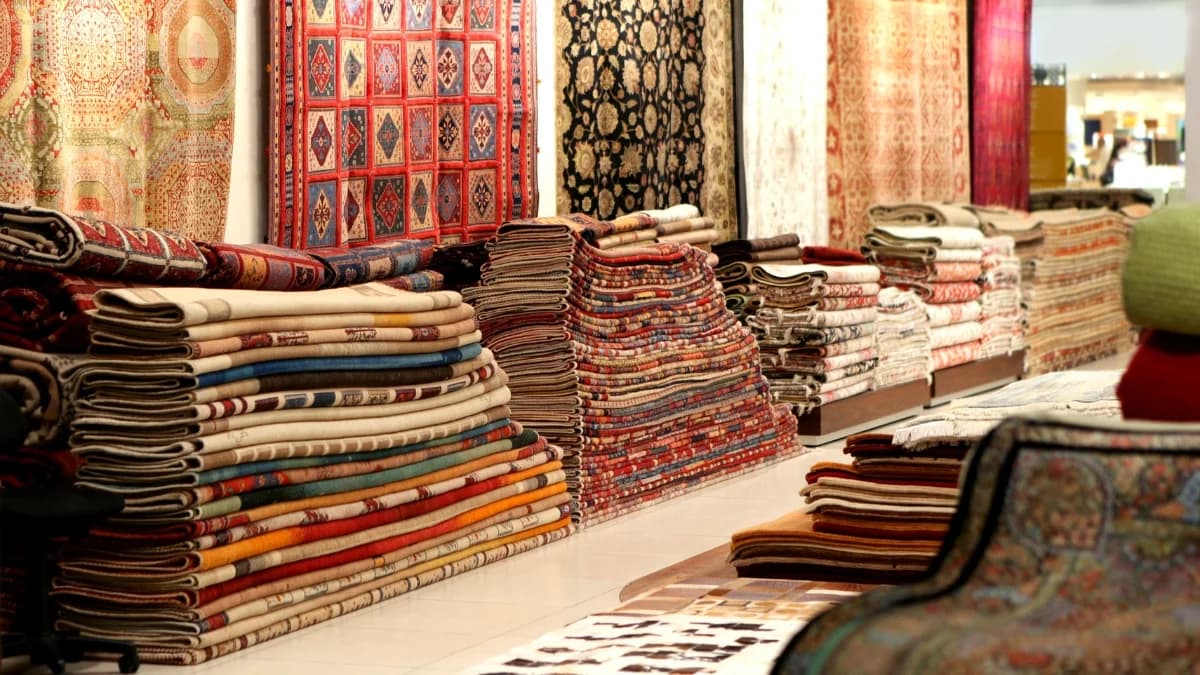
See and feel before deciding: we hold 500+ carpets in stock at Shop 45–48, Blue Souk, Sharjah, and offer free door-to-door transfer from Dubai.
It is the single most common question we hear on the showroom floor: should I buy a silk Persian carpet or a wool one? The honest answer is that neither is "better" in the abstract — they are different materials made for different purposes, and the right choice depends entirely on where the carpet will live, who will walk on it, and what you want it to do for the room. A silk Qum that would be ruined in a busy Dubai entrance hall is breathtaking on a wall above a console table; a robust Tabriz wool that anchors a family majlis would be wasted hung out of reach.
This guide walks through every difference that matters to a buyer in the UAE — durability, sheen, knot density, price, climate behaviour and care — so that by the end you can match material to room with confidence. We will use real price anchors and real regions, and point you to deeper reading where it helps.
The fibres themselves: what silk and wool actually are
Wool used in Persian carpets is sheep's wool, and its quality varies enormously with the breed, the region and even the season of shearing. The most prized is highland wool from sheep grazed at altitude in Iran, which carries a high lanolin content. That natural lanolin is the secret of a good wool carpet: it repels liquid, resists soiling and gives the pile a soft, slightly springy hand. When you press your palm into a fine Tabriz or Kashan and the pile bounces back, you are feeling lanolin-rich highland wool doing its job.
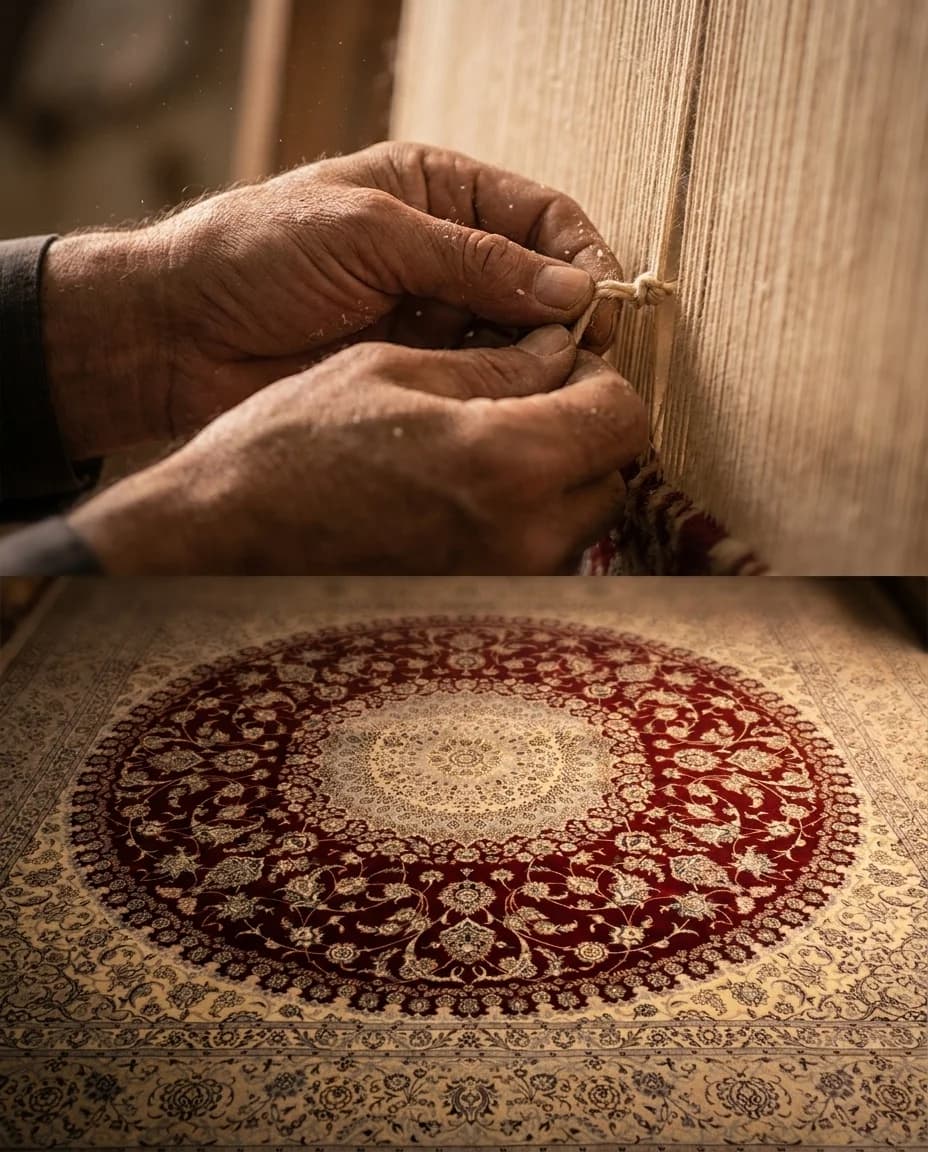
Silk is the filament spun by the silkworm, and it behaves nothing like wool. It is extraordinarily strong for its diameter — pound for pound stronger than steel wire — which is exactly why weavers can tie it into impossibly fine, dense knots. It also reflects light directionally, which produces silk's signature trait: a carpet that appears to change colour as you walk around it or as the light moves through the day. Hold a silk Qum and tilt it, and a field that looked ivory from one angle glows champagne from another. That play of light is impossible to fake in wool.
What "art silk" is — and why we never sell it as silk
Be aware that the market is full of "art silk" or "bamboo silk" — these are mercerised cotton or rayon (viscose) made to mimic the sheen of real silk. They are not silk, they are far weaker, and they degrade quickly under traffic and moisture. A genuine silk carpet passes the burn test (real silk smells of burnt hair and leaves a brittle ash; viscose smells of burning paper) and carries a price that reflects months of hand-knotting. Everything in our Sharjah showroom is labelled honestly; if you would like to understand the wider authenticity question, read about Al Malakia and our direct-sourcing model.
Durability and foot traffic: the decisive factor
For most UAE homes this is the question that settles everything. Wool is dramatically more durable than silk underfoot. A well-made wool Persian carpet can absorb decades of daily walking, furniture, children and the occasional spilled karak and still look magnificent — many of the finest antique rugs in the world are wool, and they are a century or more old. Wool's springy structure means the pile recovers after being compressed; its lanolin sheds spills before they set.
Silk, for all its strength as a fibre, is far less forgiving as a floor surface. The very fineness that makes it beautiful makes it vulnerable: the short, dense pile shows footprints, crushes in high-traffic lanes, and is sensitive to moisture and abrasion. A silk carpet placed in a Dubai hallway or under a dining table will not last — not because the silk is weak, but because that is the wrong job for it. Silk belongs where feet rarely fall: on a wall, in a formal sitting room used for guests, or as a small accent piece.
If you are buying for a busy household, do not let the romance of silk override common sense. Choose wool for the floor and, if you love silk, buy a smaller silk piece to display. You can see both side by side across our collection in the showroom.
Sheen, detail and design
This is where silk earns its reputation. Because silk takes dye deeply and reflects light directionally, silk carpets achieve a depth of colour and a luminous sheen that wool simply cannot reach. Combined with very high knot density, silk allows weavers to render astonishingly fine detail — delicate floral scrolls, calligraphic borders, pictorial scenes and intricate medallions with crisp, photographic precision.
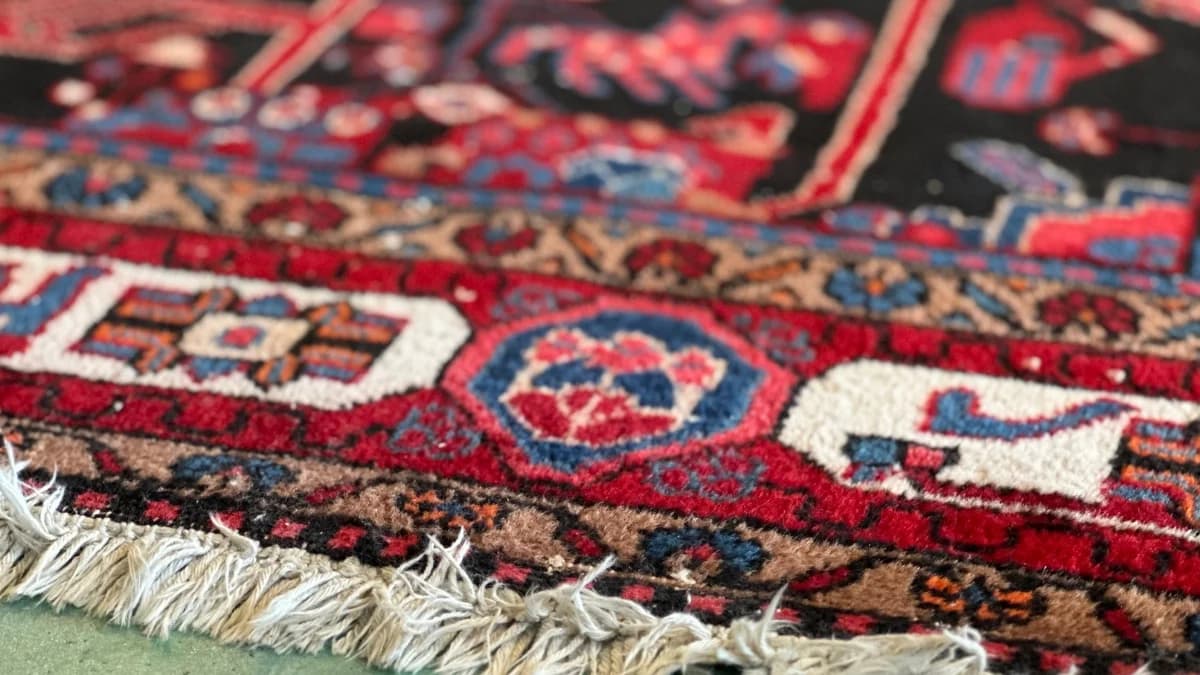
Wool produces a different beauty: warmer, matte, and more relaxed. A wool carpet's colours are softer and its motifs a touch bolder by necessity, because wool cannot be knotted as finely as silk. For many rooms this is exactly right — a wool Heriz or Bakhtiari has a grounded, lived-in warmth that suits a family space far better than the formal brilliance of silk. The two materials are not competing for the same job; they are creating two different moods.
Knot density and why it matters
The fineness of a carpet is measured in knots per square inch (KPSI), and it is directly tied to fibre choice. Silk's thinness allows enormous densities — fine Qum silk routinely reaches 600 to over 1,000 KPSI. Wool village rugs typically sit between 120 and 400 KPSI, with the finest workshop wool pieces from Tabriz or Isfahan climbing higher. Higher KPSI means finer detail and, usually, more hours of labour and a higher price. If you want the full explanation of how this number is counted and what it does and does not tell you, see What Is KPSI (Knots Per Square Inch).
Price: what each material really costs
Material is the single biggest driver of price, far more than size for a given quality. At Al Malakia, good hand-knotted wool pieces — including beautiful Afghan and Persian village rugs — start from AED 800, which makes wool genuinely accessible for a first serious carpet. Fine silk is another world: a small Qum silk begins around AED 8,000, and a large, finely knotted silk room piece can pass AED 200,000. The gap reflects raw material cost, the months of additional labour that fine silk knotting demands, and the rarity of master silk weavers.
The table below summarises how the two materials compare across the criteria that matter most to a UAE buyer.
| Criterion | Wool | Silk |
|---|---|---|
| Durability underfoot | Excellent — handles daily traffic for decades | Low — best off the floor or in low-traffic rooms |
| Sheen | Soft, matte, warm | Luminous, colour shifts with light |
| Typical KPSI | 120–400 (finer in workshop pieces) | 600–1,000+ |
| Detail / fineness | Bold to fine | Extremely fine, photographic |
| Starting price (Al Malakia) | From AED 800 | From AED 8,000 |
| Best use | Living room, majlis, bedroom, dining | Wall hanging, feature piece, formal guest room |
| Care | Forgiving; vacuum and occasional pro clean | Delicate; specialist cleaning only |
Silk and wool in the UAE climate
The Gulf climate has real implications for which material suits a given home. Wool is naturally humidity-tolerant and its lanolin resists the damp that air-conditioned-then-humid cycles can bring; it is the safer everyday choice for villas and apartments alike across Sharjah, Dubai and Abu Dhabi. Silk is more sensitive to moisture and to direct sunlight — strong UAE sun streaming through a window will fade silk faster than wool — so a silk piece should be positioned away from harsh direct light and never in a damp area.
For homes with underfloor patterns of heavy use, or for entrances and majlis that see a constant flow of guests, wool is almost always the right answer. Silk rewards a more protected, considered placement. If you are furnishing across the Emirates, our teams advise buyers in Dubai and Abu Dhabi on exactly this kind of room-by-room matching.
Care and cleaning
Wool is the more forgiving material to live with. Regular gentle vacuuming (no rotating beater bar), rotating the carpet occasionally to even out wear and sun exposure, and a professional hand-clean every few years will keep a wool Persian looking superb for generations. Spills should be blotted, never rubbed, but lanolin buys you time before a liquid sets.
Silk demands more. It should never be machine-washed or steam-cleaned, never scrubbed, and should only ever be cleaned by a specialist who understands hand-knotted silk. Keep silk out of direct sun, away from moisture, and — if displayed on a wall — mounted properly so its own weight does not stress the foundation. The reward for this care is a piece that holds its luminous beauty indefinitely.
So which should you buy?
Strip away the romance and the decision is usually clear:
- Buy wool if the carpet will go on the floor of a room you actually live in — a family majlis, a living room, a bedroom, a dining area. Wool gives you durability, warmth, honest value from AED 800, and a piece that improves with age.
- Buy silk if you want a work of art to display — a wall hanging, a feature piece in a formal guest room, or a small luminous accent in a low-traffic corner. Silk gives you unmatched sheen and detail.
- Buy both, eventually. Many of our long-standing clients begin with a wool carpet for the main room and later add a silk piece to display. They are complementary, not interchangeable.
One more useful comparison before you decide: if you are also weighing different weaving traditions, our guide to Persian vs Turkish Carpets explains how regional style affects both materials. And if you are drawn to the famously fine ivory-ground pieces, Nain Carpets: a Buyer's Guide to Persia's Fine Whites shows what high-end wool-and-silk blends can achieve. To understand the craft behind any of these pieces, How a Hand-Knotted Persian Carpet Is Made, Step by Step is the best place to start.
The surest way to choose, though, is to feel the difference yourself. Wool and silk reveal themselves the moment you touch them and tilt them under the light — and nothing online captures that. Come in, or contact us and we will walk you through both.
Why Visit Al Malakia Persian Carpets?
- Direct sourcing: Purchased from weavers in Qum, Tabriz, Isfahan, Kashan, and Nain — no intermediaries, transparent provenance.
- Scale of stock: 500+ hand-knotted pieces in the showroom, across sizes from 60×90 cm to 4×6 m.
- Free Dubai transfer: Complimentary door-to-door pick-up from Dubai hotels and homes.
- Family expertise: Founded in 2008 by Eid Al Salam, a second-generation Persian carpet merchant.
- Blue Souk location: Shop 45–48, Central Souq Block 3, King Faisal Road, Sharjah. Open Saturday–Thursday 10:00–22:00, Friday 14:00–22:00.
Contact us or WhatsApp +971 50 537 2997 to arrange your visit or request a consultation.