Quick Facts
What it is: A true Persian carpet is woven knot by knot by hand on a vertical loom — never made by machine.
Time to make: A fine room-sized carpet can take a single weaver 12 to 18 months, and the finest Qum silk pieces far longer.
Core materials: Hand-spun wool, mulberry silk, and cotton foundation threads, coloured with natural and high-grade dyes.
Key quality measure: Knots per square inch (KPSI) — fine pieces carry 400 to 800+ knots in every square inch.
Where ours come from: Al Malakia sources directly from weavers in Qum, Tabriz, Isfahan, Kashan, and Nain — no intermediaries.
Price range: From AED 800 for entry-level Afghan pieces to AED 8,000+ for fine Qum silk, and AED 200,000+ for the largest masterpieces.
When you stand on a hand-knotted Persian carpet, you are standing on thousands of hours of human work. But what actually happens between a flock of sheep and the rug under your majlis? How is a Persian carpet made, and why does one piece cost AED 800 while another costs AED 200,000? This guide walks through every stage of production, from raw fibre to the final wash, so you understand exactly what you are buying — and why no machine-made rug can replicate it.
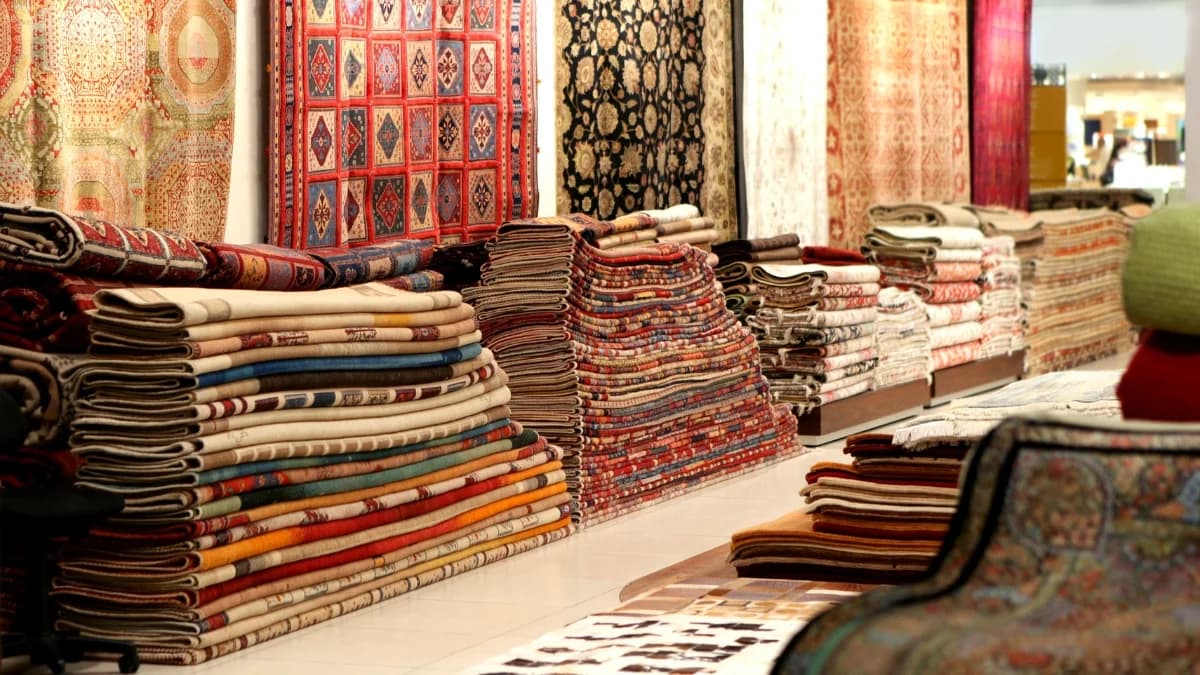
At Al Malakia Persian Carpets in Sharjah, we buy directly from the weaving families behind these pieces, so we see the whole process first-hand. Below we explain it step by step, the same way we explain it to customers who visit our showroom in the Blue Souk.
Step 1: Sourcing and Spinning the Fibre
Every carpet begins as raw fibre. The three materials at the heart of Persian weaving are wool, silk, and cotton, and each has a distinct job.
Wool comes from the fleece of highland sheep, prized for its lanolin content, which gives the finished pile a natural sheen and resistance to dirt. The best wool is hand-sheared, washed, combed, and then hand-spun on a spindle or simple wheel. Hand-spun wool is slightly irregular in thickness, and that irregularity is a feature, not a flaw — it makes the pile catch light unevenly and gives antique carpets their living, shimmering surface.
Silk is reserved for the finest pieces. Reeled from the cocoons of mulberry silkworms, it is far thinner and stronger than wool, which allows weavers to tie an astonishing number of tiny knots. This is why the most detailed designs — and the highest prices — almost always involve silk. If you are weighing the two fibres for a purchase, our guide to Silk vs Wool Persian Carpets: Which Should You Buy? breaks down the trade-offs in plain terms.
Cotton usually forms the carpet's hidden skeleton — the warp and weft foundation threads. It is strong, stable, and lies flat, which keeps a large carpet from buckling over decades of use. In some tribal and Afghan weaving, wool is used for the foundation too, which gives those rugs their characteristic soft, slightly uneven handle. The quality of these unseen threads matters enormously: a weak or loosely spun foundation will let a carpet stretch and distort over time, no matter how fine the pile above it.
Step 2: Dyeing the Yarn
Once spun, the yarn must be coloured. Traditionally, Persian dyers used entirely natural dyes: madder root for reds, indigo for blues, weld and pomegranate skin for yellows, walnut husk for browns. These plant and insect dyes age beautifully, softening over generations into the mellow palette collectors love.
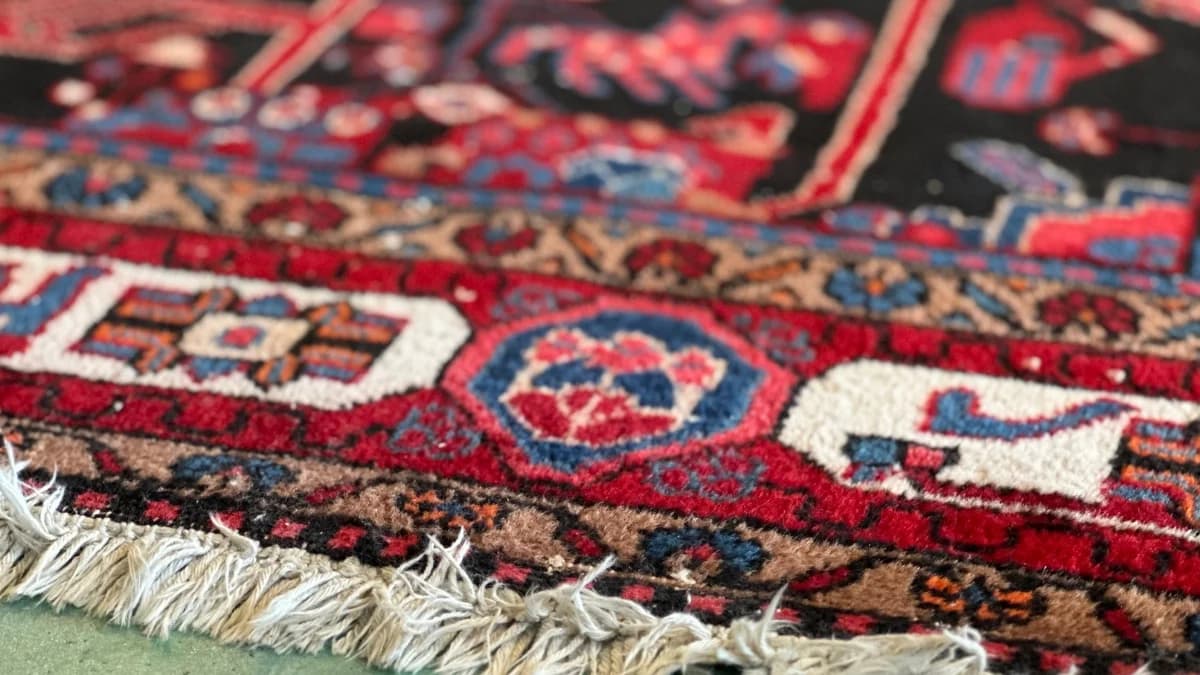
The dyeing process is slow and skilled. Skeins of yarn are simmered in dye baths, sometimes repeatedly, then dried in the sun. Because each batch is mixed by hand, slight variations occur between batches of the same colour. Weavers deliberately blend these batches as they work, producing a subtle, gentle striping called abrash. Far from a defect, abrash is one of the clearest fingerprints of a genuine hand-made carpet.
Natural vs synthetic dyes
Many modern workshops also use high-quality synthetic dyes, which offer consistency and a broader colour range. Good synthetic dyes are perfectly acceptable and very durable; the warning sign is cheap, fugitive dye that bleeds when wet or fades unevenly in sunlight. When we select pieces for our showroom, colour-fastness is one of the first things we test.
Step 3: Building the Loom and Stringing the Warp
The loom is the carpet's birthplace. For fine Persian work it is a vertical loom, a sturdy upright frame on which the weaver sits or stands at a fixed bench. Strong cotton (or sometimes silk) threads are strung tightly top to bottom — these are the warps. The density and evenness of the warp directly determine how fine the finished carpet can be: closely spaced warps allow more knots per square inch.
Before a single knot is tied, the weaver works from a cartoon — a gridded, hand-painted design map where every square represents one knot and its colour. In the great workshops of Tabriz and Isfahan, master designers spend weeks producing these cartoons, and the design itself is a prized asset. The motifs are never random; each carries meaning, as we explore in Persian Carpet Motifs and Their Hidden Meanings.
Step 4: Tying the Knots — the Heart of the Craft
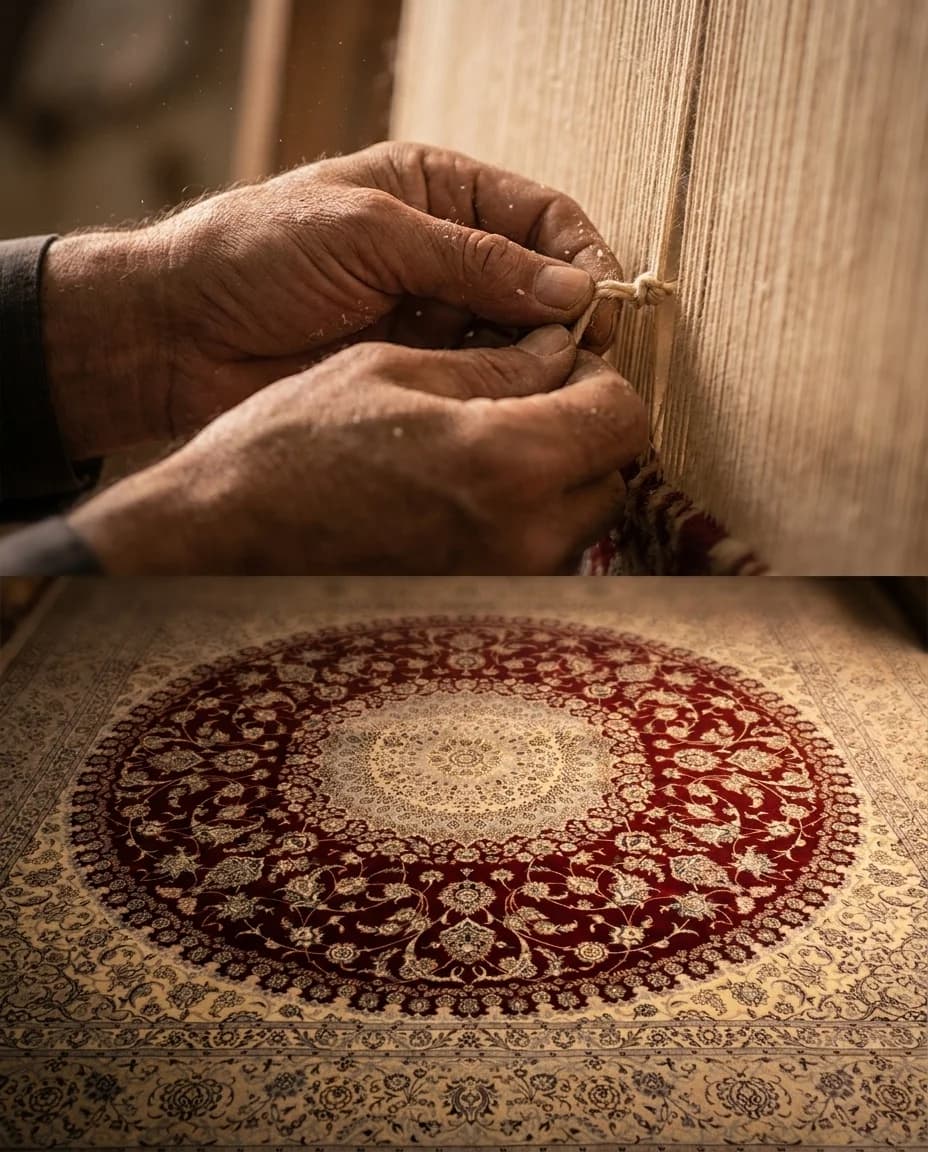
This is the stage that defines a Persian carpet. The weaver ties individual knots of coloured wool or silk around pairs of warp threads, row by row, building the design and the pile simultaneously. There are two principal knot types:
- The Persian (Senneh) asymmetric knot: wrapped around one warp and looped under the next, it allows extremely fine, curved, detailed designs. This is the knot behind the flowing florals of Qum, Isfahan, and Kashan.
- The Turkish (Ghiordes) symmetric knot: wrapped around two warps, it is robust and hard-wearing, common in tribal and village weaving and in many Afghan pieces.
After each row of knots, the weaver passes one or more weft threads horizontally through the warps and beats them down hard with a heavy metal comb. This locks the knots in place and gives the carpet its density. The whole rhythm — knot, knot, knot, then beat down the weft — repeats hundreds of thousands of times.
How many knots? Understanding KPSI
The single most useful quality measure is knots per square inch (KPSI). A coarse village rug might carry 50 to 120 KPSI; a good city carpet 200 to 400; and a fine Qum silk piece 600, 800, or even well over 1,000. More knots mean finer detail, sharper curves, and a thinner, more precious pile — and far more labour. To understand exactly why this number matters so much to price and detail, read our explainer on What Is KPSI (Knots Per Square Inch).
To put the labour in perspective: a skilled weaver might tie 8,000 to 12,000 knots in a full day. A 3×2 metre carpet at 500 KPSI contains well over four million knots. That single statistic explains, more than anything else, why a genuine hand-knotted carpet is a serious investment rather than a disposable furnishing — and why Hand-Knotted vs Machine-Made Rugs are simply not the same product.
Step 5: Shearing the Pile
As the carpet grows on the loom, the pile naturally varies a little in height. Periodically the weaver shears the surface with special scissors to level it. The final pile height is a deliberate choice: a low, tight clip shows fine detail and suits a formal city design, while a longer pile gives warmth and softness, common in tribal and Afghan rugs. This trimming is precise handwork — uneven shearing would blur the pattern that took months to build.
Step 6: Cutting the Carpet Off the Loom
When the last row is woven, the carpet is finally cut free from the loom — an emotional moment after months or years of work. The warp ends at top and bottom are knotted and finished into the fringe, which is therefore an integral structural part of a real hand-knotted carpet, not a decorative trim sewn on afterwards (a quick way to spot a machine-made imitation). The side edges are bound with selvedge overcasting to protect them from wear.
Step 7: Washing, Finishing, and Stretching
A freshly cut carpet is stiff and a little dull. It now goes through a thorough wash, which removes loose fibres and excess dye, settles the colours, and brings out the natural lustre of the wool or silk. Some workshops use a light chemical wash or sun treatment to gently mellow new colours toward an antique tone.
After washing, the carpet is laid flat and stretched and blocked to correct any distortion and ensure it lies perfectly square. Finally it is inspected, any stray knots are trimmed, and the piece is ready for sale. Only at this point does the carpet you would recognise in our showroom actually exist.
Why the Process Drives the Price
Every stage above adds cost: hand-spun wool, natural dye, weeks of design work, and above all the months of knotting. The table below summarises how the choices made during production translate into the price bands you will see in our collection.
| Type | Typical KPSI | Materials | Indicative price (AED) |
|---|---|---|---|
| Afghan / tribal | 50–150 | Wool on wool/cotton | From 800 |
| City wool (Tabriz, Kashan) | 200–400 | Wool, some silk highlights | 5,000–40,000 |
| Fine silk (Qum, Nain) | 500–1,000+ | Pure or part silk | 8,000–200,000+ |
What This Means When You Buy
Understanding how a carpet is made changes how you shop. You learn to turn a rug over and read the back: tight, even, slightly irregular knots and an integral fringe signal genuine hand work. You appreciate why abrash and minor asymmetry are signs of authenticity, not faults. And you grasp why a fine piece is priced the way it is — you are paying for a year of a skilled person's life, not a label.
In our Sharjah climate, a well-made wool or silk carpet is also genuinely practical: it insulates cool floors, tolerates dry air, and, properly cared for, lasts for generations and often appreciates in value. Whether you live in a Dubai apartment or a Sharjah villa, the right hand-knotted piece is furniture you will never need to replace. To learn more about our family and sourcing, read about Al Malakia, and feel free to contact us with any question before you visit.
Why Visit Al Malakia Persian Carpets?
- Direct sourcing: Purchased from weavers in Qum, Tabriz, Isfahan, Kashan, and Nain — no intermediaries, transparent provenance.
- Scale of stock: 500+ hand-knotted pieces in the showroom, across sizes from 60×90 cm to 4×6 m.
- Free Dubai transfer: Complimentary door-to-door pick-up from Dubai hotels and homes.
- Family expertise: Founded in 2008 by Eid Al Salam, a second-generation Persian carpet merchant.
- Blue Souk location: Shop 45–48, Central Souq Block 3, King Faisal Road, Sharjah. Open Saturday–Thursday 10:00–22:00, Friday 14:00–22:00.
Contact us or WhatsApp +971 50 537 2997 to arrange your visit or request a consultation.