Quick Facts
Living room rule: aim for a rug that sits under the front legs of all sofas — usually 2×3 m or 2.5×3.5 m in a UAE villa.
Majlis: floor-seating layouts often need 3×4 m or larger so cushions and guests stay on the carpet.
Bedroom: a 2×3 m under a king bed, or a pair of runners flanking the bed, both work beautifully.
Dining: add roughly 60–75 cm beyond the table edge on every side so chairs stay on the rug when pulled out.
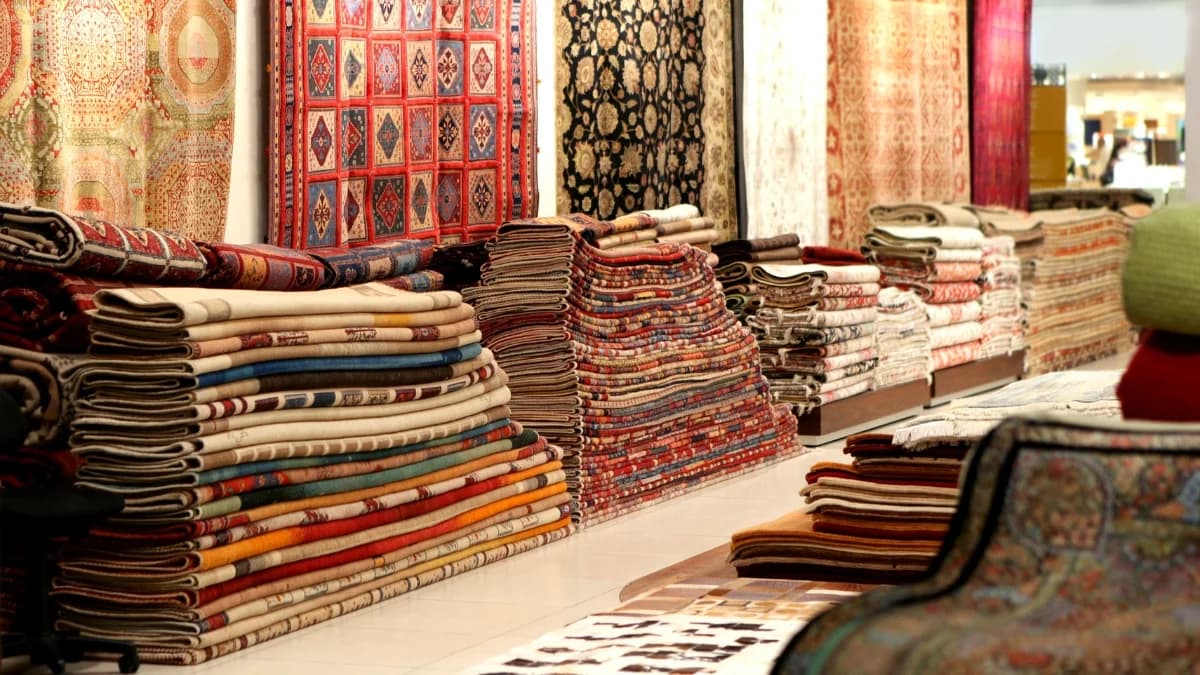
Our stock: 500+ hand-knotted pieces from 60×90 cm to 4×6 m, with Afghan rugs from AED 800 and fine Qum silk from AED 8,000+.
Visit: Shop 45–48, Blue Souk, King Faisal Road, Sharjah — free door-to-door transfer from Dubai.
The single most common mistake we see at Al Malakia is not the colour, the origin, or even the budget — it is the size. A magnificent Tabriz that is two sizes too small will float awkwardly in the middle of a Dubai villa lounge, while an oversized piece can swallow a compact apartment. Getting the proportions right is what makes a hand-knotted carpet look intentional, grounded and expensive — exactly as it should.
This guide answers a question we hear every week in the showroom: what size Persian rug do I actually need for this room? We will walk through every space in a typical UAE home — living room, majlis, bedroom, dining room, hallway, entrance and outdoor terrace — with real measurements, the reasoning behind each rule, and AED price guidance so you can plan before you ever measure your floor.
How to Measure Your Room Before You Shop
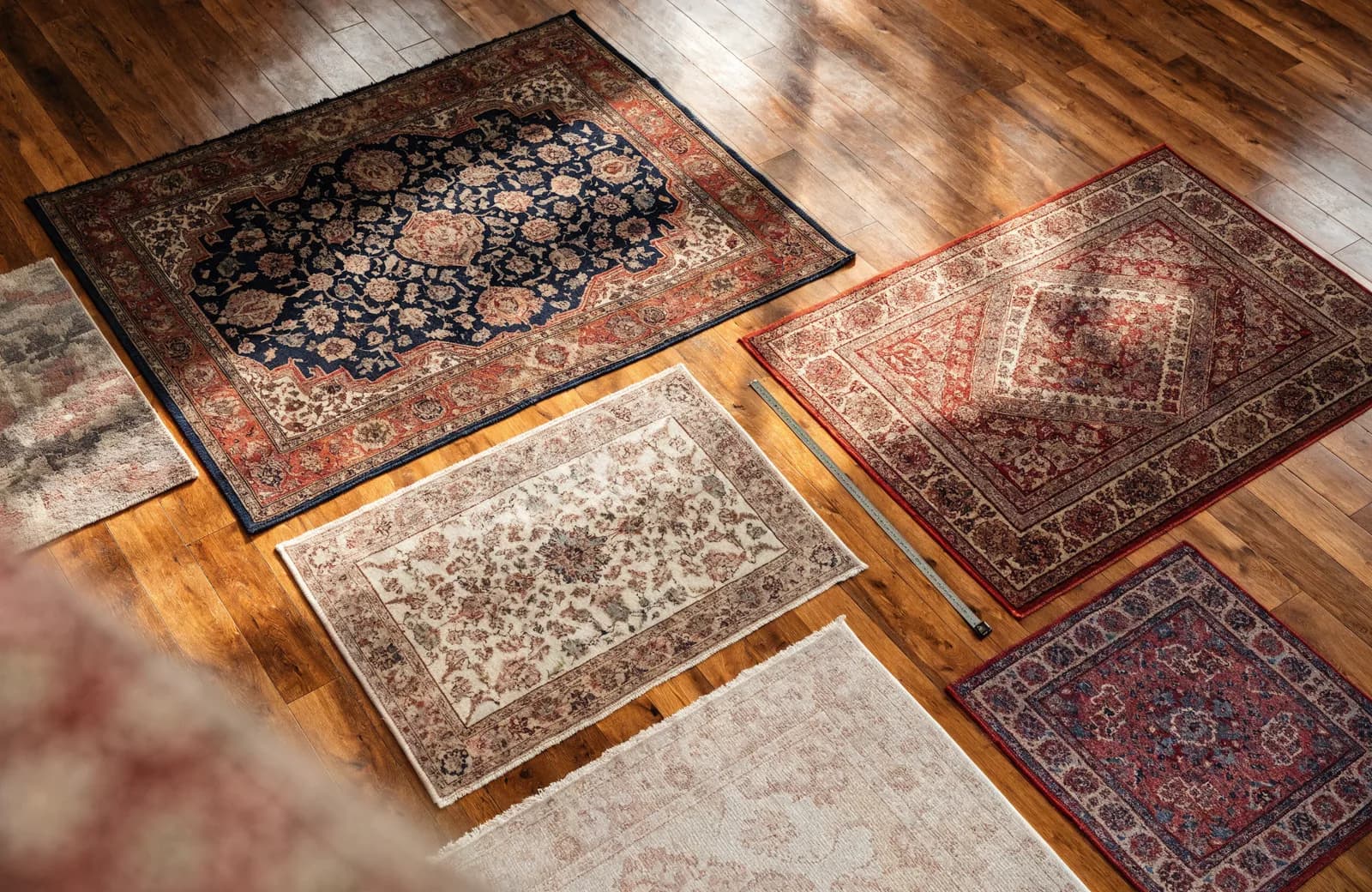
Before any size rule applies, you need two numbers: the length and width of the floor area you want the carpet to define. Use a tape measure (not your eye — UAE rooms are often larger than they feel) and write the figures down in centimetres. Then mark out the rug footprint with painter's tape or a bedsheet on the floor. Living with that outline for a day tells you more than any chart.
A few principles hold true in almost every room:
- Leave a border of bare floor. A margin of roughly 20–40 cm of visible flooring around the rug frames it and makes the room feel finished. Wall-to-wall is for carpeting, not for art.
- Anchor the furniture, don't isolate it. The rug should connect the seating, not sit marooned between the legs like a stamp.
- Bigger usually reads better. When you are between two sizes, the larger one almost always looks more deliberate and more luxurious.
If you are unsure, our team can advise from a quick photo and your measurements — feel free to contact us on WhatsApp before you visit.
Living Room: the Anchor of the Home
The living room is where most Persian carpets in the UAE end up, and where size matters most. There are three accepted layouts, and your room dimensions decide which one you use.
The three living-room layouts
- All legs on (most luxurious): every piece of furniture sits entirely on the rug. This needs a generous carpet — typically 3×4 m or larger — and suits spacious Dubai and Sharjah villas.
- Front legs on (most common): the front legs of each sofa rest on the rug while the back legs sit on the floor. A 2.5×3.5 m or 2×3 m piece usually achieves this in a mid-sized lounge.
- Floating coffee-table island (smallest): the rug holds only the coffee table and front of the seating. Use this only in compact apartments; a 1.7×2.4 m can work, but go larger if you can.
For most villa living rooms across the Emirates, a 2.5×3.5 m or 3×4 m carpet hits the sweet spot. If you are furnishing a larger space such as a double-height majlis-cum-living room, the room-sized 4×6 m pieces in our collection are built for exactly this scale. Apartment dwellers will find more tailored advice in our guide to the Best Persian Carpets for Dubai Apartments.
The Majlis: Floor Seating Needs Floor Space
The majlis is a uniquely Gulf consideration, and standard Western rug charts simply do not account for it. Because guests sit on cushions arranged around the perimeter, the carpet has to be large enough that everyone — and every cushion — stays on the rug, with the central space left open for serving coffee and dates.
For a traditional floor-seating majlis, we almost always recommend 3×4 m as a minimum, and frequently larger. Big formal majlis rooms in UAE villas often take a single 4×6 m piece, or two matched carpets laid side by side to cover an L-shaped or extended seating area. The durability of a tightly hand-knotted wool pile matters here too: a majlis sees heavy foot traffic and frequent gatherings, so a robust Tabriz or Heriz construction will outlast a fragile one by decades. A practical tip we share with every majlis client: lay the carpet so its border pattern runs parallel to the seating, not at an angle, and centre the medallion in the open space where guests will actually look. A well-centred medallion turns an ordinary gathering room into a focal point, and it is one of the small details that separates a considered majlis from a merely furnished one.
Because UAE villas and homes vary so much in scale, sizing a majlis is one of the things we are most often asked to advise on in person. Our detailed Persian Carpets for Dubai Villas: Sizing Guide goes deeper into large-format rooms.
Bedroom: Warmth Under and Around the Bed
Bedrooms reward soft, warm-toned Persian rugs, and there are three placements that consistently work:
- Large rug under the bed: a 2.5×3.5 m or 3×4 m placed so the rug extends well past the sides and foot of the bed, leaving a soft border to step onto. This is the most luxurious option for a master bedroom.
- Rug across the lower two-thirds: a 2×3 m positioned under the bottom two-thirds of the bed, leaving the bedside tables on bare floor. Economical and elegant.
- Pair of runners: two matching runners (around 80×300 cm each) flanking the bed — ideal when wall-to-wall carpet or a built-in platform makes a large rug impractical.
For a full treatment of placement, pile height and colour for sleep spaces, see our dedicated article on Persian Carpets in the Bedroom: Placement & Size Tips.
Dining Room: the Pulled-Out-Chair Rule
The dining room has the clearest rule of all, and it is non-negotiable: the rug must be large enough that the back legs of every chair stay on the carpet even when the chair is pulled out for someone to sit down. A chair that catches on the rug edge is both a trip hazard and a daily irritation.
The formula is simple: take your dining table's length and width, then add 60–75 cm on every side. A 160×90 cm table for six therefore needs a rug of roughly 280×210 cm — call it 3×2 m. A large 10-seat table for entertaining will often need a 3.5×2.5 m or larger. Because dining areas catch crumbs and spills, a flat-weave or low, tight wool pile is the practical choice, and a busy traditional pattern hides the occasional mark far better than a plain field.
Hallways, Stairs and Entrances: the World of Runners
Long, narrow spaces call for runners — typically 80–100 cm wide and anywhere from 2 m to 4 m or more in length. The aim is to leave a few centimetres of floor visible on each side and roughly 15–25 cm at each end of the corridor, so the runner reads as a deliberate strip rather than fitted carpet.
Entrances and foyers in UAE villas can take a small 1.5×1 m piece or a square format to anchor the threshold; high-traffic entrances benefit from a durable, darker, patterned wool that disguises dust carried in from outside. For the full breakdown of widths, lengths and how to handle turns and landings, read our guide to Persian Runners for Hallways, Stairs & Entrances.
A Quick Size Reference Table
The table below summarises the sizes we recommend most often, along with the rooms they suit and indicative AED starting prices. Prices vary enormously with origin, material and knot density — fine Qum silk sits at the very top — so treat these as starting points, not ceilings.
| Size (approx.) | Best for | Layout note | From (AED) |
|---|---|---|---|
| 60×90 cm | Bedside, entrance, accent | Single small space | 800 |
| 80×300 cm (runner) | Hallways, stairs, beside beds | Leave ends and sides clear | 1,200 |
| 2×3 m | Apartment living, small bedroom | Front legs on | 2,500 |
| 2.5×3.5 m | Villa living room, master bedroom | Front or all legs on | 4,500 |
| 3×4 m | Large living room, majlis | All legs on | 8,000 |
| 4×6 m | Formal majlis, double-height lounge | Room-defining centrepiece | 20,000+ |
Material, Climate and the UAE Home
Size is the first decision, but the UAE climate shapes the next one. Hand-knotted wool is the workhorse: it is resilient, forgiving of foot traffic and air-conditioned interiors, and ideal for living rooms, majlis and dining areas. Silk and silk-blend pieces — above all the famously fine carpets of Qum — are luminous and detailed, but they are best reserved for low-traffic showpiece spots: a formal sitting room, a bedroom feature, or a wall hanging. In a dry, air-conditioned Emirati home, a hand-knotted carpet that is properly sized and well looked after will comfortably outlive its first owners.
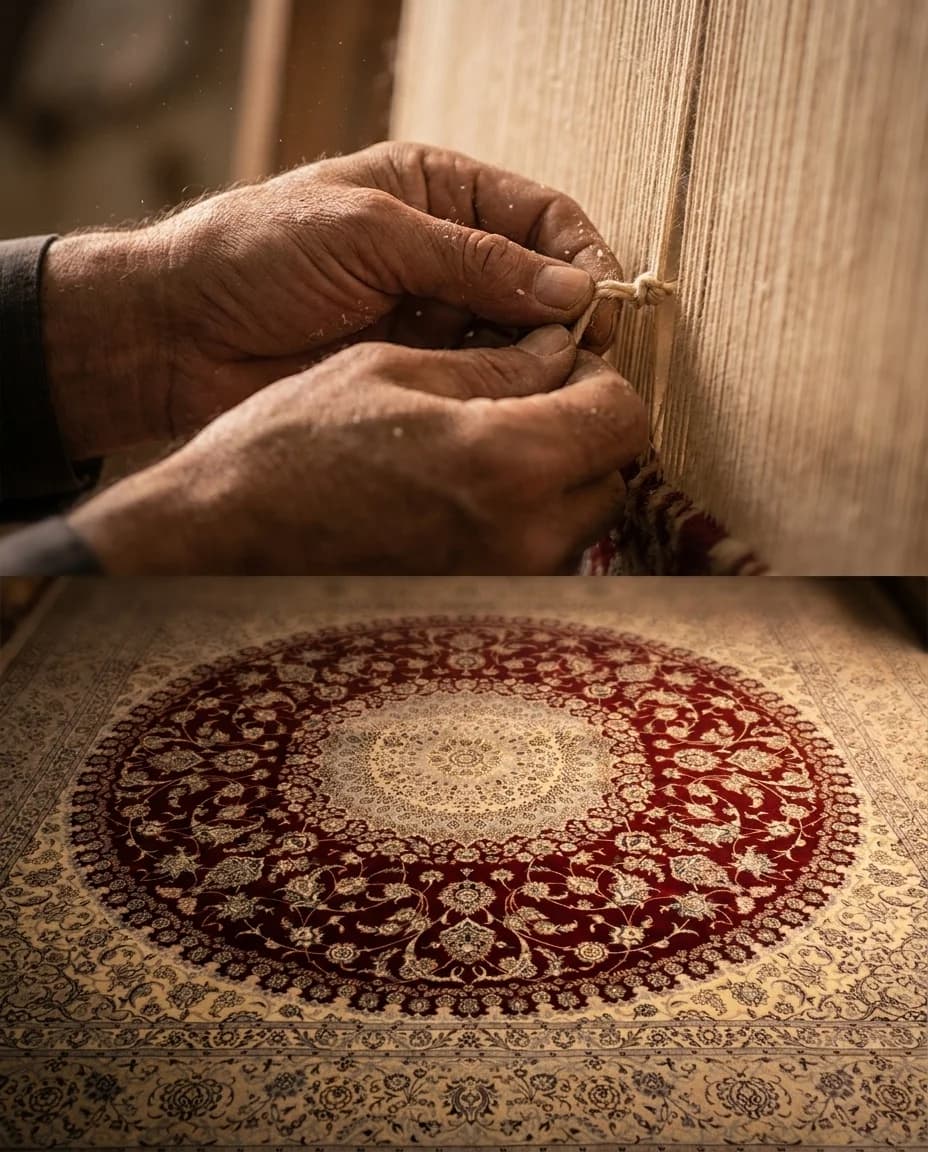
Because we source directly from weavers in Qum, Tabriz, Isfahan, Kashan and Nain with no intermediaries, we can match a piece not just to your room's measurements but to the way that room is used and the light it receives. You can learn more about Al Malakia and our second-generation family background, or browse our collection by size and origin online before you visit.
Bring Your Measurements to the Showroom
Charts and rules will get you most of the way, but a carpet is a physical, tactile object — colour shifts under villa downlights, pile feels different underfoot, and a pattern reads differently at scale. The surest way to size correctly is to bring your room measurements (and a photo) to the showroom and see candidate pieces in person. We will lay them out, talk through the layout options above, and arrange free door-to-door delivery anywhere in Dubai, Sharjah and Abu Dhabi once you have chosen.
Many of our clients arrive certain they need one size and leave with another, simply because seeing a 3×4 m piece unrolled in front of them reframes what "big" actually means in their space. There is no obligation and no pressure: most visits start with a cup of tea, your floor plan on the table, and an honest conversation about how the room is lived in — who sits where, where the sunlight falls, and whether the piece will be walked on daily or admired from the sofa. Sizing, in the end, is less about a number on a tape measure and more about how the carpet will be used for the next thirty years.
Why Visit Al Malakia Persian Carpets?
- Direct sourcing: Purchased from weavers in Qum, Tabriz, Isfahan, Kashan, and Nain — no intermediaries, transparent provenance.
- Scale of stock: 500+ hand-knotted pieces in the showroom, across sizes from 60×90 cm to 4×6 m.
- Free Dubai transfer: Complimentary door-to-door pick-up from Dubai hotels and homes.
- Family expertise: Founded in 2008 by Eid Al Salam, a second-generation Persian carpet merchant.
- Blue Souk location: Shop 45–48, Central Souq Block 3, King Faisal Road, Sharjah. Open Saturday–Thursday 10:00–22:00, Friday 14:00–22:00.
Contact us or WhatsApp +971 50 537 2997 to arrange your visit or request a consultation.