Quick Facts: Persian Carpet Prices in the UAE 2026
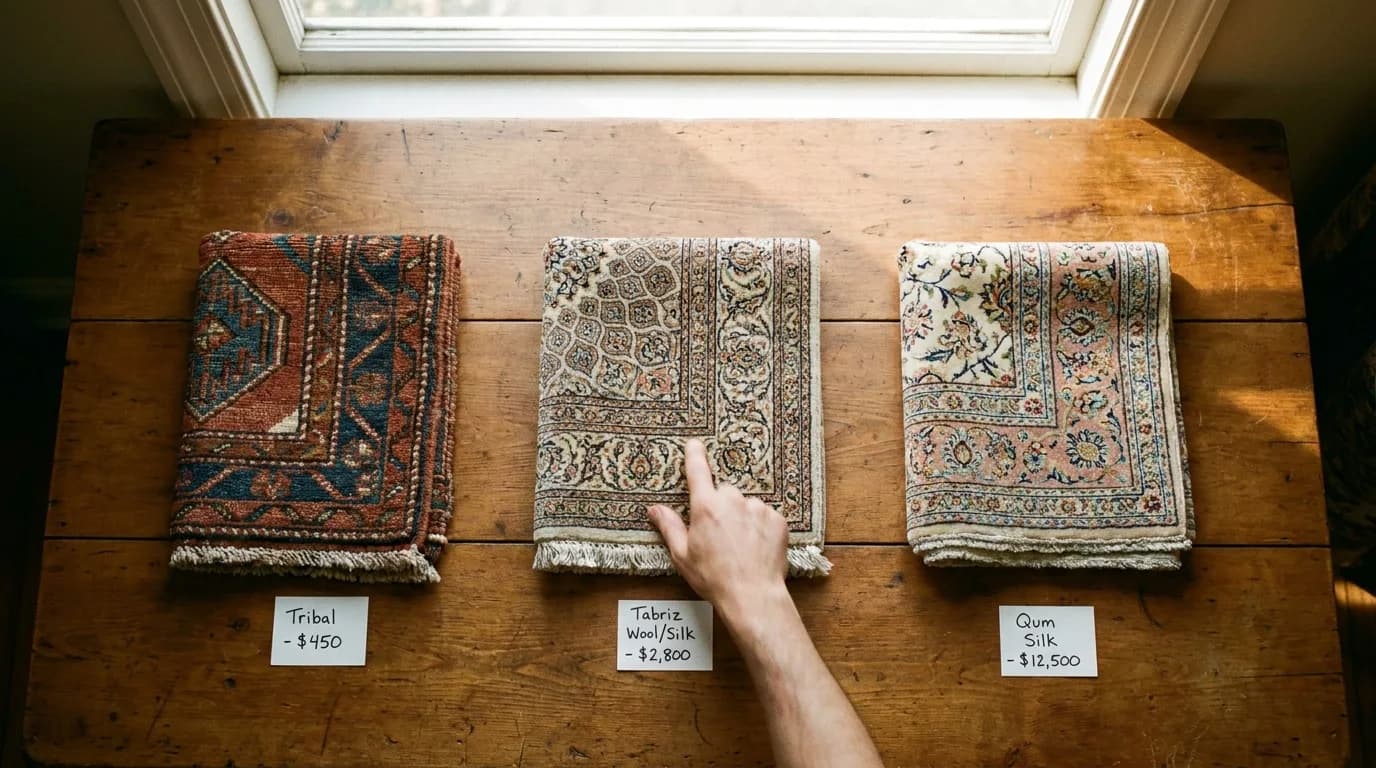
Entry-level hand-knotted carpets: From AED 1,500 for small wool pieces (approx. 1 m²)
Mid-range Tabriz or Kashan (2–4 m²): AED 8,000–AED 40,000 depending on knot density and age
Fine Qum silk carpets: AED 30,000–AED 200,000+ for room-sized pieces with 300–600 KPSI
Knot density range in stock: 40 KPSI (tribal) to 600 KPSI (Qum silk) at Al Malakia Persian Carpets
Showroom location: Shop 45–48, Central Souq Block 3 (Blue Souk), King Faisal Road, Sharjah, UAE
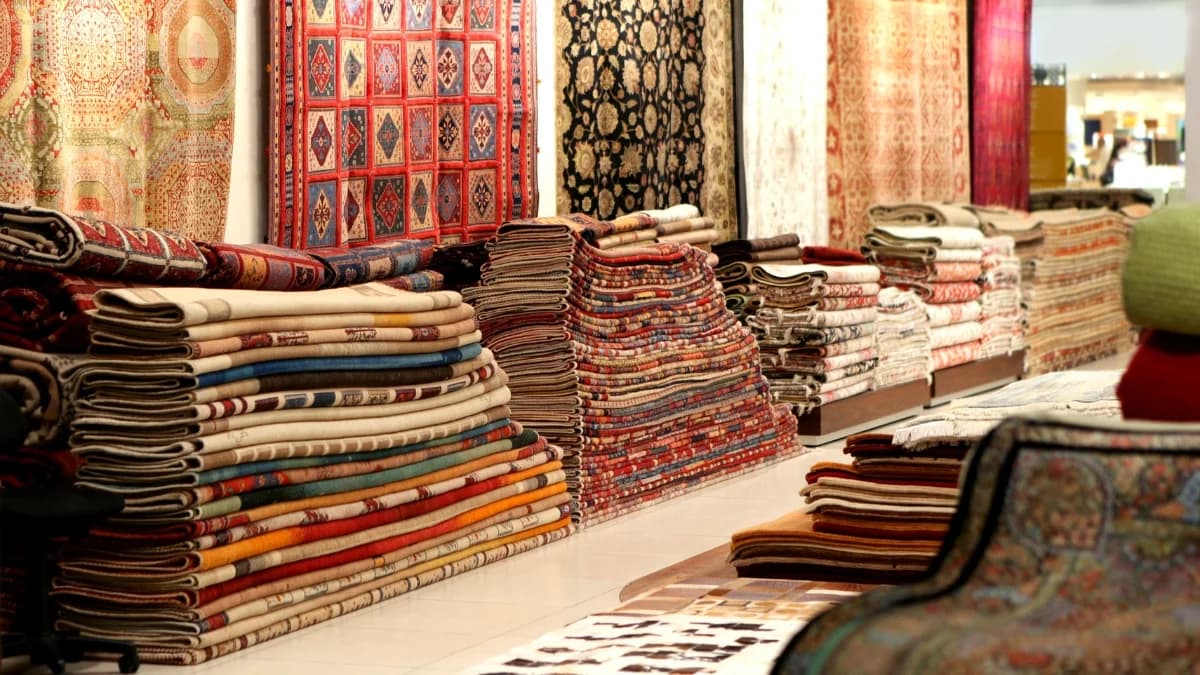
Stock on display: 500+ hand-knotted Persian and Afghan carpets sourced directly from weavers in Iran
A hand-knotted Persian carpet sold in the UAE in 2026 can carry a price tag of AED 1,500 or AED 500,000 — and both figures can be entirely legitimate. The difference lies in a set of measurable, learnable factors: knot density, material, weaving city, age, and condition. Since founding Al Malakia Persian Carpets in Sharjah in 2008, I have sourced directly from weaving families across Qum, Tabriz, Isfahan, Kashan, and Nain. In that time, the single most common mistake buyers make is comparing prices without first comparing specifications. This guide walks you through every variable that determines Persian carpet price in the UAE so you can make a confident, informed purchase.
1. Why Hand-Knotted Carpets Are Priced Differently From Machine-Made Rugs
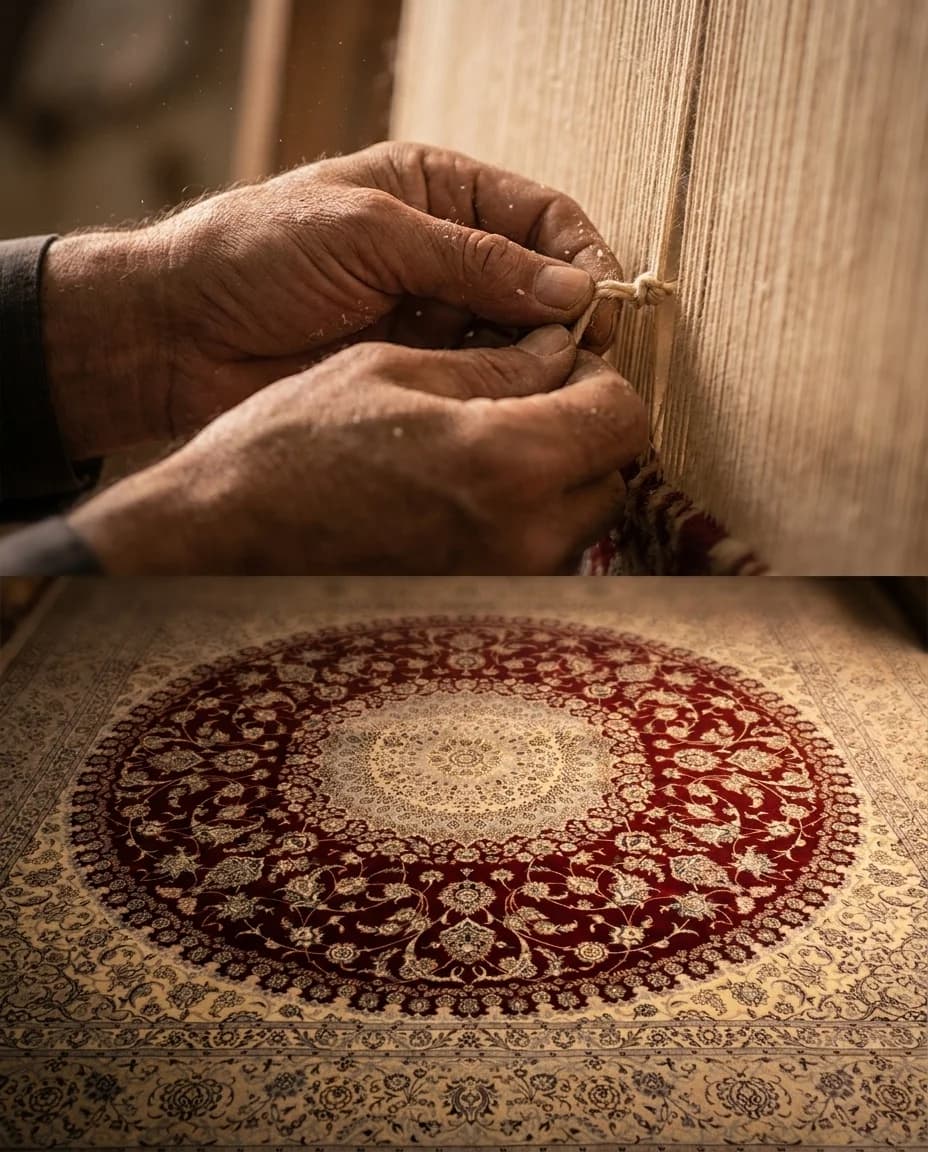
The global carpet market divides into three broad categories: hand-knotted, hand-tufted, and machine-made. Only hand-knotted carpets qualify as authentic Persian or Oriental rugs in the traditional sense. A hand-knotted Persian carpet is produced by a weaver tying individual knots — either the Persian (Senneh) or Turkish (Ghiordes) type — around warp threads, then compressing each row with a comb beater. A 2 m × 3 m carpet at 200 knots per square inch contains roughly 1.67 million individual knots. At a pace of 10,000 knots per day, one weaver needs 167 working days for that single piece.
Hand-tufted rugs use a tufting gun to push loops through a backing canvas; they take days, not months, and wear out in a fraction of the time. Machine-made carpets are produced on power looms in hours. When you see a "Persian-style" rug at a hypermarket for AED 299, it is almost certainly machine-made. Understanding this distinction is the foundation of evaluating any Persian carpet price in the UAE.
2. Knot Density: The Single Most Quantifiable Quality Measure
Knot density — measured in knots per square inch (KPSI) or knots per square metre (KPSM) — is the clearest technical indicator of a carpet's quality and price tier. A higher count means finer yarn, tighter patterns, longer production time, and typically a higher price per square metre.
| Knot Density (KPSI) | Typical Origin / Style | Price Tier (AED per m²) | Typical Use |
|---|---|---|---|
| 30–80 | Afghan tribal, coarse Tabriz | AED 800–2,500 | High-traffic areas, rustic interiors |
| 80–160 | Kashan wool, Isfahan medium | AED 2,500–7,000 | Living rooms, dining areas |
| 160–300 | Fine Tabriz, Nain 9-La, Kashan | AED 7,000–20,000 | Feature rooms, collector pieces |
| 300–600 | Qum silk, Isfahan silk-on-silk | AED 20,000–80,000+ | Investment pieces, wall display |
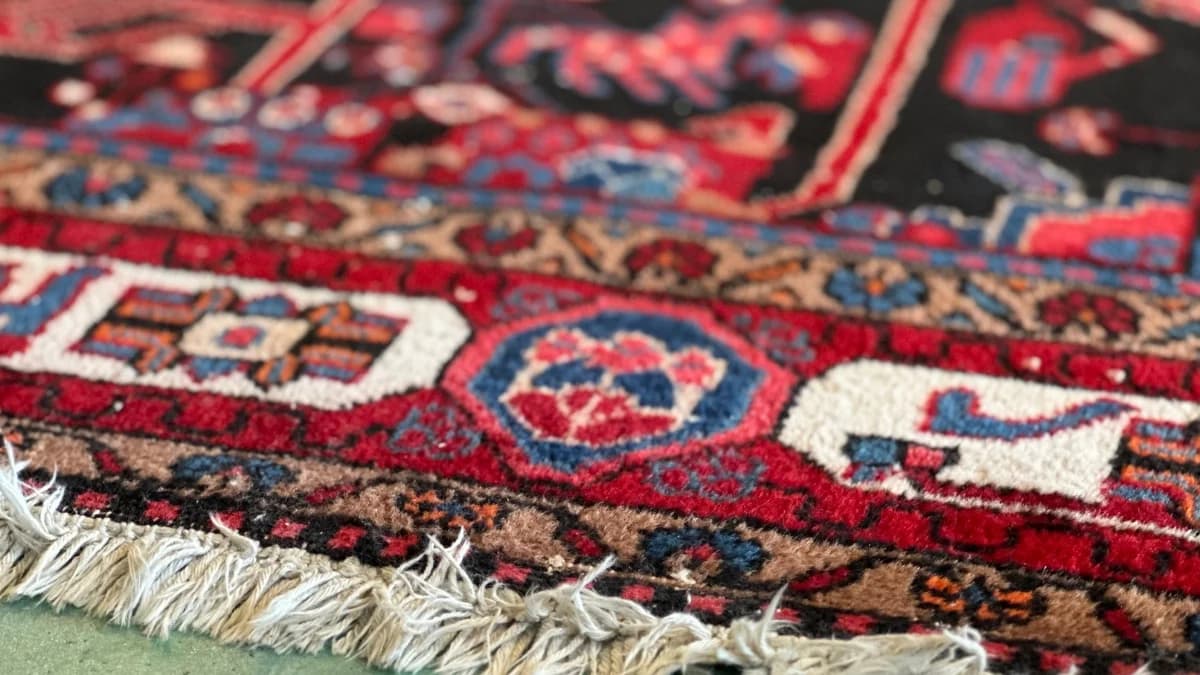
To verify knot density, bend the carpet back and count the knots visible along one inch of warp. Reputable dealers — including our team at Al Malakia's showroom collection — will always allow and encourage this inspection.
3. Material: Wool, Silk, Cotton, and Combinations
Material choice affects both price and longevity. The four materials used in authentic Persian carpets each carry distinct properties:
- Wool pile on cotton foundation: The most common configuration. Wool from Khorasan province or New Zealand is hardwearing and takes vegetable dyes well. Prices are accessible and lifespans exceed 100 years with proper care.
- Silk pile on silk foundation: Used almost exclusively in Qum and some Isfahan workshops. Silk allows knot counts above 400 KPSI, producing photographic detail. Silk carpets are not recommended for floor use in high-traffic areas — they are collector and wall-hanging pieces.
- Wool pile on silk foundation (wool-on-silk): A Tabriz speciality. The silk warp and weft allow finer detailing than an all-wool carpet while keeping the pile durable. Price sits between pure wool and pure silk.
- Cotton foundation only: Cotton warps resist stretching and keep the carpet flat. Almost always used as a structural element rather than pile material.
At Al Malakia we stock all four configurations, with Tabriz wool-on-silk and Qum silk pieces representing the upper end of our price range. If you are uncertain which material suits your space, our team can advise based on foot traffic, humidity levels, and light exposure in your home.
4. Weaving City and Region: Why Origin Commands a Premium
The city of origin is stamped into both the weaving technique and the buyer's perception of value. Each major weaving centre has a centuries-old design vocabulary, a preferred knot type, and a reputation backed by documented history.
- Qum (Qom): Produces Iran's finest silk carpets. The city's weavers adopted silk weaving in the 20th century and refined it to a level that commands the highest prices per square metre of any Iranian city today.
- Tabriz: Iran's oldest commercial carpet city, known for medallion designs, Shah Abbas patterns, and technical versatility. Both wool and silk versions are available; the Tabriz knot (Turkish/Ghiordes) allows fast re-knotting for repairs.
- Isfahan: Renowned for arabesque floral designs on ivory or indigo fields. Isfahan carpets carry a consistent premium due to controlled production quality and recognisable aesthetic.
- Kashan: Home of the historic "garden carpet" format. Kashan wool carpets are among the most reliable mid-to-high range purchases — dense, hardwearing, and with strong resale value.
- Nain: A relative newcomer (commercial production began in the 1930s) but now synonymous with fine wool-and-silk carpets in pale palettes. "9-La" and "6-La" refer to the number of threads per warp bundle — fewer threads means finer weave and higher price.
All five origins are represented in our showroom at the Blue Souk in Sharjah. You can explore the full range in our Persian carpet collection.
5. Age and Provenance: Antique, Semi-Antique, and New
Age classifications in the trade are broadly defined as follows:
- New: Woven within the last 20 years. Colours are vibrant; the carpet has full pile height. Priced on material and knot density alone.
- Semi-antique (20–80 years old): Natural dye oxidisation begins to soften colours. Slight pile wear adds a patina that many buyers prefer. Can command a 15–40% premium over comparable new pieces depending on condition.
- Antique (80+ years old): Documented age, traceable provenance, and good structural condition push prices significantly higher. A genuine antique Kashan or Isfahan in good condition is a financial asset.
Provenance documentation — workshop stamps, auction records, or family provenance letters — adds measurable value. UNESCO's recognition of Iranian traditional crafts has increased international awareness of authentic Iranian weaving heritage, which in turn supports the long-term value of documented pieces.
When buying from a private seller or smaller trader, request documentation and inspect the foundation threads (warp and weft) for brittleness — a sign of structural deterioration that significantly reduces value regardless of surface appearance.
6. Size, Colour, and Design Complexity
Price scales approximately with area, but not linearly. A 4 m × 6 m carpet is not simply four times the price of a 2 m × 3 m carpet of the same quality — larger looms, longer production runs, and the rarity of finding large pieces in premium grades all add a size premium, typically 20–40% above a linear extrapolation.
Design complexity also matters. A carpet featuring a curvilinear floral medallion with 15 colours and shaded petals requires a more detailed cartoon (the graph-paper design guide used by weavers), more dye lots, and greater weaver skill than a geometric tribal repeat. Expect a 10–25% premium for high-complexity curvilinear designs in the same origin and density tier.
Colour fastness — tested by rubbing a damp white cloth on the pile — is a basic quality check. Natural vegetable and mineral dyes used in traditional Persian carpets are more stable than synthetic chrome dyes introduced in the 20th century, and they age more gracefully, which supports long-term value.
7. Market Conditions in the UAE in 2026
The UAE remains one of the world's top three markets for authentic Persian carpets, alongside the United States and Germany. Demand in the Gulf has been sustained by interior design trends favouring natural, handcrafted materials and by a growing collector base among UAE residents and GCC nationals.
Currency dynamics play a role: the Iranian rial has experienced significant depreciation, which in theory reduces production costs. However, raw silk, premium wool, and natural dye inputs are globally priced commodities, and master weaver wages have risen. Net effect: prices for top-tier pieces have held steady or increased slightly in AED terms in 2024–2026, while entry-to-mid range wool carpets have remained broadly accessible.
Import through official channels — which Al Malakia has used since 2008 — adds customs and logistics costs but ensures pieces arrive undamaged, undeclared, and with accurate provenance. Buyers should be cautious of unusually low-priced pieces offered informally, as these may be machine-made or misdescribed as to origin.
8. How to Compare Prices: A Practical Checklist
Before committing to a purchase at any price point, work through this checklist:
- Verify it is hand-knotted: Fold the carpet back and look for the knot roots on the foundation. Machine-made carpets show a latex or jute backing.
- Count knots per inch: Use a ruler and count knots along one inch of warp and one inch of weft. Multiply to get KPSI.
- Identify the material: Burn a small fringe thread (with permission). Wool smells like hair; silk produces fine ash; synthetic fibres melt and smell chemical.
- Check for dye bleeding: Rub a damp white cloth on the pile in multiple colour areas. Minor transfer on new carpets is normal; heavy bleeding indicates unstable dyes.
- Inspect the foundation: Bend the carpet sharply. Cotton and silk warps should be supple. Brittle, cracking warps indicate age-related deterioration.
- Ask for origin documentation: A reputable dealer will have workshop labels, city of origin, and approximate weaving date on file.
- Compare like-for-like: A AED 15,000 Kashan and a AED 15,000 Qum silk are not comparable items — the silk piece is likely half the size or lower density. Always normalise by price per square metre and KPSI.
9. Buying in Sharjah vs. Dubai: Practical Considerations
Sharjah's Central Souq — known as the Blue Souk — has been the UAE's primary destination for authentic Persian carpets for decades. The Blue Souk's merchant community has deeper direct relationships with Iranian weaving workshops than most mall-based retailers, and operating costs are lower than Dubai's retail districts, which typically translates to more competitive prices for equivalent quality.
For buyers based in Dubai, Al Malakia offers a free door-to-door transfer service from Dubai hotels to our showroom at Shop 45–48, Block 3. The drive from central Dubai is approximately 25–30 minutes. Customers in Abu Dhabi and Al Ain can choose from photos and video we send on WhatsApp, and we deliver free anywhere in the UAE. Full details on reaching us are on our Dubai visitors page and our Abu Dhabi visitors page.
Visiting in person matters for carpets in the mid-to-high price range. Photographs do not capture pile depth, colour shift under different light, or the tactile quality of the wool. Our showroom holds 500+ pieces on open display — no appointment necessary during opening hours (Saturday–Thursday 10:00–22:00, Friday 14:00–22:00).
Why Visit Al Malakia Persian Carpets in Sharjah
Al Malakia was founded in 2008 by Eid Al Salam, a second-generation Persian carpet merchant with direct sourcing relationships across Qum, Tabriz, Isfahan, Kashan, and Nain. Our showroom at Shop 45–48, Central Souq Block 3 (Blue Souk), Sharjah carries 500+ hand-knotted Persian and Afghan carpets across all price tiers — from entry-level tribal wool pieces to investment-grade Qum silk.
- Direct sourcing from Iranian weaving families — no middlemen
- Free door-to-door transfer from Dubai hotels
- Abu Dhabi and Al Ain: choose from photos and video on WhatsApp, with free delivery anywhere in the UAE
- Open six days a week, evenings included
- No-pressure browsing — 500+ pieces on open display
Call or WhatsApp: +971 50 537 2997 | +971 6 573 1399
Visit us: Shop 45–48, Central Souq Block 3, King Faisal Road, Sharjah, UAE
Frequently Asked Questions: Persian Carpet Prices in the UAE
What is the average price of a hand-knotted Persian carpet in the UAE in 2026?
There is no single average because size, origin, material, and knot density create a very wide range. A practical guide: small wool carpets (under 1.5 m²) from Afghan or Tabriz workshops start from AED 1,500–3,000. A quality living-room Kashan in the 3–4 m² range typically falls between AED 12,000 and AED 35,000. Fine Qum silk pieces of 4 m² and above can exceed AED 150,000. The most useful approach is to define your budget per square metre and then ask to see pieces in that range sorted by KPSI — that allows a genuine comparison.
How can I tell if a carpet is genuinely hand-knotted and not machine-made?
Turn the carpet face-down and examine the back. Hand-knotted carpets show the same pattern on the reverse as on the face, with slight irregularities because each knot is tied by hand. The fringe is a continuation of the warp threads, not sewn on separately. Machine-made carpets typically have a uniform latex or woven backing, and the fringe is stitched or glued to the edge. You can also fold the carpet back sharply — hand-knotted pieces flex naturally along the knot rows, whereas machine-made rugs tend to crease or resist folding.
Do Persian carpets increase in value over time?
High-quality hand-knotted carpets — particularly those from Qum, Isfahan, and antique Kashan — have historically appreciated in value over decades, provided they are stored and used correctly. The key conditions are: genuine hand-knotting, natural dyes, documented origin, and good structural condition. Entry-level pieces in synthetic dyes are unlikely to appreciate meaningfully. A carpet should be purchased primarily because you want to live with it; if it also holds or grows in value, that is a welcome outcome rather than a guarantee.
Is it cheaper to buy Persian carpets in Sharjah than in Dubai?
Generally, yes. Sharjah's Blue Souk has lower commercial rents than Dubai Mall or JBR-area showrooms, and the merchant community has longer-established direct sourcing relationships with Iranian workshops. These structural cost differences tend to pass through to the buyer. That said, price is only one dimension — provenance verification, after-sales service, and the ability to inspect a large stock in person are equally important. Al Malakia offers a free transfer service from Dubai hotels specifically so that Dubai-based buyers can access the Blue Souk without logistical inconvenience.
What size Persian carpet do I need for my living room?
The standard UAE living room seating arrangement works well with a carpet that allows all front legs of sofas and chairs to rest on the pile. For a typical majlis or lounge, this usually means a minimum of 2.5 m × 3.5 m. Under a dining table, the carpet should extend at least 60 cm beyond the chair legs on all sides when chairs are pulled out — typically 3 m × 4 m for an eight-person table. Bring your room dimensions to the showroom; our team will pull relevant pieces and place them on the floor for you to assess proportion and colour in context.
How do I care for a hand-knotted Persian carpet in the UAE's climate?
The UAE's dry heat is generally kind to Persian carpets — humidity-related mould and mildew are less of a risk than in Northern Europe. Key care points: vacuum with a low-suction head running along the pile direction (never against it) once a week; rotate the carpet 180 degrees every six months to even out foot traffic and light exposure; keep out of direct sunlight wherever possible, as UV degrades both natural and synthetic dyes over time; and have the carpet professionally washed every three to five years by a specialist who understands hand-knotted construction. Avoid steam cleaning, which can shrink cotton foundations and loosen pile.
Closing Thoughts
Persian carpet pricing in the UAE is not arbitrary. Every dirham in a hand-knotted carpet's price can be traced back to a specific, verifiable quality attribute — the number of knots tied per square inch, the origin city's weaving tradition, the material used for pile and foundation, and the years of production time involved. The buyer who understands these factors is far better positioned than one who relies on visual impression alone.
Al Malakia Persian Carpets has been sourcing directly from weaving families in Iran and presenting those carpets to UAE buyers since 2008. Our showroom at Shop 45–48, Central Souq Block 3, Sharjah carries 500+ pieces across the full price spectrum, and our team is available to walk you through the technical specifications of any piece on the floor — no appointment, no pressure.
If you are in Dubai, we will arrange a free transfer from your hotel. If you are in Abu Dhabi or Al Ain, we can send photos and video on WhatsApp for you to choose from, and we deliver free anywhere in the UAE. Or simply message us on WhatsApp at +971 50 537 2997 with your requirements and budget, and we will prepare a shortlist before you arrive.