Quick Facts
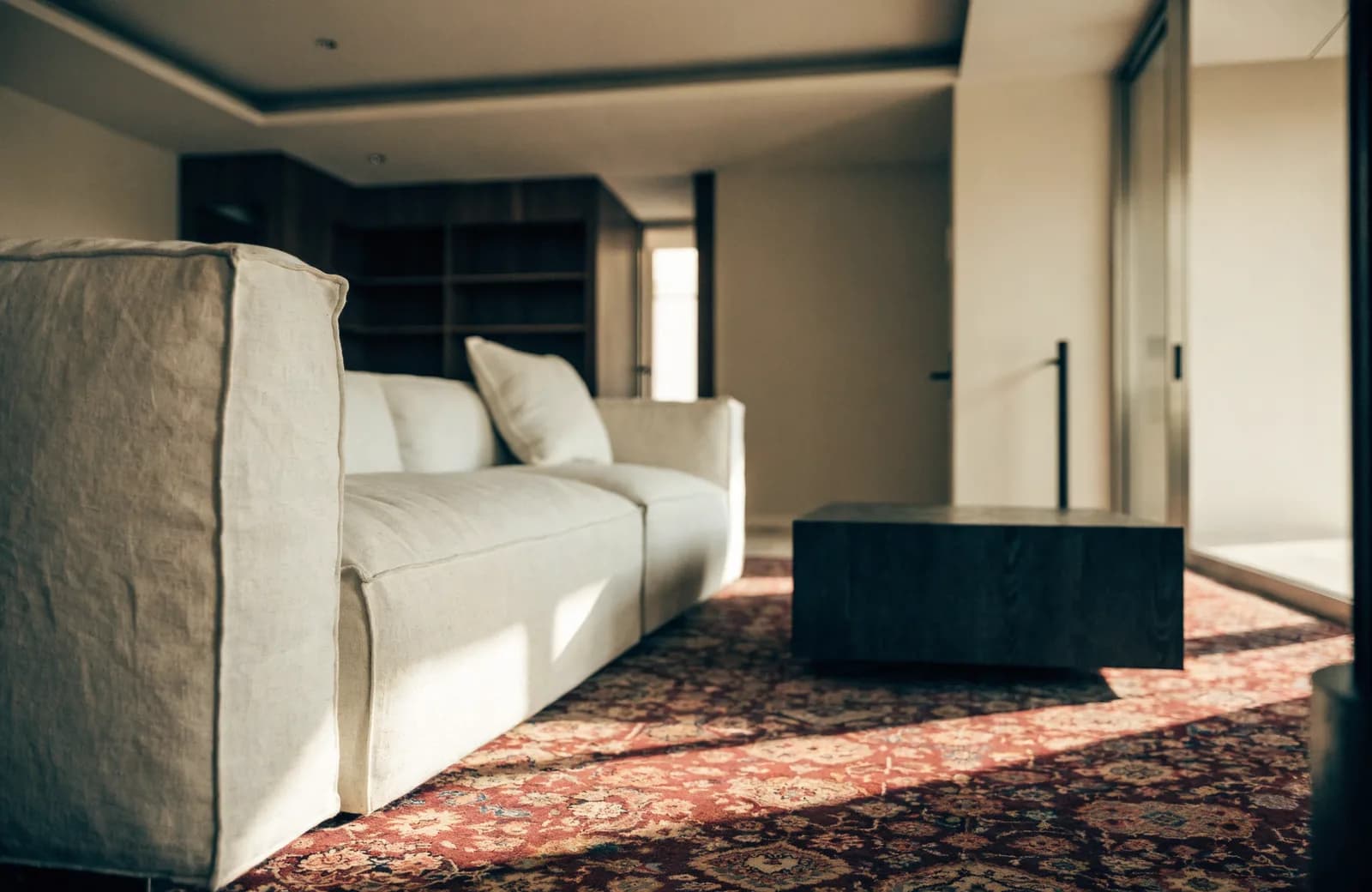
Short answer: Yes — a hand-knotted Persian carpet is one of the best things you can add to a modern, minimalist room. It supplies the warmth, texture and soul that clean-lined furniture deliberately leaves out.
The golden rule: Let one element lead. If your furniture is loud, choose a quieter rug; if your furniture is restrained, let the carpet be the hero.
Best origins for modern rooms: Soft, open-field designs from Nain and Isfahan, and contemporary or overdyed pieces, sit more easily with minimalist furniture than dense, busy patterns.
Scale matters most: In a UAE villa living room, aim for a rug large enough that the front legs of every sofa and chair rest on it — usually 2.5×3.5 m or larger.
Price range: Entry-level Afghan pieces start from AED 800; fine Qum silks from AED 8,000+; large room-sized fine carpets can reach AED 200,000+.
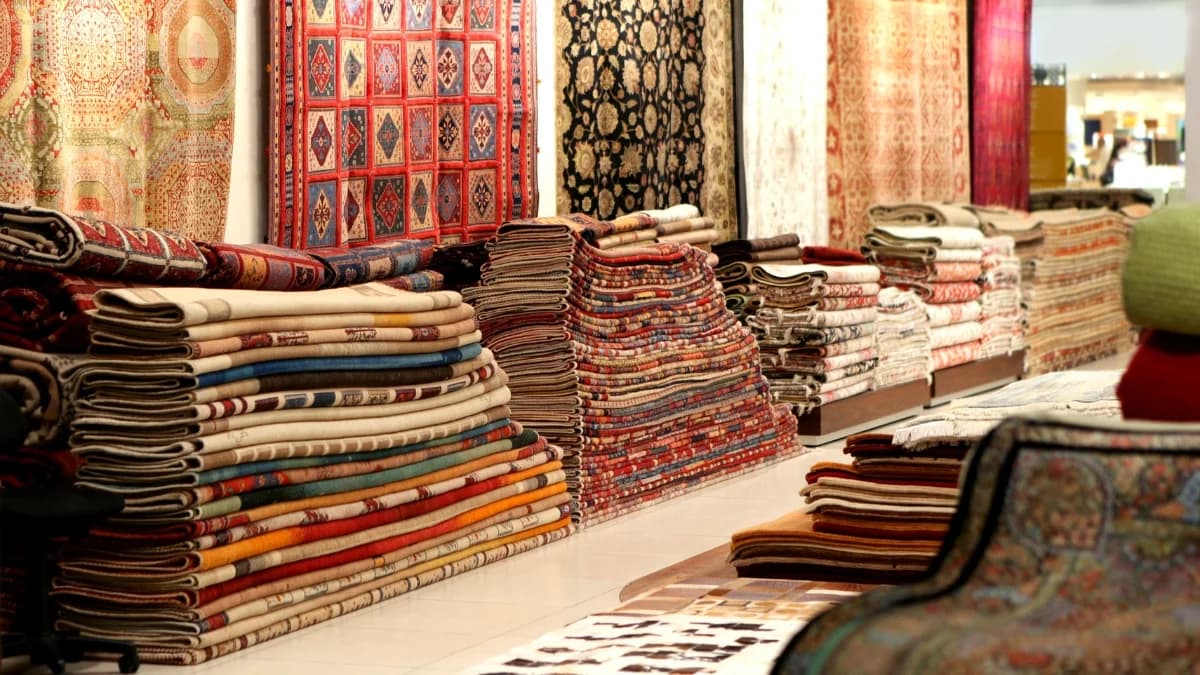
See for yourself: 500+ pieces are laid out at our Blue Souk showroom in Sharjah, with free door-to-door transfer from Dubai.
There is a stubborn myth that a Persian carpet only belongs in a traditional, ornate room — heavy curtains, carved wood, gilt frames. So when a client furnishes a glass-walled Dubai apartment or a pared-back Sharjah villa in clean greys, pale oak and Italian leather, they often assume a centuries-old hand-knotted rug would clash. The opposite is true. At Al Malakia we see it every week: the homes where a Persian carpet looks best are frequently the most modern ones.
This guide explains exactly how to combine a hand-knotted Persian carpet with modern and minimalist furniture in a UAE home — how to think about colour, scale, pattern, material and layering, and which carpet origins make the job easiest. The goal is a room that feels collected and warm rather than showroom-cold, without surrendering the calm that drew you to minimalism in the first place.
Why the contrast actually works
Minimalism is built on restraint: straight lines, neutral palettes, empty space, hard surfaces — polished concrete, glass, lacquered cabinetry, marble floors. Done well it is serene. Done carelessly it can feel cold, flat and a little anonymous, which is a real risk in UAE apartments where large porcelain-tiled floors reflect light and sound.
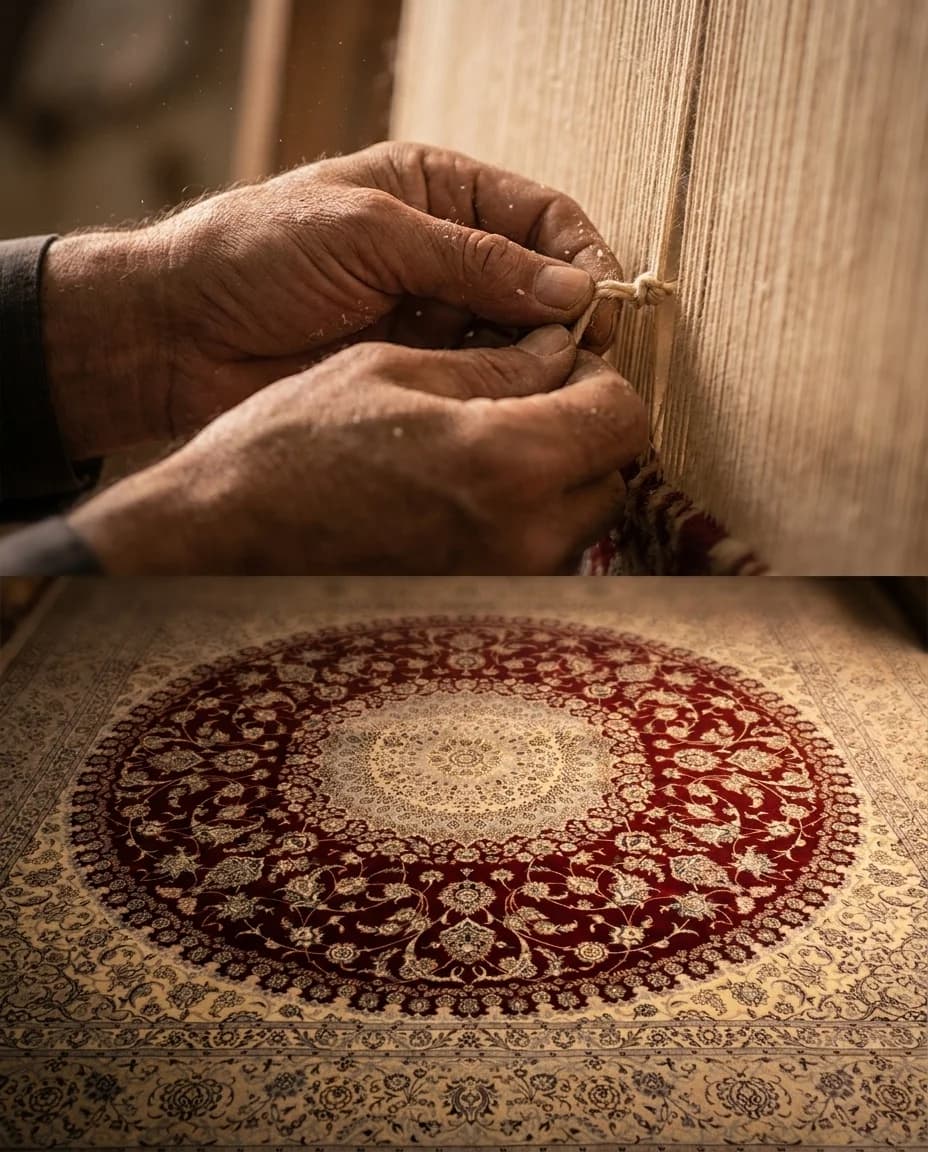
A Persian carpet is the perfect antidote because it brings three things a minimalist scheme is missing. First, texture — the irregular pile of a hand-knotted rug catches light differently across its surface, softening the room acoustically and visually. Second, warmth and colour, even in a muted piece, that stops a grey-and-white room from reading as clinical. Third, and most importantly, soul: a rug knotted by hand over many months carries a depth of craft that no factory-made object in the room can match. The tension between old and new is exactly what makes both look better.
Start with one decision: who is the hero?
Before anything else, decide whether the carpet or the furniture is the star of the room. Trying to make both shout produces visual noise; letting one lead produces a designed-looking space.
If you own a striking carpet — a classic Tabriz medallion, a richly coloured Kashan, a fine Qum silk that shifts colour as you walk past it — make it the hero. Keep the furniture quiet: a low neutral sofa, simple side tables, minimal pattern elsewhere. The rug becomes the artwork the whole room is arranged around.
If instead your furniture is the statement — a bold sectional, a sculptural chair, strong art on the walls — choose a calmer carpet: a soft open field, a subtle all-over design, or a contemporary or overdyed piece in a single dominant tone. Here the rug does the quieter job of grounding the furniture and warming the floor. Our guide on How to Choose the Right Persian Carpet Colour for Your Room is the natural next step once you have decided which role the rug should play.
Colour: pull a thread, don't match everything
The most common mistake is trying to match the carpet to the sofa exactly. You do not need to — and you should not. A good Persian carpet contains a whole palette: a dominant field colour plus several accent tones in the border and motifs. The trick is to pull one of those accent colours and echo it elsewhere in the room — a cushion, a vase, the spine of a stack of books, a throw. That single repeated note ties the old rug and the new furniture into one deliberate scheme.
Working with a neutral, modern palette
If your room is greys, whites, taupe and pale wood — the default UAE minimalist palette — you have two clean routes. You can choose a carpet that stays in that family: a soft beige-and-grey Nain, or a contemporary piece in muted earth tones, which adds texture without introducing a new colour. Or you can use the carpet as your one deliberate splash of colour — a deep indigo, a soft rose, a warm rust — and let it be the single warm event in an otherwise cool room. Both work; what fails is a third clashing colour arriving by accident.
Using a bold carpet in a restrained room
Do not be afraid of a richly coloured Persian rug in a minimalist space. A deep-red Kashan or a blue-ground Isfahan against pale walls and simple furniture is a classic, confident look — the colour reads as intentional precisely because everything around it is calm. The restraint of the furniture gives the carpet permission to be loud.
Scale and placement: get the size right first
More modern rooms are ruined by a rug that is too small than by any colour mistake. A small carpet marooned in the middle of a large floor, with all the furniture sitting off it, makes the room feel disconnected and the rug look like an afterthought. In open-plan UAE villas and larger apartments this is the number-one error.
The reliable rule for a living area: the rug should be large enough that at least the front legs of every sofa and chair in the seating group rest on it; ideally the whole sofa sits on it. For a typical UAE villa living room that usually means 2.5×3.5 m or larger; very large majlis or double-height living rooms may need 3×4 m or 4×6 m. Use this quick reference as a starting point:
| Room / setting | Suggested rug size | Placement guide |
|---|---|---|
| Apartment living area | 2×3 m | Front legs of sofa & chairs on the rug |
| Villa living room | 2.5×3.5 m – 3×4 m | All sofa legs on; rug frames the seating |
| Large majlis | 3×4 m – 4×6 m | Generous border of floor showing all around |
| Under a dining table | Table size + 70 cm each side | Chairs stay on the rug when pulled out |
| Bedroom (runner-free) | 2.5×3.5 m | Rug extends well beyond the bed on three sides |
Leave a consistent margin of bare floor — roughly 20–40 cm — between the edge of the rug and the walls, so the floor frames the carpet. If your room genuinely calls for a size between standard dimensions, hand-knotted pieces come in a wide spread of sizes; we stock from 60×90 cm up to 4×6 m, so it is usually possible to find the right footprint rather than compromising.
Pattern: how busy can you go?
Minimalist furniture is calm, so the carpet can carry more pattern than you might expect — but there is a spectrum, and where you sit on it depends on the rest of the room.
- Open-field and medallion designs (much of the floor is a single calm colour, with a central motif) are the easiest partners for modern furniture. The eye gets a place to rest.
- All-over repeating patterns (Herati, boteh/paisley, floral) work beautifully when everything else in the room is plain — no patterned cushions, curtains or wallpaper competing.
- Contemporary and overdyed pieces take a traditional knotted carpet and wash it in a single modern tone, muting the pattern so it reads almost as texture. These are made for exactly this brief and are the safest choice if you are nervous.
The principle: a busy room needs a calmer rug, and a calm room can take a busier one. If your walls, sofa and windows are all plain, a richly patterned Persian carpet becomes the welcome focal point rather than clutter.
Material and texture: where Persian rugs beat machine-made
Modern interiors lean on hard, flat, cool surfaces. A hand-knotted carpet answers with the opposite, and the material you choose changes the effect.
Wool is the everyday workhorse: warm underfoot, hard-wearing, forgiving of footfall and family life, and matte enough to keep a room feeling grounded. For a busy modern living room or majlis it is usually the right call. Silk — most famously from Qum — is finer, denser and luminous; it catches light and shifts colour as you move, which makes a silk piece read almost as a work of art on the floor. In a minimalist room a fine silk rug can be the single most luxurious object present, and it pairs especially well with restrained, high-quality modern furniture.
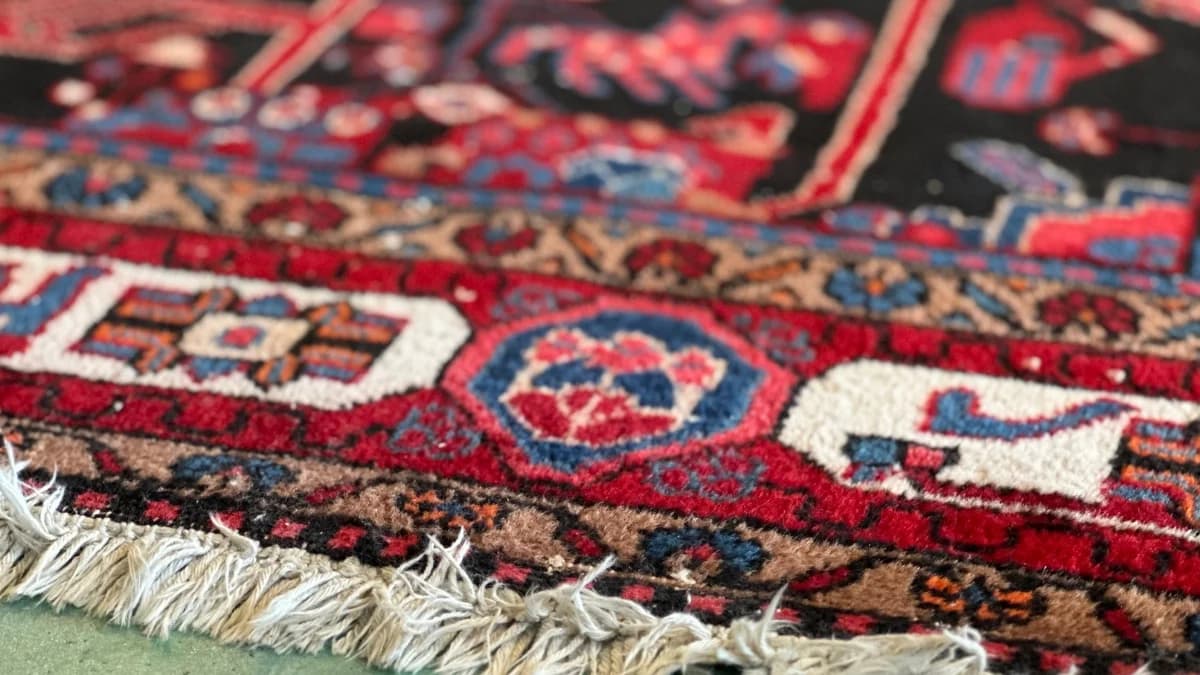
Whatever the material, the hand-knotted construction itself is what separates these carpets from the printed and machine-tufted rugs sold flat-pack. The slight irregularity, the density of knots, the way the pile lies — this is the texture that makes a modern room feel layered rather than flat. You can read more about how we source and select these pieces on our about Al Malakia page.
Layering: the designer move that suits minimalism
One of the strongest contemporary looks is layering — placing a smaller, finer or more colourful Persian rug on top of a larger, plainer base such as a flat natural-fibre mat or a simple neutral rug. In a minimalist room this adds depth and a relaxed, collected feel without introducing visual chaos, because the base layer keeps everything anchored and calm.
It also lets a treasured smaller carpet — a fine Qum silk, a family piece — sit comfortably in a large modern space where on its own it would look lost. We cover the technique in detail in Layering Rugs: the Designer Trend Explained, but the short version is: keep the base plain and large, let the Persian rug on top be the one with personality.
Room by room in a UAE home
The living room and majlis
This is where a Persian carpet earns its keep. Size it generously, let it define the seating area, and either make it the hero against quiet furniture or choose a calmer overdyed piece to ground a bolder scheme. In a majlis, where seating often lines the walls, a large central carpet pulls the whole room together.
Apartments and smaller spaces
You do not need a villa to make this work. In a Dubai apartment a single well-chosen rug warms a tile floor and zones an open-plan living-dining space instantly. Lighter fields and softer patterns help a smaller room feel larger. Our guide to the Best Persian Carpets for Dubai Apartments goes deeper on sizes and colours for compact homes.
Bedrooms and dining areas
In a modern bedroom, a soft-toned rug that extends well past the bed brings warmth underfoot and quiet luxury. Under a dining table, choose a piece large enough that the chairs stay on the rug even when pulled out, and a wool pile that copes with traffic and the occasional spill.
A few honest cautions
Three things to keep in mind so the pairing works long-term. First, buy the size you need, not the size on offer — a beautiful rug in the wrong dimensions will always look slightly off, so measure your room before you fall in love. Second, in the UAE's climate, run air-conditioning and the occasional gentle airing rather than direct harsh sun, which fades natural dyes over years. Third, a fine hand-knotted carpet is an investment piece that holds and often grows in value; treat the purchase as you would a piece of art, and view several in person before deciding. You are welcome to browse our collection or contact us to talk through your specific room before visiting.
Why Visit Al Malakia Persian Carpets?
- Direct sourcing: Purchased from weavers in Qum, Tabriz, Isfahan, Kashan, and Nain — no intermediaries, transparent provenance.
- Scale of stock: 500+ hand-knotted pieces in the showroom, across sizes from 60×90 cm to 4×6 m.
- Free Dubai transfer: Complimentary door-to-door pick-up from Dubai hotels and homes.
- Family expertise: Founded in 2008 by Eid Al Salam, a second-generation Persian carpet merchant.
- Blue Souk location: Shop 45–48, Central Souq Block 3, King Faisal Road, Sharjah. Open Saturday–Thursday 10:00–22:00, Friday 14:00–22:00.
Contact us or WhatsApp +971 50 537 2997 to arrange your visit or request a consultation.