Quick Facts
Best for Abu Dhabi buyers: hand-knotted pieces from Qum, Tabriz, Isfahan, Kashan and Nain — bought direct, no intermediaries.
Entry price: Afghan hand-knotted from AED 800; fine Qum silk from AED 8,000+; large fine pieces can reach AED 200,000+.
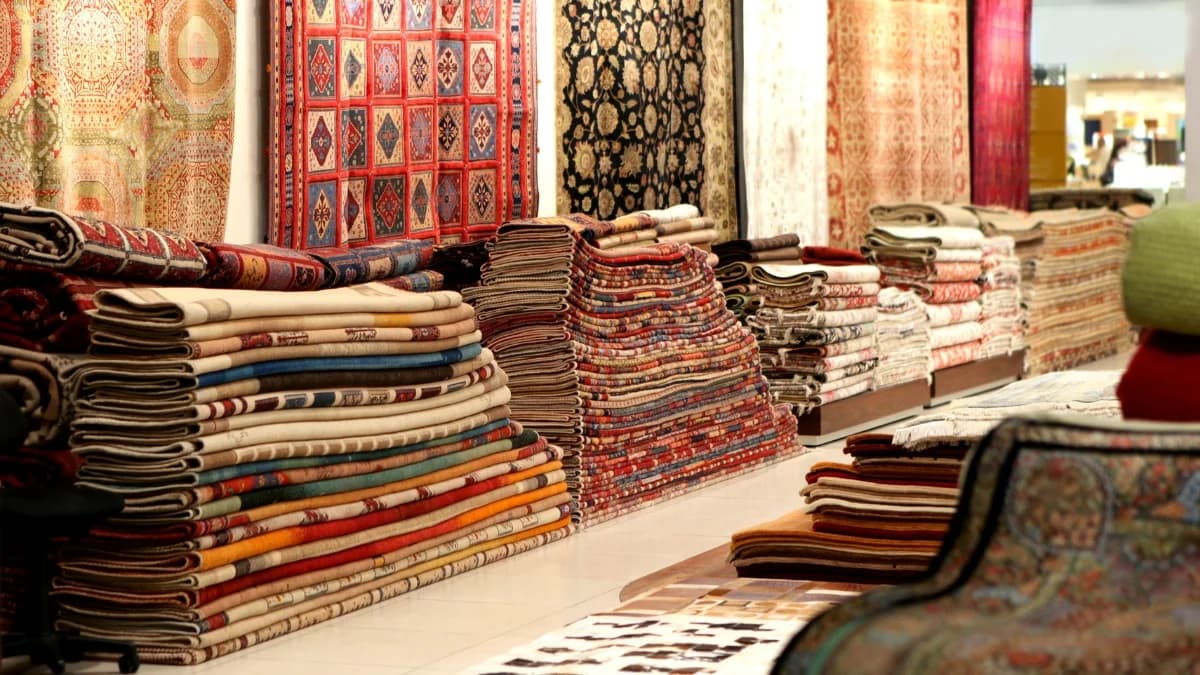
Sizes in stock: 500+ carpets from 60×90 cm up to 4×6 m.
Where to see them: Al Malakia Persian Carpets, Shop 45–48, Central Souq Block 3 (Blue Souk), King Faisal Road, Sharjah — about 75 minutes from Abu Dhabi.
Free help: complimentary door-to-door transfer from Dubai, and consultations by appointment. WhatsApp +971 50 537 2997.
Founded: 2008 by Eid Al Salam, a second-generation Persian carpet merchant.
If you live in Abu Dhabi and want a real, hand-knotted Persian carpet — not a printed machine rug dressed up as one — the question quickly becomes practical: where do you actually look, how do you know what you are buying, and what is a fair price in dirhams? The capital has plenty of furniture stores and a few rug counters inside malls, but genuine workshop-sourced Persian carpets are a different category, and buying one well rewards a little knowledge.
This guide answers those questions in order: how to recognise a genuine hand-knotted carpet, which Persian origins suit which rooms, what AED prices are realistic at each level, the practical steps for buying from Abu Dhabi, and how Al Malakia in Sharjah serves capital buyers. By the end you should be able to walk into any showroom and judge a piece on its merits.
1. Why Persian carpets still matter in an Abu Dhabi home
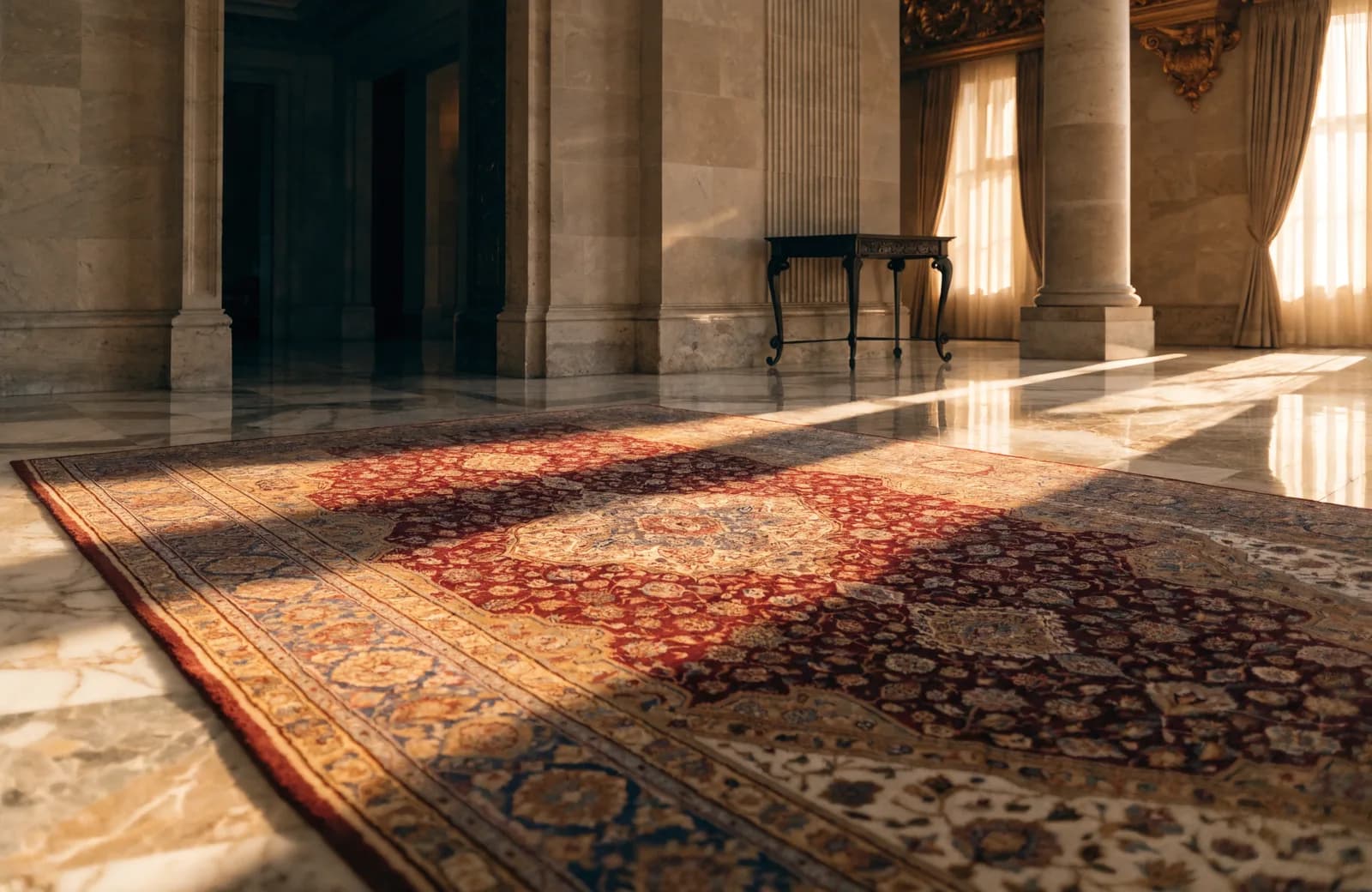
An Abu Dhabi home — whether a Saadiyat or Khalifa City villa with a formal majlis, or a Reem Island apartment — tends to be built around hard, reflective surfaces: marble, porcelain tile, glass and rendered walls. These look elegant but sound and feel cold. A hand-knotted wool or silk carpet is one of the few additions that softens acoustics, warms the floor underfoot in winter, and gives a large open room a defined centre.
There is also the question of value. A machine-made rug is a consumable; it wears flat and is discarded in a few years. A genuine hand-knotted Persian carpet, properly chosen, holds its character for decades and is routinely passed down. For many UAE families it functions as both furnishing and a quiet store of value — which is exactly why it is worth buying the real thing rather than a convincing imitation.
Finally, there is provenance and meaning. Each Persian weaving region carries centuries of design tradition, and a carpet from Qum or Tabriz brings a piece of that lineage into a modern Abu Dhabi interior. In a city where so much furniture is mass-produced and interchangeable, a hand-knotted carpet is genuinely one-of-a-kind — no two are identical, and the one you choose becomes specific to your home.
2. How to tell a genuine hand-knotted carpet from a fake
The single most important skill for an Abu Dhabi buyer is telling hand-knotted from machine-made, because the price gap is enormous and the visual difference can be subtle to an untrained eye. A few reliable checks:
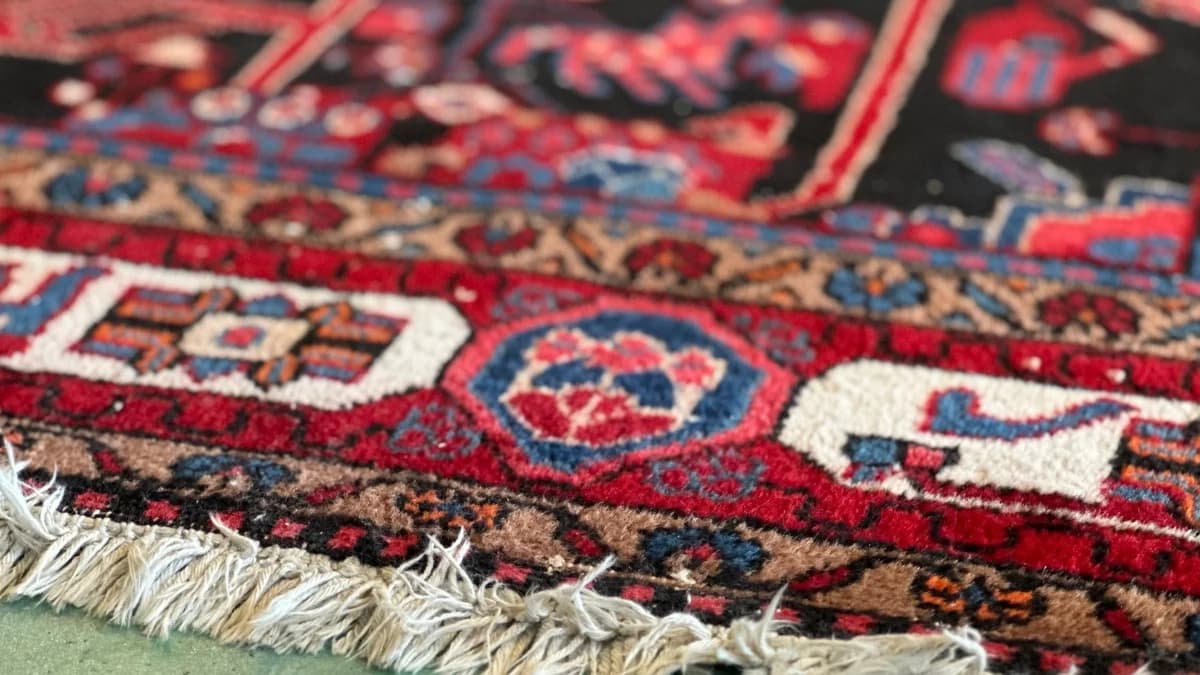
- Turn it over. On a hand-knotted carpet the pattern is visible on the back, knot by knot, with the same clarity as the front. The reverse is slightly irregular — a fingerprint of human work. Machine rugs have a uniform, gridded, often gauze-backed reverse.
- Look at the fringe. On a genuine piece the fringe is the warp threads of the carpet itself, continuous with the body. A sewn-on or glued fringe almost always signals a machine rug.
- Check the knots. Fold the pile back along a row and you will see individual knots tied around the warp. Density (knots per square centimetre) rises with fineness — a coarse village rug might be 1,500–2,500 knots, a fine Qum many times that.
- Feel the irregularity. Hand-knotted carpets carry tiny, honest variations in line and colour (abrash). Perfect, mechanical uniformity is a warning sign, not a virtue.
If you are uncertain, ask the seller to explain the back, the fringe and the knot type on the actual piece. A genuine merchant will welcome the questions. To compare construction styles side by side it helps to browse our collection before you commit.
3. The main Persian origins and what each is good for
"Persian carpet" is not one thing — it is a family of distinct weaving traditions, each with its own character. At Al Malakia we source directly from five regions, and matching origin to room is half the art of buying well.
Qum
Often woven in pure silk, Qum carpets are the finest and most luminous, with very high knot counts and intricate floral or pictorial designs. They suit formal majlis settings, low-traffic feature areas, and wall hangings. They are an investment-grade choice.
Tabriz
From north-west Iran, Tabriz pieces are prized for crisp, precise designs — medallions, garden patterns, and the famous Mahi (fish) motif — usually in wool or wool-and-silk. Durable and versatile, they work in both formal and family rooms.
Isfahan
Elegant and balanced, Isfahan carpets pair fine wool pile with silk foundations and classic medallion layouts. A safe, refined choice for a main reception room.
Kashan
Rich, traditional, and deeply coloured — classic reds and indigos with central medallions. Kashan pieces give a room instant warmth and gravitas.
Nain
Recognisable by their soft palettes (ivory, pale blue, beige) and fine wool-and-silk weave, Nain carpets suit lighter, contemporary Abu Dhabi interiors that need pattern without heaviness.
4. Wool, silk, or a blend?
Material drives both look and budget. Wool is the workhorse — durable, resilient underfoot, and forgiving in a busy household with children. Silk is finer, denser, and shimmers as the light changes, but it is delicate and best kept to low-traffic or display areas. Wool-and-silk blends use silk only for highlight details, giving sheen where it counts while keeping the durability of a wool ground.
For an Abu Dhabi family room with daily footfall, a good wool Tabriz or Kashan is usually the wiser buy. For a formal majlis you rarely walk through with shoes, a Qum silk earns its place.
5. What you should expect to pay (in AED)
Prices vary with origin, material, size, age and knot density, but realistic Abu Dhabi-level expectations look like this:
| Type / origin | Material | Typical use | Indicative price (AED) |
|---|---|---|---|
| Afghan hand-knotted | Wool | Entry-level, family rooms | From 800 |
| Tabriz / Kashan | Wool / wool-silk | Reception, majlis | 3,000–40,000 |
| Isfahan / Nain | Wool-silk | Formal rooms | 6,000–60,000 |
| Qum | Pure silk | Feature, investment | From 8,000+ |
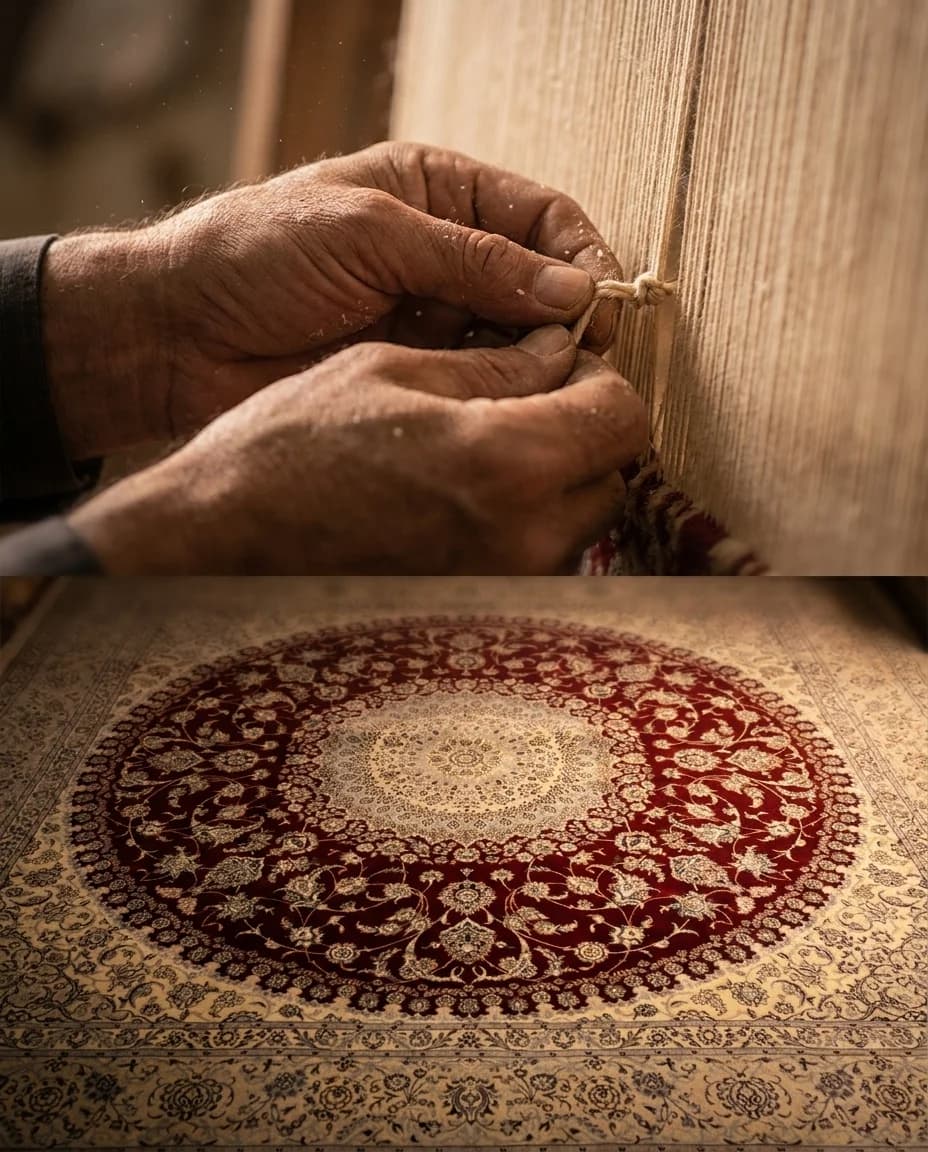
| Large fine pieces (4×6 m) | Silk / fine wool | Grand reception | Up to 200,000+ |
Be sceptical of "Persian silk" carpets priced at a few hundred dirhams — at that level you are almost certainly looking at machine-made or mercerised cotton sold as silk. Honest pricing tracks the labour: a fine carpet can take one or two weavers many months to a year to complete.
It also helps to understand what actually moves the price within a single category. Knot density is the biggest lever — two Qum silks of the same size can differ severalfold in price purely because one is more finely knotted. After that come the dyes (natural vegetable dyes age more gracefully and cost more than synthetics), the complexity of the design, and the size, since a large carpet is not just more material but exponentially more labour. Age and condition matter for older pieces. None of this is mysterious once a knowledgeable seller walks you through it on the actual carpet, which is why an in-person viewing with someone who can explain the trade-offs is worth far more than comparing price tags online.
6. Choosing the right size for your room
Size is where many buyers go wrong, usually by buying too small. As a rule, the carpet should be large enough that the front legs of your majlis seating or sofas sit on it, anchoring the arrangement. A rug that floats in the middle of a large Abu Dhabi reception, with bare floor all around, looks lost.
- Apartment living rooms: 2×3 m is a common sweet spot.
- Villa reception / majlis: 3×4 m to 4×6 m holds the space properly.
- Runners and accents: 60×90 cm to 1×1.5 m for entries, bedsides and prayer areas.
If your room is an unusual shape or you want an exact fit, a made-to-order piece is worth considering — we cover that fully in our guide to Custom-Size & Made-to-Order Persian Carpets.
7. Buying from Abu Dhabi: the practical route
Abu Dhabi has rug counters, but the deepest, best-provenance stock in the Emirates is concentrated in the traditional carpet souks of Sharjah and Dubai. The good news for capital buyers is that the drive is straightforward — roughly 75 minutes up Sheikh Zayed Road to the Sharjah Blue Souk.
A sensible plan: shortlist online first, then visit in person. Photos cannot convey scale, sheen, or how a silk changes with the light, so the in-person viewing matters. Many of our Abu Dhabi clients combine the trip with Dubai, and we explain how the geography compares in Best Persian Rug Shops in Dubai vs Sharjah and Where to Buy Persian Carpets in Dubai.
If you are travelling via Dubai, you do not even need a car: we offer a free Dubai-to-Sharjah showroom transfer, picking you up door-to-door so you can view 500+ pieces without the logistics.
8. After you buy: delivery, care and shipping
Once you have chosen a piece, a few practical matters follow. Delivery across Abu Dhabi and the wider UAE is straightforward to arrange. Care is simpler than people fear: rotate the carpet periodically so wear and sun-fade even out, vacuum gently without a beater bar, address spills promptly, and have a fine piece professionally hand-washed every few years rather than machine-cleaned.
If you are an expat who may relocate, factor in onward shipping before you buy a large piece — it is very doable, and we walk through the customs and packing detail in Shipping a Persian Carpet Abroad from the UAE. For anything specific to your situation you are always welcome to contact us directly.
9. Why buy from a specialist
The strongest protection against a poor purchase is dealing with people who source the carpets themselves. We buy directly from weavers in Qum, Tabriz, Isfahan, Kashan and Nain, with no intermediaries — which means transparent provenance and prices that reflect the carpet, not a chain of markups. You can read more about Al Malakia and our second-generation background. A specialist will also tell you honestly when a cheaper wool piece serves you better than an expensive silk — advice a general furniture store cannot give.
Why Visit Al Malakia Persian Carpets?
- Direct sourcing: Purchased from weavers in Qum, Tabriz, Isfahan, Kashan, and Nain — no intermediaries, transparent provenance.
- Scale of stock: 500+ hand-knotted pieces in the showroom, across sizes from 60×90 cm to 4×6 m.
- Free Dubai transfer: Complimentary door-to-door pick-up from Dubai hotels and homes.
- Family expertise: Founded in 2008 by Eid Al Salam, a second-generation Persian carpet merchant.
- Blue Souk location: Shop 45–48, Central Souq Block 3, King Faisal Road, Sharjah. Open Saturday–Thursday 10:00–22:00, Friday 14:00–22:00.
Contact us or WhatsApp +971 50 537 2997 to arrange your visit or request a consultation.