Quick Facts
Nearest showroom to Dubai: Al Malakia Persian Carpets, Shop 45–48, Central Souq Block 3, King Faisal Road, Sharjah — approximately 20–25 minutes from Downtown Dubai
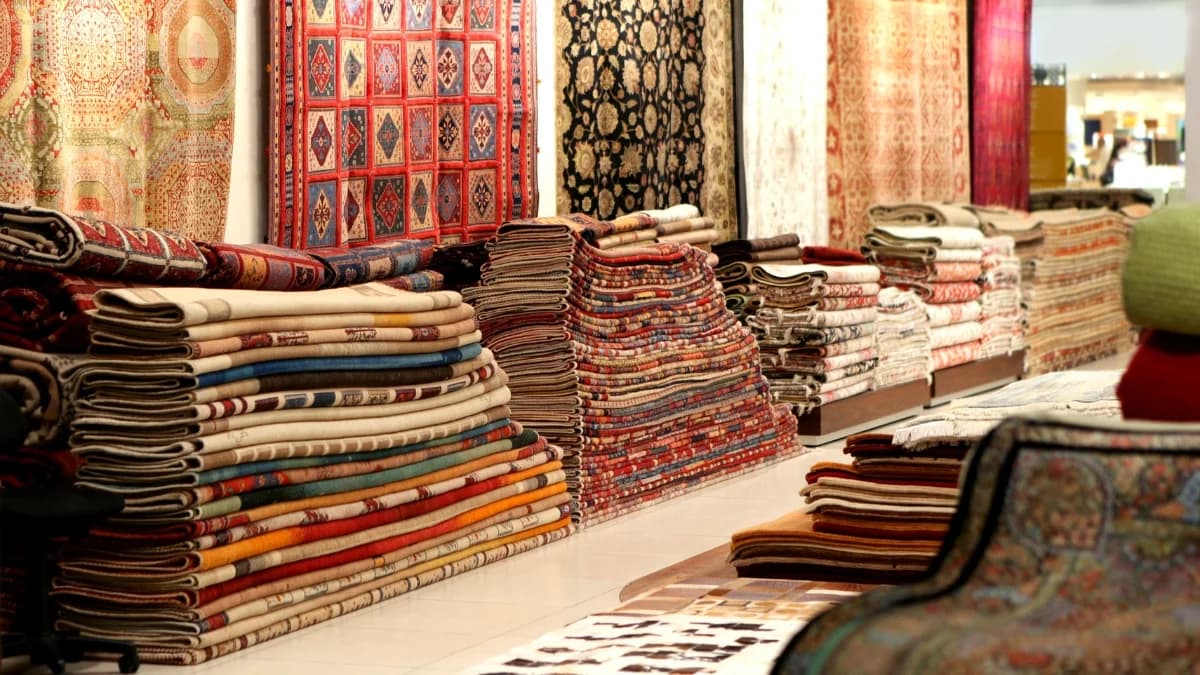
Stock on display: 500+ hand-knotted Persian and Afghan carpets across all major weaving origins
Knot density range: From 40 knots/cm² (Tabriz wool) to 400+ knots/cm² (Qum silk)
Price indication: Wool-on-cotton room-size carpets from AED 2,000; Qum silk pieces from AED 8,000 upward depending on size and knot count
Free transfer from Dubai: Door-to-door from Dubai hotels — call or WhatsApp +971 50 537 2997 to arrange
Founded: 2008; family-owned, carpets sourced directly from weavers in Iran
Roughly 40,000 hand-knotted Persian carpets enter the UAE market each year, yet the majority of what is sold in Dubai's malls and tourist markets is machine-made or tufted rather than genuinely hand-knotted. For Dubai residents and visitors serious about purchasing an authentic piece — one that carries a verifiable origin, a measurable knot count, and the potential to hold or appreciate in value — knowing where to look matters far more than knowing how much to spend. This guide covers the defining characteristics of authentic Persian carpets, the questions you should ask any retailer, and how to make the most efficient use of your time when shopping from Dubai in 2026.
What Makes a Persian Carpet "Authentic"?
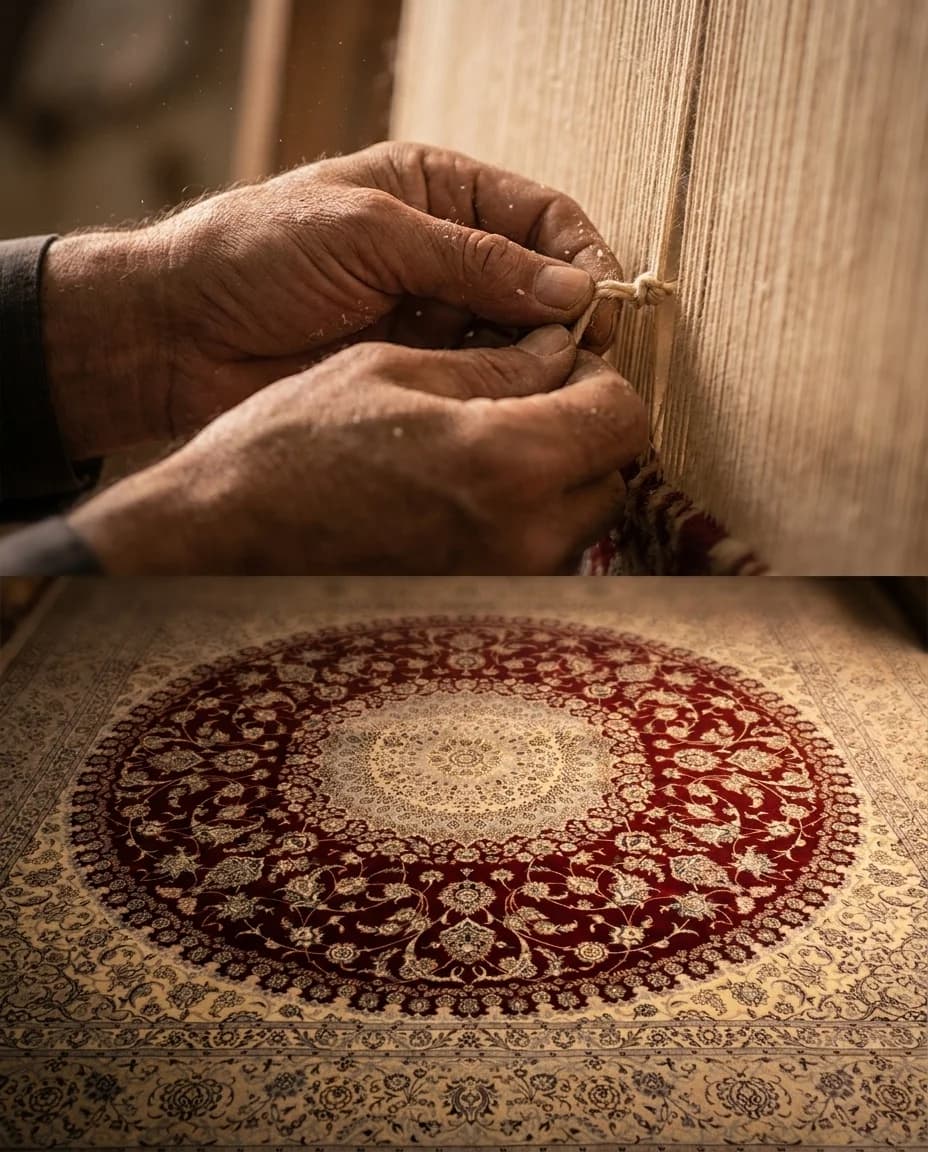
The term "Persian carpet" refers specifically to hand-knotted floor coverings produced in Iran, using techniques that UNESCO recognised in 2010 as Intangible Cultural Heritage. Each knot — tied individually by a weaver around the warp threads — is what separates a hand-knotted carpet from a hand-tufted or machine-made alternative. A genuine Qum silk carpet may contain over 400 knots per square centimetre; a fine Tabriz wool piece typically falls between 70 and 120 knots/cm². These figures are verifiable: a reputable dealer will confirm knot count, warp and weft material, and city of origin before you commit to a purchase.
Three material categories account for most of what you will find in a serious showroom:
- Wool pile on cotton foundation — the most common structure; durable and accessible in price
- Wool pile on wool foundation — traditional in village and tribal pieces; slightly softer underfoot
- Silk pile on silk foundation — characteristic of Qum; highest knot density and finest detail
Wool-on-silk hybrids, produced notably in Tabriz, combine the durability of wool with the luminosity of a silk foundation and represent strong value at mid-range price points.
The Main Weaving Centres and What They Produce
Persian carpet production is not uniform. Each city and region has a recognisable style, colour palette, and construction method. The table below summarises the five origins most commonly available in UAE showrooms:
| Origin | Typical Material | Characteristic Style | Typical Knot Density |
|---|---|---|---|
| Qum (Qom) | Silk on silk | Medallion, floral, pictorial; very fine detail | 200–500 knots/cm² |
| Tabriz | Wool, silk, or wool-on-silk | Medallion-and-corner; wide colour range | 70–180 knots/cm² |
| Isfahan | Wool on silk foundation | Arabesque vine scrolls; deep red and blue fields | 100–200 knots/cm² |
| Kashan | Wool on cotton | Central medallion; rich jewel tones | 80–160 knots/cm² |
| Nain | Wool with silk highlights | Ivory ground with blue-and-gold floral detail | 100–300 knots/cm² |
At Al Malakia's showroom collection, all five of these origins are represented across more than 500 pieces, allowing you to compare weaving styles side by side rather than relying on photographs.
Why Dubai Residents Often Shop in Sharjah
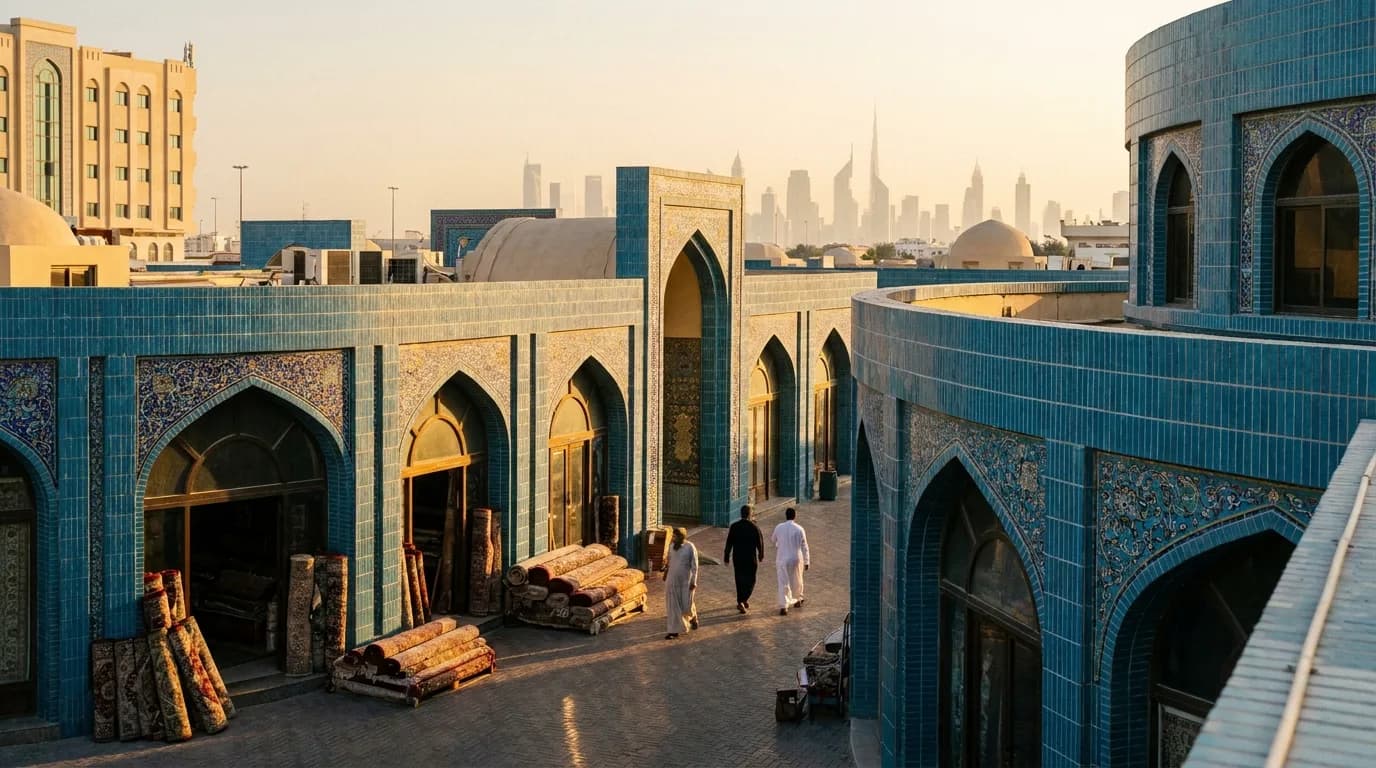
Dubai's retail landscape for carpets is dominated by mall boutiques, many of which stock machine-made or tufted pieces at prices that reflect location rent rather than carpet quality. Genuine hand-knotted inventory requires large warehouse-style showrooms to display properly — not a 40 m² mall unit. Sharjah's Central Souq (the Blue Souk) has historically been the UAE's primary destination for authentic carpet retail, a function it has served since well before the emirate's modern development, for several structural reasons:
- Showroom spaces are large enough to unroll and examine full room-size pieces
- Operating costs are lower, allowing merchants to price on carpet merit rather than rent recovery
- The souq's established reputation attracts specialist merchants, creating a concentrated cluster for comparison shopping
- Proximity to Sharjah's port historically made it the UAE's entry point for Iranian goods
From Downtown Dubai, the drive to the Blue Souk takes approximately 20–25 minutes via Sheikh Mohammed Bin Zayed Road or the coastal route along the Corniche. Al Malakia also arranges free door-to-door transfer from Dubai hotels — contact the team on WhatsApp at +971 50 537 2997 to schedule a visit before you travel.
How to Verify Quality Before You Buy
Regardless of where you shop, these five checks will protect you from paying hand-knotted prices for machine-made goods:
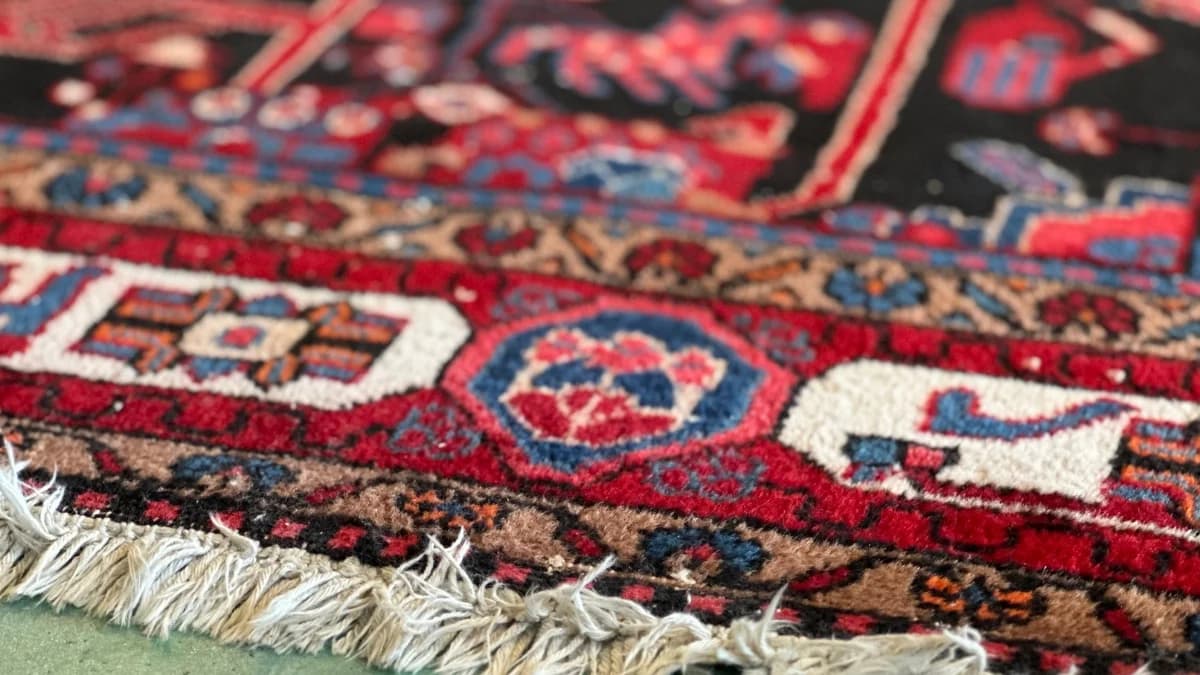
- Turn the carpet over. On a hand-knotted piece, the pattern on the reverse is nearly as clear as the face. Blurred, indistinct reverse patterns indicate tufting or machine production.
- Count the knots. Use a ruler and count the knots visible along a 1 cm line on the reverse in both directions (warp and weft), then multiply. A dealer claiming Qum silk should be able to demonstrate 200+ knots/cm².
- Check the fringe. On hand-knotted carpets, the fringe is a structural extension of the warp threads — it cannot be removed without damaging the carpet. On tufted or machine-made pieces, fringe is typically sewn or glued on.
- Ask for the origin certificate or provenance. Reputable merchants who source directly from weaving families can often provide documentation or describe the specific workshop in detail.
- Test the pile. Run your hand against the pile direction: on a wool carpet, you should feel a slight resistance and see a sheen change. On a silk piece, the colour shifts noticeably as you change angle — this is known as sheen reversal and is specific to hand-spun silk.
Afghan Carpets: an Increasingly Popular Alternative
Afghan hand-knotted carpets — particularly those woven by Afghan craftspeople using techniques and wool types closely related to the Persian tradition — have grown significantly in demand across the UAE market. Pieces from Herat and the northern Afghan provinces use high-lanolin wool that gives a distinctive lustre, and tribal designs such as the geometric gul motif are produced at knot densities comparable to mid-range Persian city carpets. They frequently represent stronger value per knot than equivalent-quality Persian city carpets, partly because they carry less name premium.
Al Malakia stocks Afghan hand-knotted carpets alongside its Persian inventory, allowing for a direct side-by-side comparison that is difficult to make elsewhere in the UAE.
What to Expect on Price in 2026
Prices for hand-knotted carpets in the UAE vary enormously based on origin, size, age, knot density, and dye type (natural vs synthetic). The following gives a practical framework for 2026 retail pricing in AED:
- Afghan wool, tribal, 2×3 m: AED 1,800 – 4,500
- Persian Kashan wool, 2×3 m: AED 3,500 – 9,000
- Persian Tabriz wool-on-silk, 2×3 m: AED 6,000 – 18,000
- Persian Nain wool with silk, 2×3 m: AED 7,000 – 20,000
- Persian Isfahan wool on silk, 2×3 m: AED 10,000 – 30,000+
- Persian Qum silk on silk, 1.5×2.5 m: AED 12,000 – 60,000+
Antique and semi-antique pieces (50+ years) carry additional premium dependent on condition, rarity, and provenance documentation. At Al Malakia, pricing is transparent and based on the characteristics of each individual piece rather than a standard mark-up schedule.
Visiting from Abu Dhabi
For visitors or residents travelling from Abu Dhabi, the drive to Sharjah's Blue Souk takes approximately 90–100 minutes via Sheikh Mohammed Bin Zayed Road. Customers in Abu Dhabi and Al Ain who would rather not make the trip can choose from photos and video sent on WhatsApp, with free delivery anywhere in the UAE. See the Abu Dhabi visitors' page for details or call +971 6 573 1399. The showroom is open Saturday through Thursday from 10:00 to 22:00, and on Fridays from 14:00 to 22:00, making an evening visit feasible even on a weekday.
Shipping and Export: Taking Your Carpet Home
For international visitors purchasing in Dubai or Sharjah for export, the UAE imposes no export duty on hand-knotted carpets. Carpets purchased at Al Malakia can be professionally rolled, packed, and shipped internationally; the team works with established freight partners and can advise on import duty implications for GCC, European, and North American destinations. Smaller pieces can typically be carried as hold luggage without difficulty. UAE VAT (5%) applies to domestic retail purchases; this cannot be reclaimed on tourist purchases under the current UAE tax framework as the UAE tourist refund scheme covers eligible goods through Planet Tax Free — verify your eligibility at the point of purchase.
Why Visit Al Malakia Persian Carpets?
Founded in 2008 by the Al Salam family and now managed by second-generation merchant Eid Al Salam, Al Malakia operates from Shops 45–48 in Central Souq Block 3 — the Blue Souk — in Sharjah. Carpets are sourced directly from weaving families in Qum, Tabriz, Isfahan, Kashan, and Nain, which means the provenance of each piece can be described from first-hand knowledge rather than importer catalogues.
With 500+ hand-knotted Persian and Afghan carpets on display, this is one of the largest dedicated showroom floors in the UAE. There is no pressure to purchase; time is taken to explain the structure, origin, and value characteristics of each piece you consider.
Free door-to-door transfer from Dubai hotels. Customers in Abu Dhabi and Al Ain can choose from photos and video on WhatsApp, with free delivery anywhere in the UAE.
Frequently Asked Questions
Are there authentic Persian carpet shops in Dubai itself?
A small number of specialist merchants operate in Dubai, primarily in older commercial areas such as Deira and Al Quoz. However, the UAE's primary concentration of dedicated Persian carpet showrooms — those with large inventory, direct sourcing from Iran, and the floor space necessary to display full room-size pieces — is in Sharjah's Central Souq. The 20–25 minute drive from Downtown Dubai is straightforward, and Al Malakia offers free hotel transfer so there is no logistical barrier to visiting the Blue Souk directly.
How do I know if a Persian carpet is genuinely hand-knotted?
Turn the carpet over: on a hand-knotted piece, the design on the reverse is clearly visible, with individual knots discernible to the eye. The fringe will be a structural continuation of the warp threads, not a sewn-on addition. A reputable dealer will count knots with you on request and will be able to confirm the city of origin, weaver type (workshop or family), pile material, and foundation material. If a seller is unwilling or unable to answer these questions specifically, treat that as a warning sign.
What is the difference between a Qum silk carpet and a Tabriz carpet?
Qum (also spelled Qom) is a city in central Iran specialising almost exclusively in silk-on-silk hand-knotted carpets of extremely high knot density — typically 200 to 500 knots per cm² — with fine floral, medallion, or pictorial designs. Tabriz, in north-west Iran, produces a wider variety: wool-on-cotton, wool-on-silk, and silk-on-silk, generally at slightly lower knot densities (70–180 knots/cm²), with a broader colour palette and stronger commercial availability in different sizes. Both are city carpets of high quality; Qum silk pieces are typically higher in price per square metre due to material cost and weaving time.
Can I bring a Persian carpet back to the UK, US, or Europe from the UAE?
Yes. The UAE places no export restrictions on hand-knotted carpets. Import into the UK, EU, and US is generally straightforward for personal-use quantities; duties vary by country and declared value. The US applies a specific import duty rate to hand-knotted rugs from Iran (currently suspended for personal imports under a certain value — verify current rules with US Customs before purchase). EU and UK import declarations are required above a de minimis threshold. Al Malakia's team can provide documentation to support customs declarations and works with international freight partners for larger pieces.
What sizes are available, and can I order a custom size?
Al Malakia's showroom stocks carpets from small decorative pieces (approximately 0.6×0.9 m) through to oversized formats (4×6 m and larger). Given that the inventory exceeds 500 pieces at any time, the majority of standard room sizes — 2×3 m, 2.5×3.5 m, 3×4 m — will be represented in multiple origins and designs. Custom-order hand-knotted carpets are possible through direct commission with weaving families in Iran; lead times are typically 12–24 months depending on size and complexity. Contact the showroom to discuss commission requirements.
Is the free Dubai hotel transfer really available, and how do I arrange it?
Yes — Al Malakia provides complimentary door-to-door transfer for visitors staying at Dubai hotels who wish to visit the Sharjah showroom. To arrange, WhatsApp or call +971 50 537 2997 at least one day in advance with your hotel name, preferred date, and approximate time. The service is offered as a practical convenience — Sharjah's Blue Souk is 20–25 minutes from most Dubai hotel areas — and carries no purchase obligation.
Whether you are furnishing a new home in Dubai, looking for a considered long-term acquisition, or searching for an exceptional gift, the difference between a hand-knotted Persian carpet and a machine-made alternative is measurable and lasting. Al Malakia Persian Carpets at the Blue Souk in Sharjah — 20 minutes from Dubai, with free hotel transfer — is one of the few places in the UAE where that comparison can be made properly, across a full range of origins, at transparent pricing. Visit the showroom, or start a conversation on WhatsApp at +971 50 537 2997 to arrange your visit.