Quick Facts
Defining material: Hand-spun, lanolin-rich highland wool from Afghanistan's mountain flocks.
Knot type: Almost always the asymmetric Persian (Senneh) knot, tied by hand on a wool or cotton foundation.
Signature look: Deep madder reds, indigo blues and tribal geometry — elephant-foot guls, octagons and stylised borders.
Dyes: Predominantly natural — madder root, indigo, walnut husk and pomegranate skin.
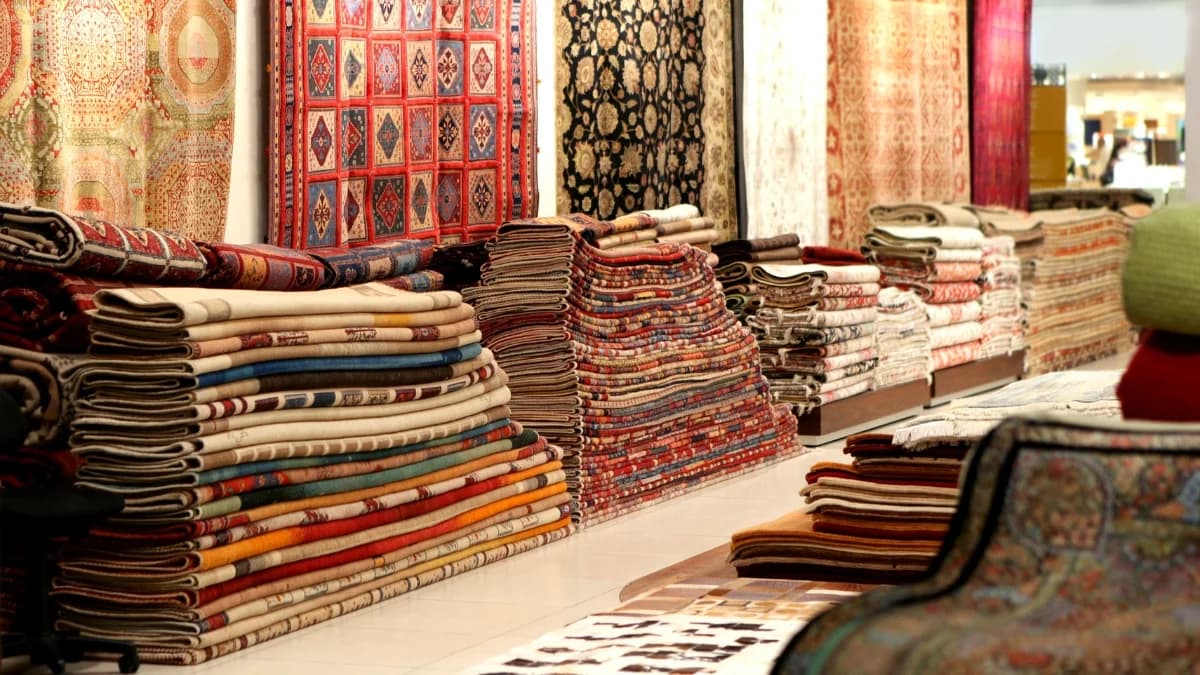
At Al Malakia: Entry-level Afghan pieces start from AED 800, with 500+ hand-knotted carpets in our Blue Souk showroom in Sharjah.
Where to see them: Shop 45–48, Central Souq Block 3, King Faisal Road, Sharjah — free door-to-door transfer from Dubai.
Walk into any serious carpet showroom and you will find Afghan rugs sitting quietly alongside the more famous Persian city pieces. They rarely shout for attention, yet experienced buyers keep coming back to them. So what exactly makes an Afghan carpet unique — and why does that uniqueness matter when you are furnishing a villa in Dubai or an apartment in Sharjah?
This guide answers that question in plain terms. We will look at the wool, the knots, the dyes, the patterns and the weaving culture behind these rugs, and explain how each of those Afghan carpet characteristics shows up in the piece you eventually walk on every day. By the end you will be able to spot a genuine Afghan rug, judge its quality, and understand why it behaves the way it does in a UAE home.
It Starts With the Wool
If there is one thing that defines an Afghan carpet, it is the wool. Afghanistan's highland sheep graze at altitude through cold winters and dry summers, and that climate produces a fleece that is unusually rich in lanolin — the natural oil that gives wool its sheen and its resistance to dirt. This is not a marketing claim; it is the reason a good Afghan rug develops a soft, candle-lit lustre after a few years of use rather than going dull.
Just as important is how the wool is handled. In traditional Afghan weaving the wool is hand-spun, not machine-spun. Hand-spun yarn has slight, irregular variations in thickness, and when it takes up dye those tiny variations create the gentle, living colour movement known as abrash. Machine-spun yarn dyes perfectly evenly, which sounds desirable but actually produces a flatter, more synthetic-looking surface. The faint striping you see across a fine Afghan field is not a fault — it is the fingerprint of genuinely hand-made wool.
Why the wool matters in the UAE
Lanolin-rich wool is also remarkably practical for this region. It naturally repels dust and resists the dry static you get from air-conditioned interiors, and it is far more forgiving of spilled qahwa or a child's juice than a synthetic rug. A well-made Afghan wool rug is built to survive decades of real family life, which is exactly why we cover its upkeep in detail in our guide to Caring for Afghan Wool Rugs in a UAE Home.
The Knot: Slow, Dense and Done by Hand
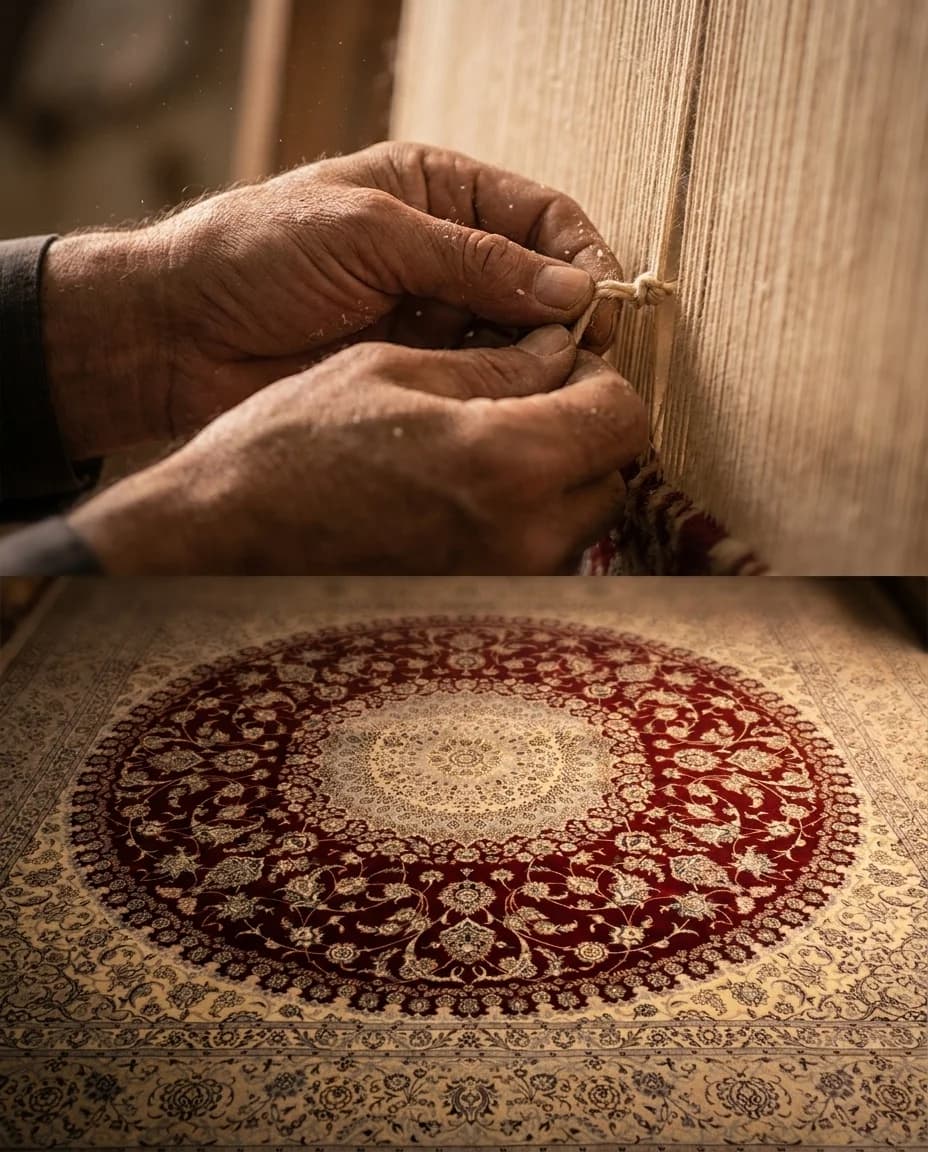
Every hand-knotted carpet is built knot by knot, and Afghan weavers overwhelmingly use the asymmetric Persian knot (also called the Senneh knot). This is the same knot family used across the great Iranian weaving centres, which is one reason Afghan and Persian rugs share a certain structural DNA. Each knot is tied around two warp threads by hand, the row is beaten down tight with a metal comb, and the weaver moves on — thousands of times per row, hundreds of thousands of times per rug.
Knot density varies by region and quality. Coarser nomadic pieces might carry 40–80 knots per square inch, while a fine Afghan rug can reach 150 knots or more. Higher density means crisper pattern detail and a longer life, but it does not automatically mean “better” — a chunky, lower-count tribal rug has its own honest character that a very fine piece cannot replicate. What matters is that the knotting is even, the back is legible, and the work is genuinely manual.
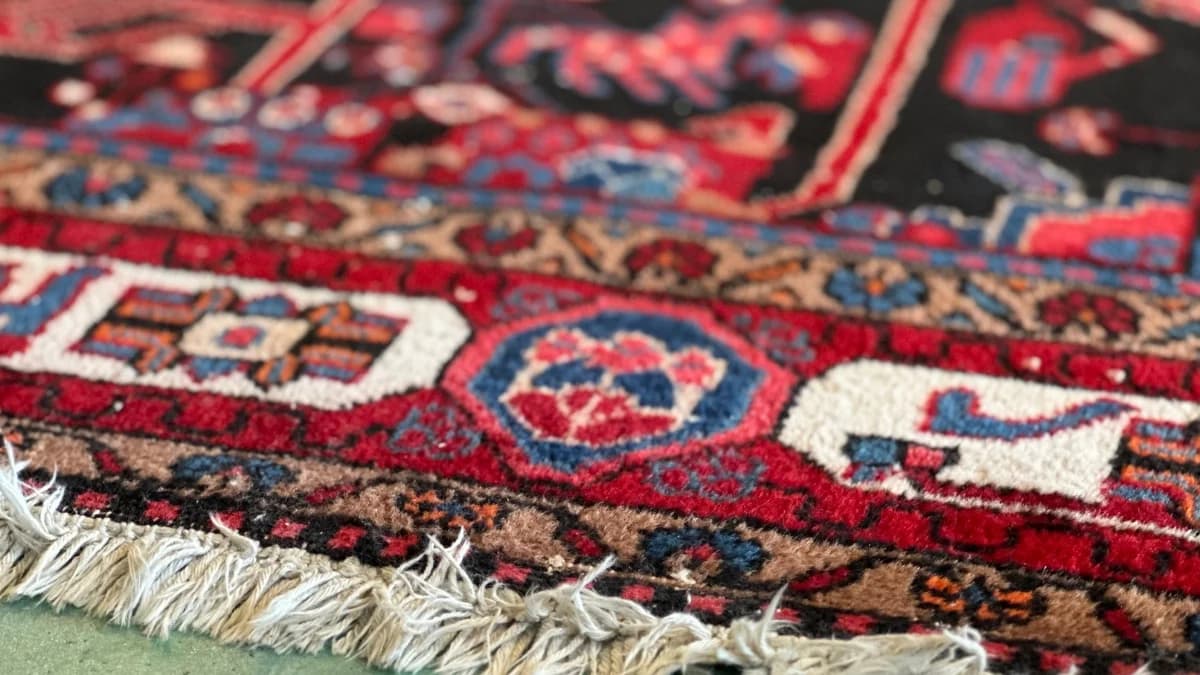
You can usually confirm this yourself. Fold an Afghan rug back on itself and look at the reverse: on a hand-knotted piece the pattern reads clearly on the back, the individual knots are visible, and the lines are subtly irregular. A machine-made imitation will have a suspiciously perfect grid and often a glued or mesh backing. If you would like a closer look at how the construction differs across origins, browse our collection in the showroom where you can turn the pieces over yourself.
Natural Dyes and the Famous Afghan Red
Colour is the next pillar of Afghan identity. Traditional Afghan rugs lean heavily on natural, plant- and mineral-based dyes, and the palette is instantly recognisable: deep brick and rust reds, ink-dark blues, warm browns and creamy ivories.
- Reds come from madder root, giving everything from terracotta to a deep oxblood.
- Blues come from indigo, ranging from midnight to a soft denim.
- Browns and golds come from walnut husk and pomegranate skin.
- Darkest accents sometimes use iron-rich mineral dyes.
Natural dyes age beautifully. Rather than fading to a tired grey the way many synthetic colours do, they mellow and deepen, which is a large part of why antique Afghan rugs look richer than the day they left the loom. The trade-off is the gentle unevenness of abrash mentioned earlier — something collectors prize and machine production cannot fake.
There is also a meaningful difference between a fully naturally dyed rug and one that uses modern chrome dyes. Chrome dyes are colour-fast and consistent, and many perfectly good contemporary Afghan rugs use them — they are not a sign of a fake. But the very best pieces, the ones worth keeping for a generation, still rely on the old vegetable recipes. When you compare two rugs at similar prices, ask which dyes were used; a knowledgeable seller will tell you honestly, and the answer often explains the difference in how each will age on your floor.
Tribal Geometry: Reading the Patterns
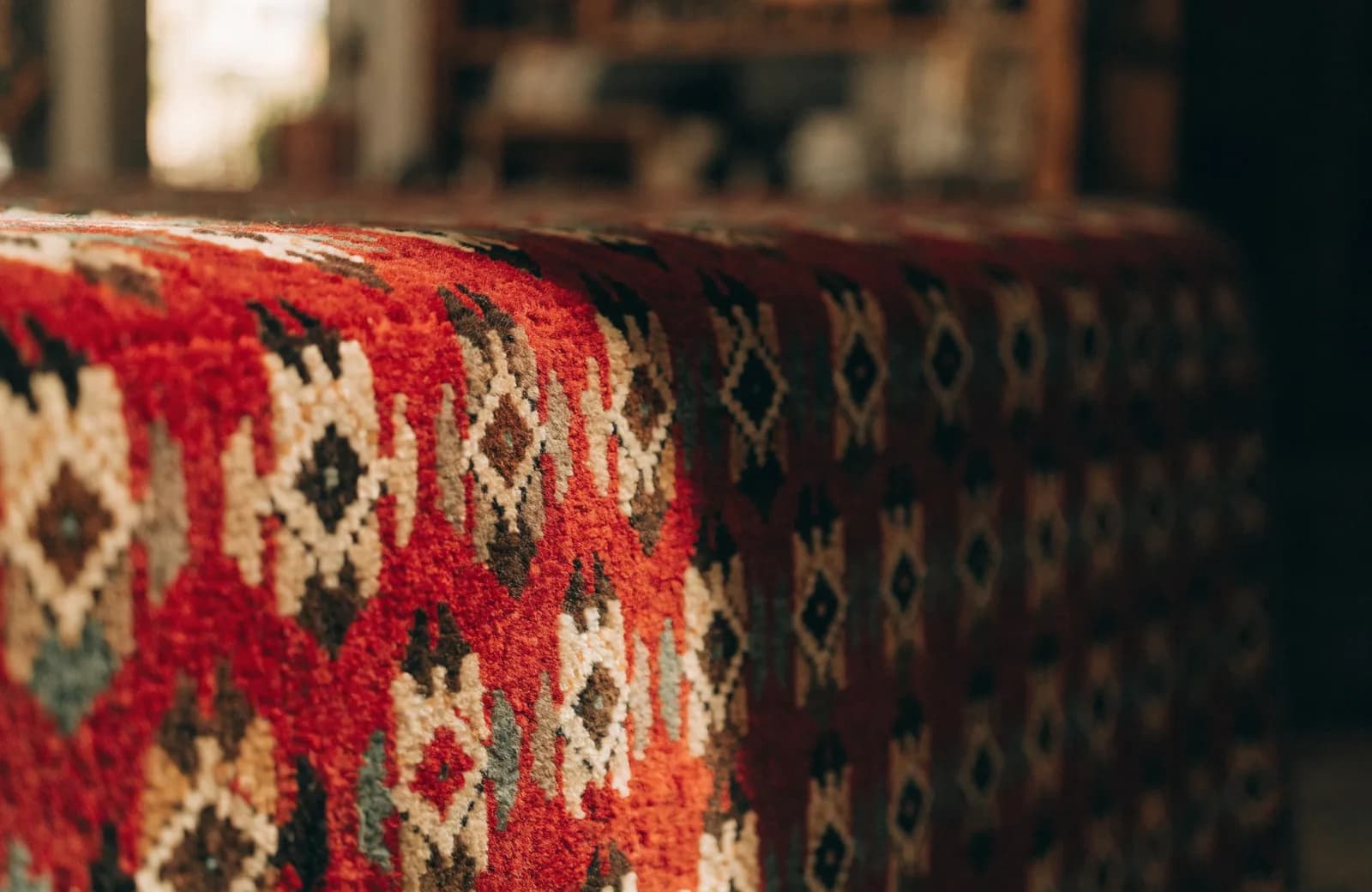
Where fine Persian city rugs often feature flowing floral medallions and curved vines, Afghan design is rooted in tribal geometry. The motifs are bold, symmetrical and repeated, carrying meaning passed down through generations of weaving families rather than copied from a paper cartoon.
The gul
The most characteristic Afghan motif is the gul — an octagonal or stepped medallion repeated in neat rows across the field. The famous “elephant-foot” gul, a chunky octagon, is the signature of many Turkmen-influenced Afghan designs and is one of the easiest ways to recognise the style at a glance.
Khal Mohammadi and Kazak
Two names you will hear constantly are Khal Mohammadi — deep-red, densely patterned rugs that are arguably the best-known modern Afghan type — and the bold, large-scale geometric Kazak designs. Both reward a closer look, and we cover them fully in our Afghan Kazak & Khal Mohammadi Rugs: a Buyer's Guide. If you simply want to see the breadth of what comes out of Afghanistan, our overview of Afghani Handmade Carpets and Rugs is a good place to start.
Afghan vs Persian: a Quick Comparison
One of the most common questions we hear at our Sharjah showroom is how Afghan rugs differ from Persian ones. The two traditions are cousins, not strangers — but the differences are real and worth understanding before you buy.
| Characteristic | Afghan Carpets | Fine Persian City Carpets |
|---|---|---|
| Typical design | Tribal geometry, repeated guls | Curvilinear medallions, florals |
| Knot | Asymmetric (Persian) knot | Asymmetric or symmetric |
| Material | Hand-spun highland wool | Wool, or silk (Qum, fine Isfahan) |
| Palette | Madder reds, indigo, browns | Wider, often softer/pastel range |
| Entry price (at Al Malakia) | From AED 800 | Qum silk from AED 8,000+ |
| Best for | High-traffic, family rooms, majlis | Formal living areas, statement pieces |
Neither is “better” — they answer different needs. For a deeper side-by-side, including how each ages and which suits which room, read our dedicated Persian vs Afghan Carpets comparison.
How to Tell a Genuine Afghan Rug
Because Afghan styles are widely imitated, it helps to know the practical signs of authenticity. None of these requires an expert eye — just a few minutes with the rug.
- Check the back. Hand-knotted Afghan rugs show the pattern clearly on the reverse with visible individual knots and slight irregularity. A perfect machine grid or a glued backing is a red flag.
- Look for abrash. Gentle colour variation across a single field signals hand-spun, naturally dyed wool.
- Feel the wool. Genuine highland wool feels slightly oily and springs back when pressed; it should not feel papery or plasticky.
- Inspect the fringe. On a hand-knotted rug the fringe is a continuation of the warp threads, not stitched or glued on afterwards.
- Smell and weight. Real wool has a faint natural smell and a reassuring heft; very light, odourless rugs are often synthetic.
If you are ever unsure, the honest answer is to buy from people who will turn the rug over with you and explain exactly what you are looking at. That transparency is the whole point of our family business — you can read more about Al Malakia and how we source directly from weavers.
Why Afghan Carpets Suit UAE Homes
Beyond the craft, there are practical reasons Afghan rugs work so well across Sharjah, Dubai and Abu Dhabi. Their durable, lanolin-rich wool stands up to high-traffic majlis areas and busy family living rooms. Their warm, grounded palette flatters both the neutral interiors common in new Dubai apartments and the richer, layered look of a traditional villa. And their tribal patterns are forgiving — they hide everyday footfall and the occasional spill far better than a pale, plain rug.
They are also accessible. A genuine hand-knotted Afghan rug is one of the few authentic, collectable carpets you can own without a luxury budget, which is why our Afghan pieces start from AED 800 while still being true hand-knotted work. For buyers across the Emirates, that combination of authenticity, durability and value is hard to beat.
Why Visit Al Malakia Persian Carpets?
- Direct sourcing: Purchased from weavers in Qum, Tabriz, Isfahan, Kashan, and Nain — no intermediaries, transparent provenance.
- Scale of stock: 500+ hand-knotted pieces in the showroom, across sizes from 60×90 cm to 4×6 m.
- Free Dubai transfer: Complimentary door-to-door pick-up from Dubai hotels and homes.
- Family expertise: Founded in 2008 by Eid Al Salam, a second-generation Persian carpet merchant.
- Blue Souk location: Shop 45–48, Central Souq Block 3, King Faisal Road, Sharjah. Open Saturday–Thursday 10:00–22:00, Friday 14:00–22:00.
Contact us or WhatsApp +971 50 537 2997 to arrange your visit or request a consultation.
The Bottom Line
What makes Afghan carpets unique is not one feature but the way several come together: hand-spun highland wool with real lanolin, the dense asymmetric Persian knot, natural plant dyes that deepen with age, and a tribal geometry that carries genuine cultural meaning. The result is a rug that is honest, hard-wearing and quietly beautiful — a piece that improves rather than wears out. If you would like to feel the difference for yourself, simply contact us and we will arrange a visit, including free transfer from anywhere in Dubai.