Quick Facts
Golden rule: Always blot, never rub — rubbing pushes the stain deeper and felts the wool.
Speed matters: A fresh spill blotted within minutes is far more likely to lift completely than one left overnight.
Safe cleaners: Cool water, a teaspoon of clear pH-neutral wool detergent, and white vinegar diluted 1:4 — never hot water, bleach or alkaline products.
Coffee & wine: Water-based stains; treat with cool water and mild detergent, then a vinegar rinse for any residual colour.
Oil & grease: Absorb with cornflour or talc first, then lift the residue with a tiny amount of dish soap.
When in doubt: For antique, silk-blend or valuable pieces, stop and call us — Al Malakia handles hand-knotted rugs from AED 800 to AED 200,000+.
Spill a glass of red wine on a hand-knotted wool rug and your stomach drops. It is the most common worry we hear at our Blue Souk showroom in Sharjah: can I save it, or have I just ruined an investment? The honest answer is that most everyday stains — coffee, wine, cooking oil, tea, juice — can be removed at home if you act quickly and treat the wool gently. This guide explains exactly how to remove stains from a wool rug without bleeding the dyes, felting the pile, or making things worse.
We sell Persian and Afghan rugs every day to families across Sharjah, Dubai and Abu Dhabi, and we have seen the full range of accidents that real homes produce. Below we walk through the universal first-response method, then give specific recipes for the three trickiest culprits — coffee, wine and oil — followed by the UAE-specific factors (hard water, fast evaporation, sand) that change how you should clean here.
Why Wool Behaves the Way It Does
Wool is the reason a good Persian rug survives generations, and it is also why stain removal needs a careful hand. Each wool fibre is coated in lanolin, a natural oil that makes the surface mildly water-repellent. That is your friend: it buys you time, because a spill sits on top of the pile for a few seconds before it soaks in. Act in that window and you have won half the battle.
But wool has two weaknesses. First, it is protein-based, like hair, so hot water and alkaline or bleaching agents will scorch and yellow it permanently. Second, the agitation of vigorous rubbing makes the scales on each fibre lock together — a process called felting — which dulls the pile and can never be reversed. Almost every "ruined" rug we are shown was not ruined by the spill itself but by panicked scrubbing with the wrong product afterwards.
The two principles that protect every wool rug
- Blot, do not rub. Press a clean white cloth straight down to lift liquid out. Work from the edge of the stain inward so you never spread it.
- Cool and mild only. Cool water, pH-neutral detergent, diluted white vinegar. Skip anything hot, anything with bleach, and anything strongly alkaline (most general-purpose floor cleaners).
Your Universal First-Response Kit
Keep these few items within reach if you own wool rugs. None of them are exotic, and most are already in a UAE kitchen.
- White cotton cloths or kitchen paper — white so no dye transfers to your rug.
- Cool water in a small bowl or spray bottle.
- A clear, pH-neutral wool-safe detergent — a wool wash liquid is ideal; a tiny amount of clear, dye-free dish soap works in a pinch.
- White vinegar, diluted one part vinegar to four parts water, for colour residue and odour.
- Cornflour or talcum powder for grease and oil.
- A soft brush or your fingers to gently realign the pile while it dries.
That is genuinely all you need for the vast majority of household accidents. The expensive solvent sprays sold for synthetic carpets are usually too harsh for wool and too alkaline for natural dyes.
The Step-by-Step Method (Works for Most Spills)
- Scoop or lift solids first. Use a spoon to remove anything chunky, scooping toward the centre of the spill so you do not smear it outward.
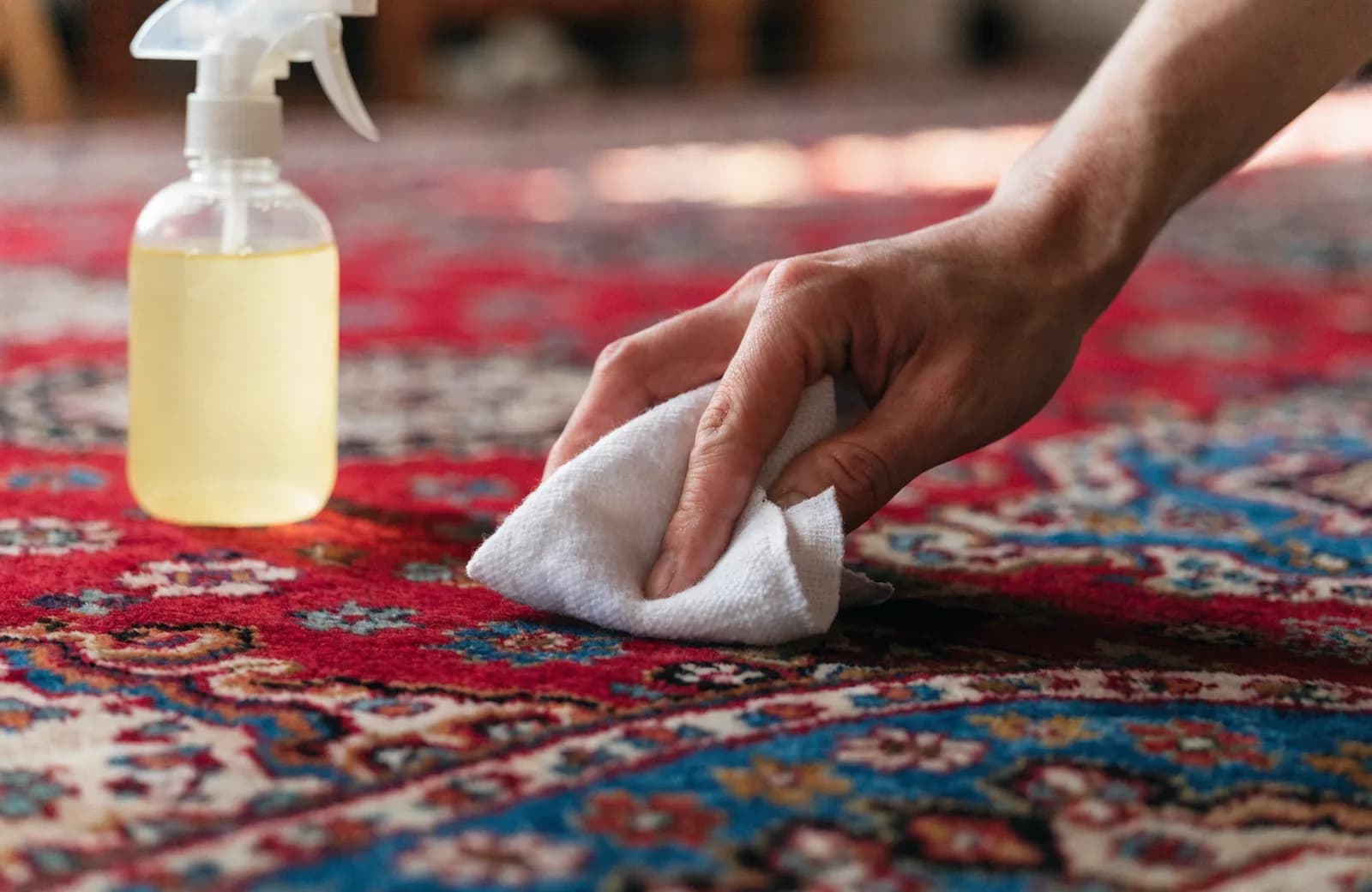
- Blot up the liquid. Press a dry white cloth firmly onto the stain, lift, refold to a clean section, and repeat until little or no moisture transfers.
- Apply cool water. Lightly dampen — do not soak — the stained area with cool water and blot again. For many fresh spills, water alone removes most of the mark.
- Add mild detergent if needed. Mix a teaspoon of wool-safe detergent into a cup of cool water, dab it onto the stain with a cloth, and keep blotting. Never pour detergent directly onto the pile.
- Rinse. Blot with a cloth dampened in clean cool water to lift out the soap, which would otherwise attract dirt later.
- Dry properly. Press out as much moisture as you can, lay a dry towel over the area, and let it air-dry away from direct sun. Realign the pile with your fingers as it dries.
Always test any cleaner on a hidden corner first — the back fringe or an edge under furniture — to confirm the dyes are colourfast before you treat a visible patch.
Removing Coffee Stains
Coffee is a tannin stain, water-soluble when fresh but stubborn once it dries and oxidises into that telltale brown ring. In a country where Arabic coffee and karak are poured all day, it is the stain we are asked about most.
Blot up every drop you can, then dampen with cool water and the mild wool detergent solution, blotting repeatedly. If a faint brown tint remains after the area dries, return with the 1:4 white vinegar solution — the mild acid breaks down the tannin. Blot, rinse with cool water, and dry. Resist the urge to use hot water, which sets coffee proteins into the fibre. For milky or sweetened coffee, the same method works, but rinse thoroughly so no sugar residue is left to attract dust.
Removing Red Wine Stains
Red wine is the spill that causes the most panic, and the most bad advice. You may have heard about dumping salt or white wine on it — both can backfire on a hand-knotted rug, driving pigment deeper or over-wetting the foundation.
The calm, correct sequence is this. Blot up as much wine as possible immediately. Dilute with a little cool water and keep blotting — you will see colour transferring to your cloth, which is exactly what you want. Then apply the mild detergent solution, blot, and finish with the diluted white vinegar, which neutralises the remaining red pigment. Rinse with cool water and dry. The single biggest factor is time: wine blotted in the first few minutes usually lifts completely, while a stain left to dry overnight may need professional attention. If the rug is a fine silk-blend or antique piece, do the minimum blotting and call us before going further.
Removing Oil & Grease Stains
Oil behaves differently from water-based stains, so the water-first method does not apply. Cooking oil, ghee, butter, or the grease from a dropped kebab needs an absorbent, not a liquid, as the first step.
- Absorb. Generously sprinkle cornflour or talcum powder over the grease and leave it for fifteen to thirty minutes. The powder draws the oil out of the fibres.
- Lift the powder. Gently brush or vacuum it away — it will carry much of the oil with it. Repeat with fresh powder if the patch is large.
- Treat the residue. Now use a tiny amount of clear, dye-free dish soap (it is formulated to cut grease) in cool water, dabbed on and blotted off.
- Rinse and dry as in the universal method.
Never start an oil stain with water and detergent alone — you will spread a thin film of grease across a wider area and trap dust into it.
Coffee vs Wine vs Oil at a Glance
| Stain | Stain type | First step | Key treatment | Avoid |
|---|---|---|---|---|
| Coffee | Tannin / water-based | Blot, then cool water | Mild detergent, then 1:4 vinegar for residue | Hot water (sets the stain) |
| Red wine | Pigment / water-based | Blot immediately | Cool water dilution, detergent, then vinegar | Salt, scrubbing, over-wetting |
| Oil / grease | Oil-based | Cover with cornflour or talc | Absorb, brush off, then dish soap on residue | Starting with water (spreads it) |
UAE-Specific Factors That Change How You Clean
Cleaning a wool rug in Sharjah or Dubai is not quite the same as cleaning one in a cooler, more humid climate, and a few local realities are worth knowing.
Hard water
Tap water across much of the UAE is hard and mineral-rich. On a delicate stain it can leave a faint chalky bloom as it dries. For valuable pieces, blot the final rinse with bottled or filtered water and dry promptly to avoid a water ring.
Fast evaporation and air conditioning
The dry desert air and constant AC mean rugs dry quickly here — an advantage, because over-wetting and slow drying are what cause mildew and dye-bleed. Still, never let a wool rug bake in direct sunlight through a window, which fades natural dyes over time.
Sand and fine dust
Fine sand works its way deep into the pile and acts like sandpaper underfoot. Regular gentle vacuuming before any stain even occurs keeps grit from grinding the foundation, a point we cover further in our guide on how to clean a Persian carpet at home safely. Combined with sensible storage and pest awareness — see protecting Persian carpets from moths and pests in the UAE — good routine care means you will rarely face a stain you cannot handle.
When to Stop and Call a Professional
Home treatment is right for fresh, everyday spills on robust wool. But some situations genuinely call for expert hands, and pushing on yourself can turn a recoverable stain into permanent damage.
- Antique, silk, or silk-blend rugs — fine Qum silk and old natural-dyed pieces are far more sensitive to water and friction.
- Old, dried or set-in stains that have already oxidised.
- Dye bleeding — if colour is migrating between areas of the rug, stop adding moisture immediately.
- Pet accidents, ink, or bleach contact, which need specialised treatment.
- Large spills that have soaked into the foundation rather than sitting in the pile.
In any of these cases, blot up what you safely can, then bring the rug to us or arrange a professional clean. For deep restorative work we recommend reading about expert Persian carpet cleaning in Dubai before handing your piece to anyone. We also offer contact us for honest, no-pressure advice — and if you ever want to learn more about Al Malakia and how we source our pieces, our story explains why we care so much about keeping them in good condition.
Prevention Beats Removal
The best stain is the one that never sets. A few simple habits protect your investment far more than any cleaning product. Vacuum gently and regularly to keep grit out of the foundation. Rotate the rug a couple of times a year so wear and sun exposure are even. Keep a small spill kit nearby so you can respond in seconds rather than minutes. And consider a quality rug pad, which reduces the abrasion that lets dirt embed in the first place.
If you are choosing a new wool rug for a high-traffic majlis or a family living room, ask us about pieces with denser knotting and busier traditional patterns — they hide the occasional mark remarkably well. You can browse our collection in person at the showroom or online, and we are always happy to point you toward a rug that suits how your household actually lives.
Why Visit Al Malakia Persian Carpets?
- Direct sourcing: Purchased from weavers in Qum, Tabriz, Isfahan, Kashan, and Nain — no intermediaries, transparent provenance.
- Scale of stock: 500+ hand-knotted pieces in the showroom, across sizes from 60×90 cm to 4×6 m.
- Free Dubai transfer: Complimentary door-to-door pick-up from Dubai hotels and homes.
- Family expertise: Founded in 2008 by Eid Al Salam, a second-generation Persian carpet merchant.
- Blue Souk location: Shop 45–48, Central Souq Block 3, King Faisal Road, Sharjah. Open Saturday–Thursday 10:00–22:00, Friday 14:00–22:00.
Contact us or WhatsApp +971 50 537 2997 to arrange your visit or request a consultation.