Quick Facts
Kilim: Flat-woven, no pile, thin, reversible (usable on both sides), lighter and easier to fold.
Pile carpet: Hand-knotted with thousands of cut knots that stand up to form a soft, plush surface; one usable side only.
Feel underfoot: Kilims are firm and cool; pile carpets are cushioned, warm and quiet.
Durability: Both last for decades when hand-made; pile resists footprint flattening better in high-traffic majlis.
Price at Al Malakia: Tribal Afghan and Persian kilims start from around AED 800; fine Qum silk pile carpets begin at AED 8,000 and climb to AED 200,000+ for large room-sized masterpieces.
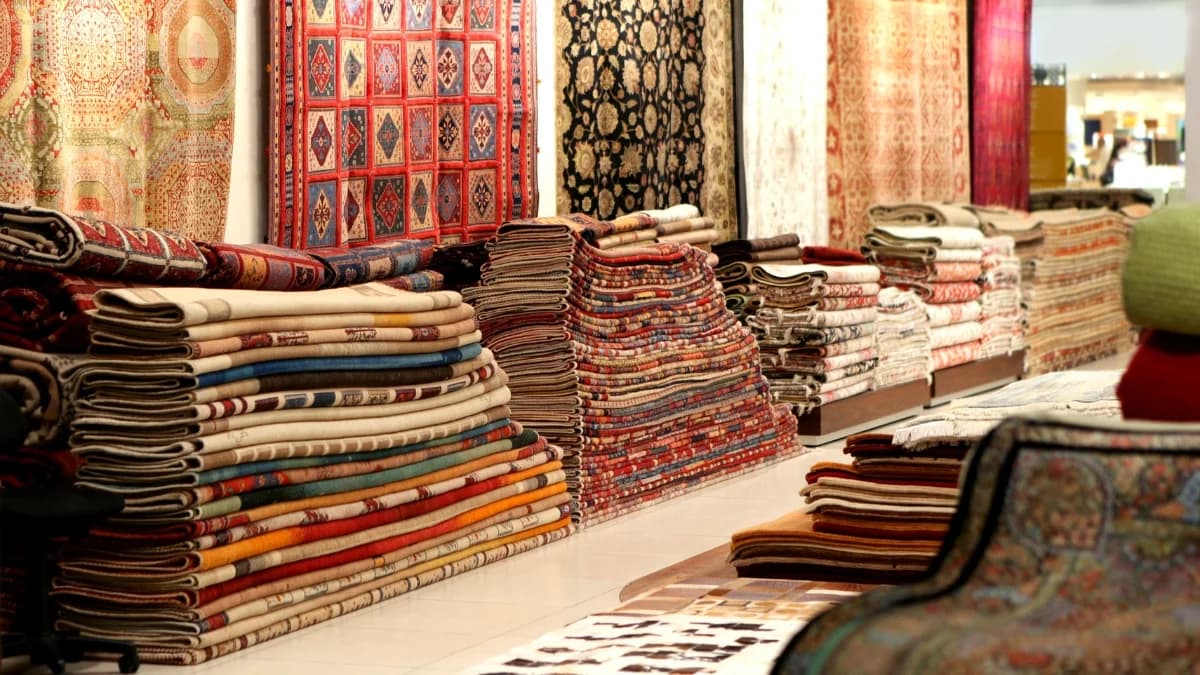
Where to see both: Shop 45–48, Central Souq Block 3 (Blue Souk), King Faisal Road, Sharjah — 500+ pieces in stock.
If you have ever browsed a carpet showroom in Sharjah or Dubai and wondered why one rug is feather-thin and reversible while another is thick, soft and clearly has a "right way up," you have already met the two great families of hand-woven floor coverings: the kilim and the pile carpet. They are made on the same kind of loom, often by the same weaving communities, yet they are constructed in fundamentally different ways — and that single difference shapes how they look, how they feel underfoot, how long they last, and what they cost.
This guide explains kilim vs pile carpet from the ground up, with UAE homes in mind. By the end you will know which suits a high-traffic family majlis, which works as a wall hanging or a layered accent, how to judge quality in each, and roughly what to budget. At Al Malakia Persian Carpets we keep both side by side in the showroom, so the easiest way to decide is always to feel them — but let us start with the theory.
What Is a Kilim?
A kilim (also spelled gelim or kelim) is a flat-woven textile. There is no pile and no knotting in the sense most people imagine. Instead, the weaver passes coloured weft threads horizontally over and under the vertical warp threads, packing them down tightly so the warp disappears completely. The pattern is the structure: the design is built directly into the weave rather than tied on top of it.
Because both faces are made the same way, a true kilim is reversible — the back looks almost identical to the front, which is one of the quickest ways to tell a genuine flat-weave from a printed imitation. Kilims are thin, relatively light, easy to fold and carry, and historically were the practical, everyday weaving of nomadic and village life across Iran, Afghanistan, Anatolia and the Caucasus.
Most kilim designs are geometric: diamonds, hooks, stepped medallions, stripes and bold blocks of colour. This is not a limitation but a consequence of the technique — curved lines are hard to render in a flat weave, so weavers developed a confident, angular visual language that has become deeply collectible in its own right. If you love that tribal, graphic spirit, you may also enjoy the related world of Gabbeh Rugs Explained: Tribal Simplicity & Bold Colour, which sit closer to the pile family but share the same nomadic heart.
What Is a Pile Carpet?
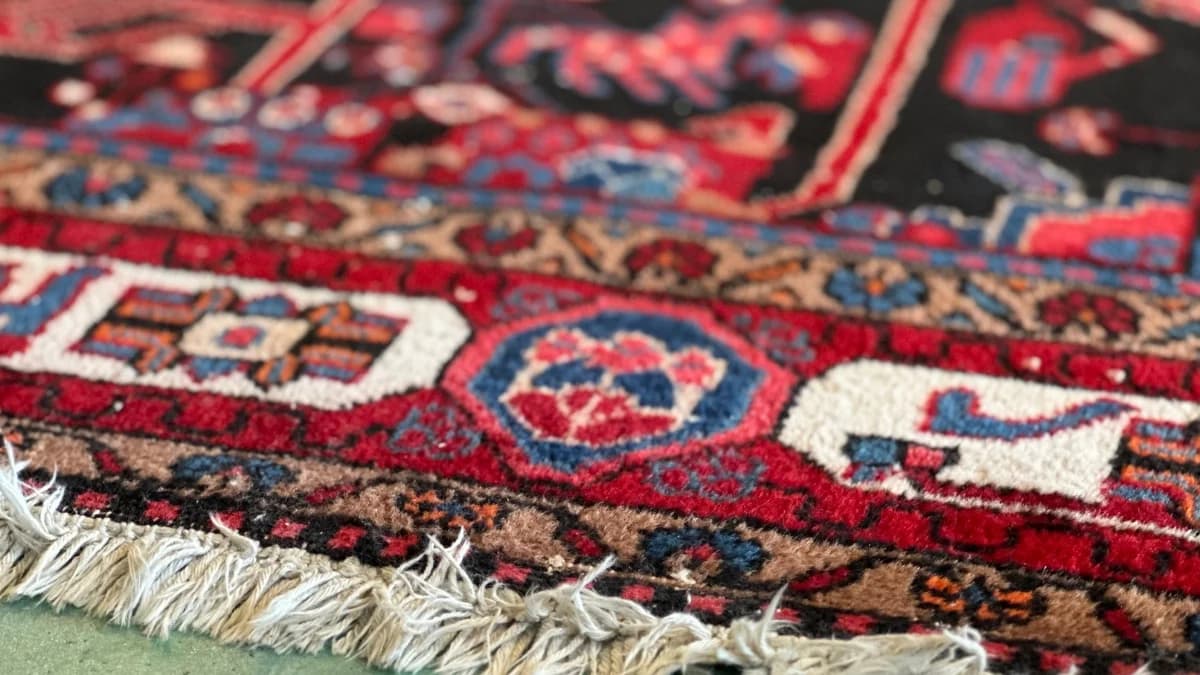
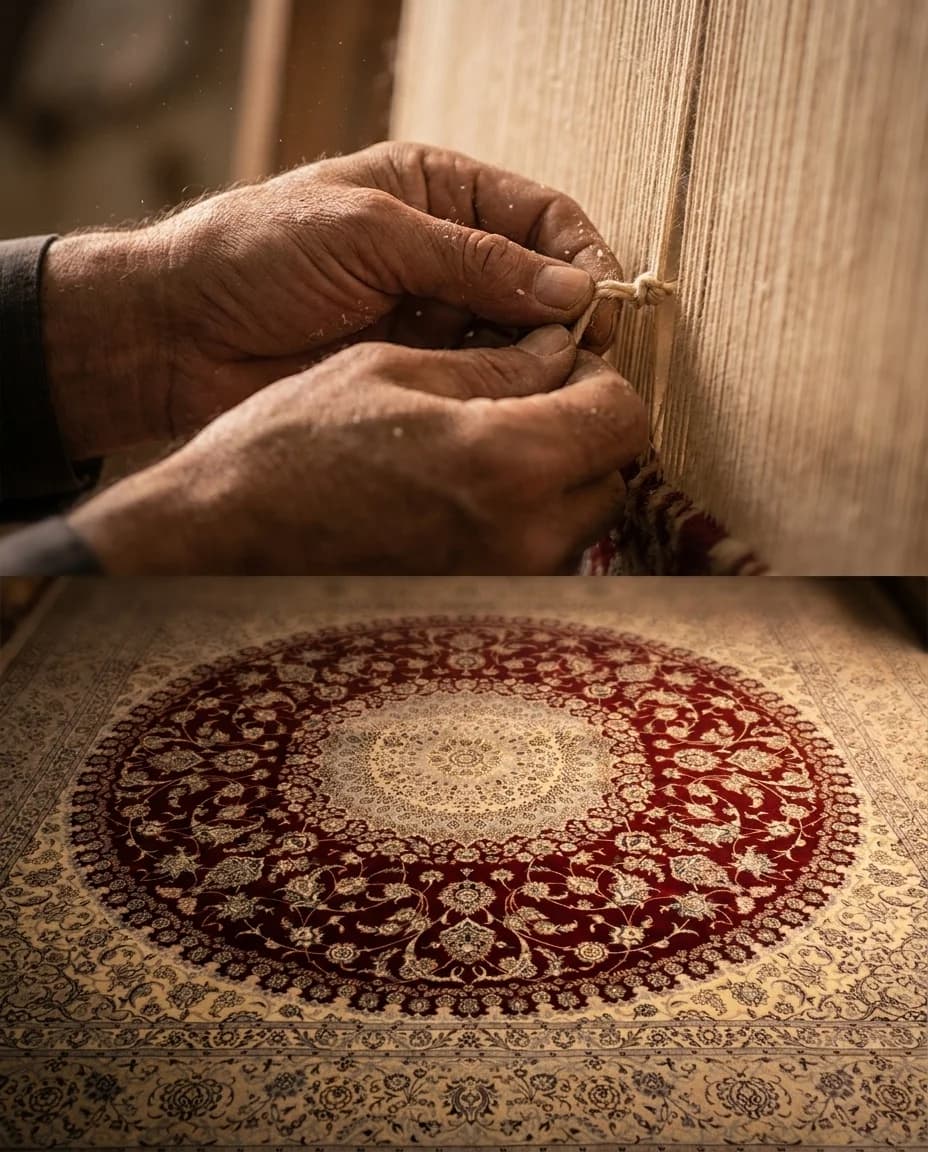
A pile carpet is what most people picture when they hear the words "Persian rug": a thick, soft, often intricately patterned floor covering with a raised, velvety surface. That surface is made of knots. The weaver ties short lengths of wool or silk yarn around pairs of warp threads, row by row, and after each row of knots locks in one or more passes of weft. When the carpet is finished, the protruding ends of those knots are sheared level to create the pile — the soft "nap" you run your hand across.
This construction is far more labour-intensive. A fine pile carpet can carry hundreds, even over a thousand, knots per square inch, and a single room-sized piece may represent many months — sometimes years — of work at the loom. The reward is a surface that can render flowing curves, gardens, hunting scenes, floral medallions and astonishing fine detail. If you want the full picture of that craftsmanship, our companion article on How a Hand-Knotted Persian Carpet Is Made, Step by Step walks through every stage from raw wool to final wash.
Unlike a kilim, a pile carpet has a clear front and back: the knots and pile are on top, and the reverse shows the grid of knots and the weft structure. The fineness and clarity of that reverse pattern is one of the first things an experienced merchant inspects — it is a window into the real knot density and skill behind the piece.
Kilim vs Pile: The Construction Difference Explained
The single sentence to remember is this: a kilim is woven, a pile carpet is knotted. Everything else flows from that.
- Weave vs knot: In a kilim the coloured weft is the visible surface. In a pile carpet the visible surface is a forest of individually tied, then trimmed, knots.
- Thickness: Kilims are typically a few millimetres thick; pile carpets are noticeably thicker because of the standing nap.
- One side or two: Kilims are reversible; pile carpets have a single usable face.
- Pattern style: Kilims favour bold geometry; pile carpets can achieve both geometric and flowing curvilinear designs.
- Weight and portability: Kilims are lighter and fold flat; pile carpets are heavier and are rolled, not folded.
It is worth noting that some pieces blend both techniques — a few weaving traditions add small areas of flat-weave or extra-weft brocade (often called soumak) into an otherwise knotted carpet. But for the everyday decision a buyer faces in the UAE, the kilim-versus-pile distinction holds clean and clear.
Side-by-Side Comparison
Here is the practical breakdown UAE buyers ask us for most often. Treat it as a quick reference rather than a set of absolute rules — there are wonderful exceptions in every category.
| Feature | Kilim (flat-woven) | Pile carpet (knotted) |
|---|---|---|
| Construction | Interlocked weft & warp, no pile | Hand-tied knots, sheared to a soft pile |
| Surface feel | Firm, smooth, cool | Soft, plush, cushioned |
| Reversible | Yes — both sides usable | No — one usable face |
| Typical patterns | Geometric, angular, tribal | Geometric or flowing floral / medallion |
| Thickness & weight | Thin, light, folds flat | Thicker, heavier, rolled |
| Insulation & sound | Minimal warmth, little sound damping | Warm underfoot, quietens a room |
| Entry price at Al Malakia | From around AED 800 | From around AED 800 (Afghan wool); fine silk AED 8,000+ |
| Best for | Layering, wall art, light-traffic rooms, summer feel | Majlis, living rooms, bedrooms, statement floors |
How They Feel and Perform in a UAE Home
Construction theory matters most when it meets a real living room in Sharjah, Dubai or Abu Dhabi. Here is how the two behave day to day.
Underfoot and underclimate
A pile carpet is cushioned and warm — wonderful in an air-conditioned majlis where the marble or porcelain floor can feel cold, and genuinely comfortable to sit on for long gatherings. A kilim is firmer and cooler underfoot, which some families actually prefer in the hottest months, and it lies almost flush with the floor — useful under a dining table where chairs are pulled in and out, or in a doorway where a thick rug would catch.
Sound, dust and maintenance
Pile absorbs sound, softening the echo in tiled UAE apartments and villas. It also holds a little more dust deep in the nap, so it benefits from regular gentle vacuuming. A kilim has nowhere for dust to hide, shakes out easily, and is light enough to take outside and air — a practical advantage in a busy household. Both, when hand-made from good wool, are remarkably forgiving of the region's fine dust if cared for sensibly.
Layering, a popular UAE look
One of the most elegant moves in contemporary interiors is layering a smaller kilim over a larger, plainer pile carpet — combining the plushness of pile with the graphic punch of a flat-weave. Because kilims are thin, they layer beautifully without creating a trip edge. We help clients across Dubai and the wider UAE put exactly these combinations together.
Durability and Care: Which Lasts Longer?
A common myth is that thin kilims are fragile and thick pile carpets are tougher. The truth is more nuanced. Both, when genuinely hand-made, are built to last for decades — the antique kilims and pile carpets that pass through collectors' hands are often a hundred years old or more.
Where they differ is in how they age. A pile carpet's nap can flatten in the busiest walkways over many years, but a quality wool pile recovers well and the slight sheen of "patina" is prized, not penalised. A kilim has no pile to crush, so it never develops walkways in the same way; its main vulnerability is the long weft slits where two colour blocks meet, which on a well-made piece are reinforced and rarely an issue. The decisive factor for both is the same: hand-knotted or hand-woven quality versus machine production. If you are weighing that choice generally, our guide to Hand-Knotted vs Machine-Made Rugs explains why the construction method matters more than thickness alone.
Simple care that suits the climate
- Rotate both types every six to twelve months so any wear and sun-fading stays even.
- Vacuum gently in the direction of the pile for knotted carpets; for kilims, a light vacuum or a good shake outdoors is enough.
- Blot spills immediately with a clean cloth — never rub — and keep harsh chemicals away from natural dyes.
- Use a quality underlay to stop slipping on UAE marble and to add a little extra cushioning under a thin kilim.
Materials, Origins and What They Mean for Price
Both kilims and pile carpets are most often made from wool, prized for its resilience and the way it holds natural dye. Pile carpets are also where you find silk — particularly the famously fine silk pieces from Qum — because silk's strength allows the ultra-high knot counts that produce jewel-like detail. Kilims are almost always wool (sometimes with cotton or goat-hair accents), in keeping with their tribal, hard-wearing heritage.
Origin shapes character too. Afghan and tribal Persian weavers produce some of the most characterful kilims, while the great Iranian city workshops of Qum, Tabriz, Isfahan, Kashan and Nain are renowned for their fine pile carpets. At Al Malakia we source directly from weavers in all five of those Iranian centres, with no intermediaries, which is how we keep provenance transparent and prices fair. If you are weighing regional styles, our comparison of Persian vs Afghan Carpets is a useful next read, and you can always browse our collection to see the full range.
As a rough budget guide for UAE buyers: entry-level Afghan and tribal kilims and wool pile pieces start from around AED 800; fine Qum silk pile carpets begin at AED 8,000; and the very largest, finest room-sized pile masterpieces can reach AED 200,000 or more. Kilims, because they are flat-woven and faster to produce, generally sit at the more accessible end — making them a wonderful entry point into hand-made textiles.
Which Should You Choose?
There is no universally "better" option — only the right piece for a particular room and life.
- Choose a pile carpet if you want softness underfoot for a majlis or living room, warmth against cold marble, sound absorption in a tiled space, the option of flowing floral designs, or an heirloom investment piece in fine silk.
- Choose a kilim if you love bold geometric, tribal patterns, want a lighter and reversible textile, are decorating a lower-traffic space or a wall, prefer a cooler firm feel for the hot months, or are looking for an affordable, characterful first hand-made rug.
- Choose both — layer a kilim over a pile carpet, or use kilims in entryways and dining areas while pile anchors the seating zones. This is increasingly the favourite approach in UAE villas and apartments alike.
The honest answer is that most homes end up with a mix over time, and that is exactly as it should be. To see how each feels in person, you are always welcome to visit, or to contact us for guidance tailored to your space. You can also read more about Al Malakia and our family's two generations in the trade.
Why Visit Al Malakia Persian Carpets?
- Direct sourcing: Purchased from weavers in Qum, Tabriz, Isfahan, Kashan, and Nain — no intermediaries, transparent provenance.
- Scale of stock: 500+ hand-knotted pieces in the showroom, across sizes from 60×90 cm to 4×6 m.
- Free Dubai transfer: Complimentary door-to-door pick-up from Dubai hotels and homes.
- Family expertise: Founded in 2008 by Eid Al Salam, a second-generation Persian carpet merchant.
- Blue Souk location: Shop 45–48, Central Souq Block 3, King Faisal Road, Sharjah. Open Saturday–Thursday 10:00–22:00, Friday 14:00–22:00.
Contact us or WhatsApp +971 50 537 2997 to arrange your visit or request a consultation.