Quick Facts
What it is: A thick, coarsely knotted tribal Persian rug woven by the nomads of the Zagros mountains in south-west Iran.
Look: Bold, simple fields of vegetable-dyed colour with few or no formal motifs — the opposite of an ornate city carpet.
Pile: Unusually deep and plush — often 1.5–2.5 cm high, far thicker than a fine Qum or Isfahan piece.
Material: Almost always hand-spun wool on a wool (sometimes cotton) foundation; never silk.
Price at Al Malakia: Genuine hand-knotted Gabbeh pieces typically start around AED 1,200–1,500, well below a fine Qum silk from AED 8,000+.
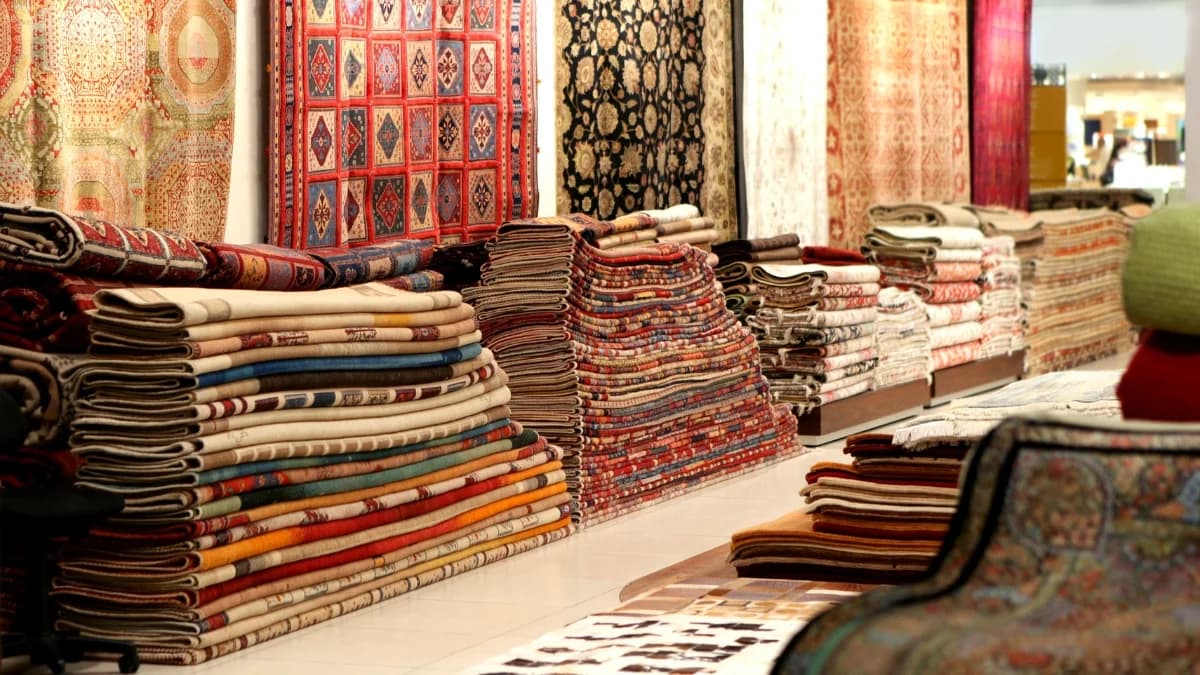
See them: Shop 45–48, Central Souq Block 3 (Blue Souk), Sharjah — 500+ hand-knotted pieces in stock.
Ask most people to picture a Persian carpet and they imagine a dense medallion, swirling vines and a hundred tiny motifs. A Gabbeh rug is the joyful exception: thick, soft underfoot, and built around a few large blocks of glowing colour rather than fine detail. If you have walked through the Blue Souk and felt drawn to a rug that looked almost modern — abstract, warm, and unmistakably hand-made — there is a good chance it was a Gabbeh.
This guide explains exactly what a Gabbeh is, where it comes from, how it is knotted, how to judge quality, and what it costs in the UAE. By the end you will know whether a Gabbeh is the right rug for your majlis, your child's room, or that bright corner of a Dubai apartment that needs warmth without fuss.
What Is a Gabbeh Rug?
The word gabbeh (sometimes spelled gabba or khersak) comes from a Persian term meaning roughly "raw", "natural" or "uncut" — and that tells you almost everything. A Gabbeh is the rug a tribal weaver makes for her own family rather than for the export market: a coarse, thick, generously piled weave with a simple, often improvised design.
Where a city carpet from Qum or Isfahan can carry 600 to 1,000 knots per square inch and a precise, paper-drawn pattern, a Gabbeh is deliberately the reverse. The knot count is low, the wool is left long and lustrous, and the design grows freely from the weaver's imagination. The result is a rug that feels honest and tactile — something you sit on, not just something you admire. If you would like to see how this fits into the wider Persian weaving tradition, our overview of the 5 main Persian carpet regions puts the tribal weaves in context next to the great city workshops.
Where Gabbehs Come From: The Zagros Nomads
Authentic Gabbehs are woven by the nomadic and semi-nomadic tribes of the Zagros mountain range in south-west Iran, principally around the province of Fars near the city of Shiraz. The best-known weavers are the Qashqai and the Luri tribes, who have moved their flocks between summer and winter pastures for centuries.
That nomadic life shapes the rug directly. The wool comes from the tribe's own fat-tailed sheep — prized for a long, glossy, hard-wearing staple. The looms are horizontal and portable, set up on the ground and rolled away when the camp moves. And because the weaver is not copying a fixed cartoon, each Gabbeh carries small irregularities — a wandering line, a colour that shifts mid-field — that are signatures of a genuine hand-knotted tribal piece, not flaws.
The Look: Bold Colour, Few Motifs
The single most recognisable feature of a Gabbeh is its use of large, open fields of colour. Instead of an all-over pattern, you might see a plain saffron-yellow ground with one stylised tree, a few small animals, or a scattering of geometric diamonds. Classic Gabbeh palettes lean on warm, earthy tones drawn from natural dyes:
- Reds and terracottas from madder root
- Yellows and golds from vine leaves, pomegranate skin or weld
- Blues from indigo
- Greens blended from indigo and a yellow dye
- Natural ivory, camel and charcoal from undyed wool
Because the motifs are sparse, a Gabbeh reads as warm and contemporary in a way that suits modern UAE interiors — a minimalist Dubai apartment, a bright children's room, or a relaxed majlis. The symbols that do appear — a tree of life, a sheep, the sun, a comb — usually carry old tribal meanings of fertility, protection and good fortune. If that visual language interests you, our piece on Persian carpet motifs and their hidden meanings decodes the most common ones in detail.
How a Gabbeh Is Knotted
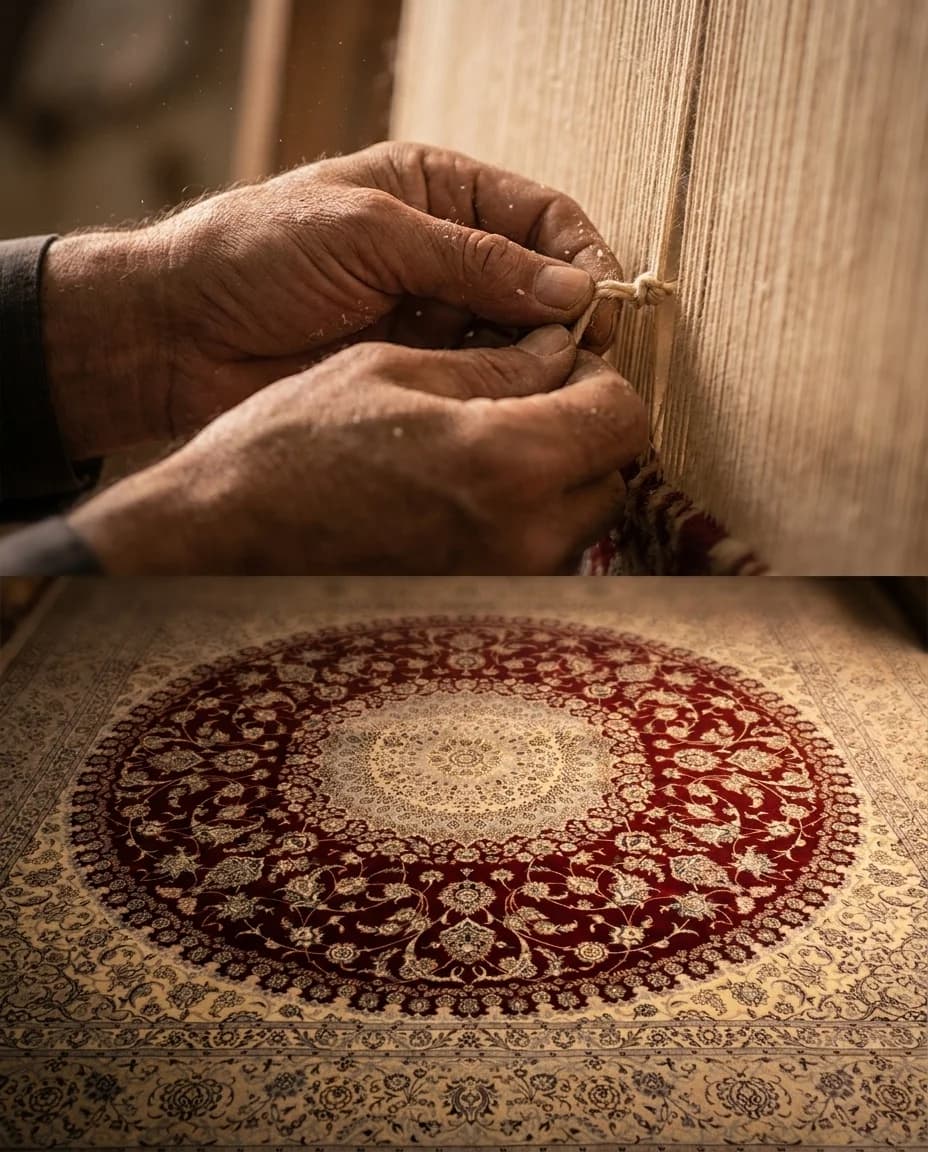
A Gabbeh is a pile carpet: the weaver ties individual knots of wool around the warp threads, row by row, and the cut ends of those knots form the soft surface you walk on. This is the same family of technique used for every classic Persian carpet — and it is worth understanding how it differs from a flat-woven kilim. Our guide to kilim vs pile carpets explains the distinction; in short, a kilim has no pile and is reversible, while a Gabbeh has a thick, one-sided plush surface.
What sets the Gabbeh apart within the pile family is the length of that pile and the coarseness of the knot. A fine Tabriz may have a clipped pile only a few millimetres high; a Gabbeh is often left at 1.5 to 2.5 centimetres. Fewer knots and longer wool mean a thicker, heavier, more cushioning rug — and a much faster weave, which keeps Gabbehs relatively affordable. The trade-off is that fine detail is impossible, which is exactly why the designs stay big and bold.
The wool is the whole story
Because there is so little pattern to hide behind, the quality of the wool is what separates a good Gabbeh from a mediocre one. Look for hand-spun yarn (slightly uneven, which catches the light beautifully), a deep lustre, and a springy, lanolin-rich handle. Machine-spun, over-washed or chemically brightened wool will feel flat and dull and will not age with the soft sheen that makes old Gabbehs so prized.
Gabbeh vs Other Persian Rugs
It helps to place the Gabbeh next to the rug types you are most likely to compare it with. The table below summarises the practical differences our customers ask about most.
| Feature | Gabbeh | Fine city carpet (Qum/Isfahan) | Kilim (flat-weave) |
|---|---|---|---|
| Construction | Pile, coarse knot | Pile, very fine knot | Flat-woven, no pile |
| Pile height | Thick (1.5–2.5 cm) | Low, clipped | None |
| Design | Bold, minimal, tribal | Intricate, detailed | Geometric, repeating |
| Material | Wool on wool/cotton | Silk, or fine wool | Wool or cotton |
| Underfoot feel | Soft, plush, warm | Firm, refined | Thin, flat |
| Typical UAE price | From AED 1,200 | From AED 8,000+ | From AED 800 |
If you are weighing a Gabbeh against an Afghan tribal rug — another great-value, wool-on-wool option — our comparison of Persian vs Afghan carpets walks through the differences in knotting, colour and price.
Sizes and Where Gabbehs Work Best
Gabbehs are woven in everything from small accent mats to large room-filling pieces, and at Al Malakia we stock the full practical range from 60×90 cm runners and mats up to 4×6 m room sizes. Because the design is bold and uncluttered, a Gabbeh holds its own at almost any scale.
- Small (60×90 to 1×1.5 m): a warm welcome by an entrance, beside a bed, or as a play mat — the deep pile is gentle for children.
- Medium (1.5×2 to 2×3 m): ideal under a coffee table or anchoring a seating cluster in a Dubai apartment.
- Large (3×4 m and up): a single statement piece for a villa living room or a generous majlis, where the open colour fields feel calm rather than busy.
One practical UAE note: the thick wool pile of a Gabbeh is forgiving in homes with strong air-conditioning and tiled or marble floors, adding warmth and softening sound in rooms that can otherwise feel hard and echoey. You can browse the sizes and colours currently available in our collection, or tell us your room dimensions and we will pull suitable pieces before you visit.
How to Spot a Genuine Hand-Knotted Gabbeh
The market is full of machine-made and tufted imitations that borrow the Gabbeh look. A few quick checks tell you whether a rug is the real, hand-knotted article:
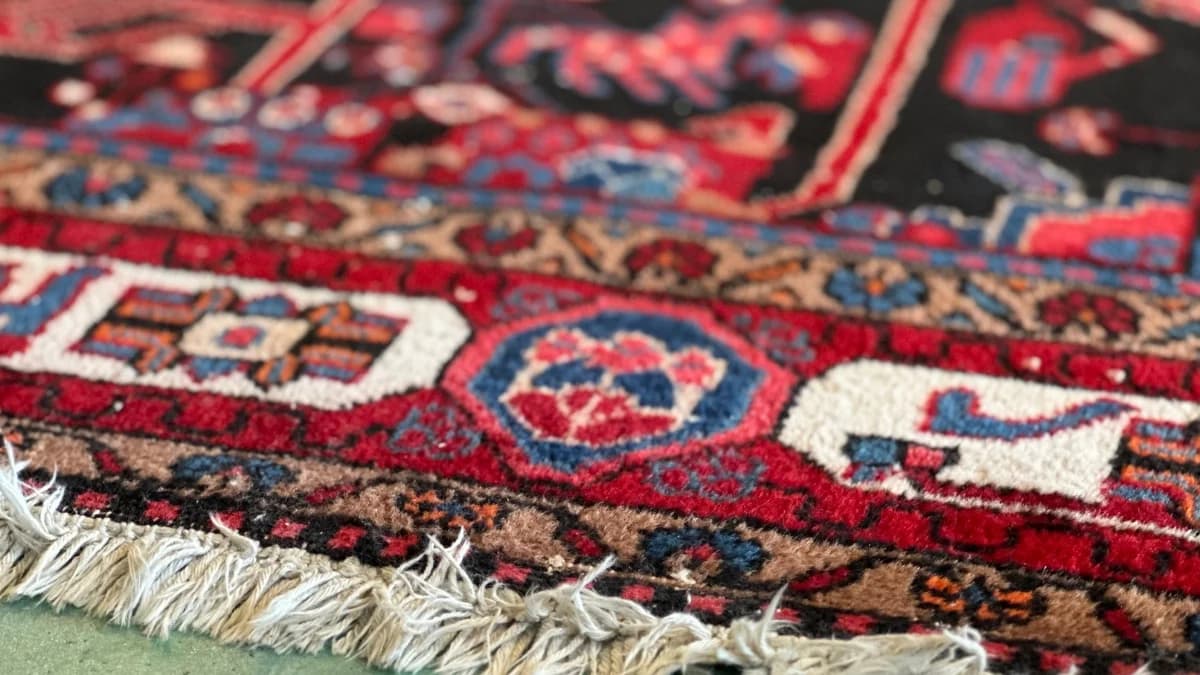
- Turn it over. On a genuine hand-knotted Gabbeh the pattern is visible on the back, with slightly irregular knots. A machine-made copy has a perfectly uniform, often gridded reverse, and a tufted rug has a fabric or latex backing glued on.
- Feel the wool. Hand-spun tribal wool is springy and lanolin-rich; synthetic or over-processed wool feels flat and slick.
- Look for honest irregularity. Slight shifts in colour (abrash) and a line that is not laser-straight are marks of an authentic tribal weave, not defects.
- Check the fringe. On a real piece the fringe is an extension of the warp threads — part of the structure — not sewn on afterwards.
At Al Malakia we source directly from weavers and trusted tribal suppliers, with no intermediaries, so the provenance of every Gabbeh is transparent. You are always welcome to contact us with photos or questions before deciding.
Caring for a Gabbeh in the UAE
Gabbehs are among the most hard-wearing of Persian rugs, which is why nomadic families trusted them for daily floor life. To keep one looking its best in a Sharjah or Dubai home:
- Vacuum gently in the direction of the pile; avoid a rotating beater bar, which can pull the long wool.
- Rotate the rug every few months so sunlight and footfall wear it evenly — important near the large windows common in UAE villas.
- Blot spills immediately with a clean cloth; the lanolin in good wool resists staining if you act quickly.
- Have it professionally hand-washed every few years rather than steam-cleaned, to protect the natural dyes.
Treated well, a quality wool Gabbeh will not just survive decades of UAE family life — it will develop the soft, mellow sheen that makes older pieces so desirable. To understand how Al Malakia selects and stands behind every rug we sell, you can read more about Al Malakia.
Is a Gabbeh Right for You?
A Gabbeh is the ideal Persian rug if you want warmth, softness and a bold splash of natural colour without the formality (or the price) of a fine city carpet. It suits relaxed, modern UAE living, copes well with children and high traffic, and offers genuine hand-knotted craftsmanship at an accessible price point. If, on the other hand, you are drawn to intricate medallions and fine silk detail, a Qum or Isfahan piece may speak to you more — and we are happy to show you both side by side so you can feel the difference yourself.
Why Visit Al Malakia Persian Carpets?
- Direct sourcing: Purchased from weavers in Qum, Tabriz, Isfahan, Kashan, and Nain — no intermediaries, transparent provenance.
- Scale of stock: 500+ hand-knotted pieces in the showroom, across sizes from 60×90 cm to 4×6 m.
- Free Dubai transfer: Complimentary door-to-door pick-up from Dubai hotels and homes.
- Family expertise: Founded in 2008 by Eid Al Salam, a second-generation Persian carpet merchant.
- Blue Souk location: Shop 45–48, Central Souq Block 3, King Faisal Road, Sharjah. Open Saturday–Thursday 10:00–22:00, Friday 14:00–22:00.
Contact us or WhatsApp +971 50 537 2997 to arrange your visit or request a consultation.