Quick Facts
Golden rule: always roll a Persian carpet — never fold it; folding cracks the foundation and leaves permanent creases.
Clean first: a carpet must be fully dust-free and bone-dry before storage, or moths and mildew will breed inside the roll.
Roll direction: roll with the pile facing inward, in the direction the pile leans, around a sturdy core.
Climate: aim for a cool, dry, dark space — roughly 18–22°C and 45–55% relative humidity, which matters a great deal in the UAE.
Never use plastic: wrap in breathable cotton or unbleached muslin, not sealed plastic sheeting that traps moisture.
Need help? At Al Malakia in Sharjah’s Blue Souk we professionally clean and prepare carpets for storage; WhatsApp +971 50 537 2997.
A hand-knotted Persian carpet is built to last generations — but only if it is stored correctly during the months it spends off the floor. Whether you are moving home, renovating a villa in Dubai, swapping a summer rug for a winter one, or simply protecting an heirloom Qum silk, the way you store the piece decides whether it emerges fresh or ruined. In the UAE the stakes are higher than in cooler climates: heat, swings between humid outdoor air and dry air-conditioned interiors, and an active population of carpet moths all conspire against a rolled-up rug left in the wrong place.
This guide walks through exactly how to store a Persian carpet properly, step by step — cleaning, rolling, wrapping, choosing a location, pest control, and how often to check on it. Everything here reflects how we handle the 500+ hand-knotted pieces in our own showroom, adapted for the realities of an Emirati home.
Why Correct Storage Matters So Much
A Persian carpet is a textile of wool or silk knotted onto a cotton or silk foundation, coloured with dyes that took weeks to prepare. Left flat on the floor and walked on, it is remarkably resilient. Rolled up and forgotten in a hot garage, it is suddenly vulnerable on several fronts at once: the foundation can crack, the dyes can migrate in damp conditions, moth larvae can eat the wool from the inside, and crushing weight on top can flatten the pile permanently.
The good news is that none of these risks require expensive equipment to avoid — they require the right sequence of simple steps. Get the sequence wrong, though, and the damage is often invisible until you unroll the carpet months later. By then a mild mildew smell, a line of bald wool, or a hard crease across the centre may already be permanent. If you are storing a fine piece — a Qum silk that started at AED 8,000+, or a room-sized investment carpet — the few hours of care described below are the cheapest insurance you will ever buy.
Step One: Clean the Carpet Thoroughly First
Storage begins with cleaning, and this is the step most people skip. A carpet that looks clean to the eye almost always carries fine grit deep in the pile, plus food traces, skin cells and pollen — exactly the diet that carpet-moth larvae thrive on. Sealing that into a roll for a season is an open invitation to pests.
Start by vacuuming both sides on a low-suction setting, with the beater bar off so the fringes are not chewed. Vacuum the back as well as the front; a surprising amount of grit hides against the foundation. For a deeper clean before long-term storage, a proper professional wash is worth it — see our guide to Expert Persian Carpet Cleaning in Dubai for what a correct hand-wash involves. Never store a carpet that has had a spill or a pet accident without washing it first; organic residues are the single biggest magnet for moths.
Make Sure It Is Completely Dry
This point cannot be overstated in the UAE. A carpet that feels “dry” after a wash may still hold residual moisture at the base of the pile and inside the foundation. Rolling a damp carpet and wrapping it is the fastest route to mildew, dye-run and rot. After any washing, let the carpet dry fully — ideally flat, in shade, with air moving across both sides — for at least a full day longer than you think it needs.
Step Two: Always Roll — Never Fold
This is the single most important rule of carpet storage. Folding a hand-knotted carpet is one of the few things that can cause irreversible damage. A fold forces the cotton or silk foundation to bend sharply against its own weave; over weeks under its own weight, the foundation fibres crack along the fold line. When you finally lay the carpet out, a hard white crease appears that no cleaning can remove.
Rolling distributes the bend gently across a wide curve instead. To roll correctly:
- Lay the carpet flat and brush the pile to find which way it leans — run your hand across it; one direction feels smooth, the other rough.
- Roll in the direction the pile leans, with the pile facing inward. This protects the delicate surface and lets the more robust foundation take the outer curve.
- Roll around a sturdy core — a cardboard tube, a length of PVC pipe, or an acid-free roller — rather than around nothing, which lets the centre collapse into a tight, crushing curl.
- Keep the roll straight and even, not skewed, so weight is shared along the whole length.
For very large room-sized carpets, two people make this far easier and prevent the roll from twisting. If a piece is simply too large to roll into a manageable cylinder, that is a sign to bring it to a professional rather than forcing a fold.
Step Three: Wrap It Correctly — and Never in Sealed Plastic
Once rolled, the carpet needs a protective wrap that keeps dust and insects out while still letting the fibres breathe. The wrong wrap is almost as damaging as no wrap at all.
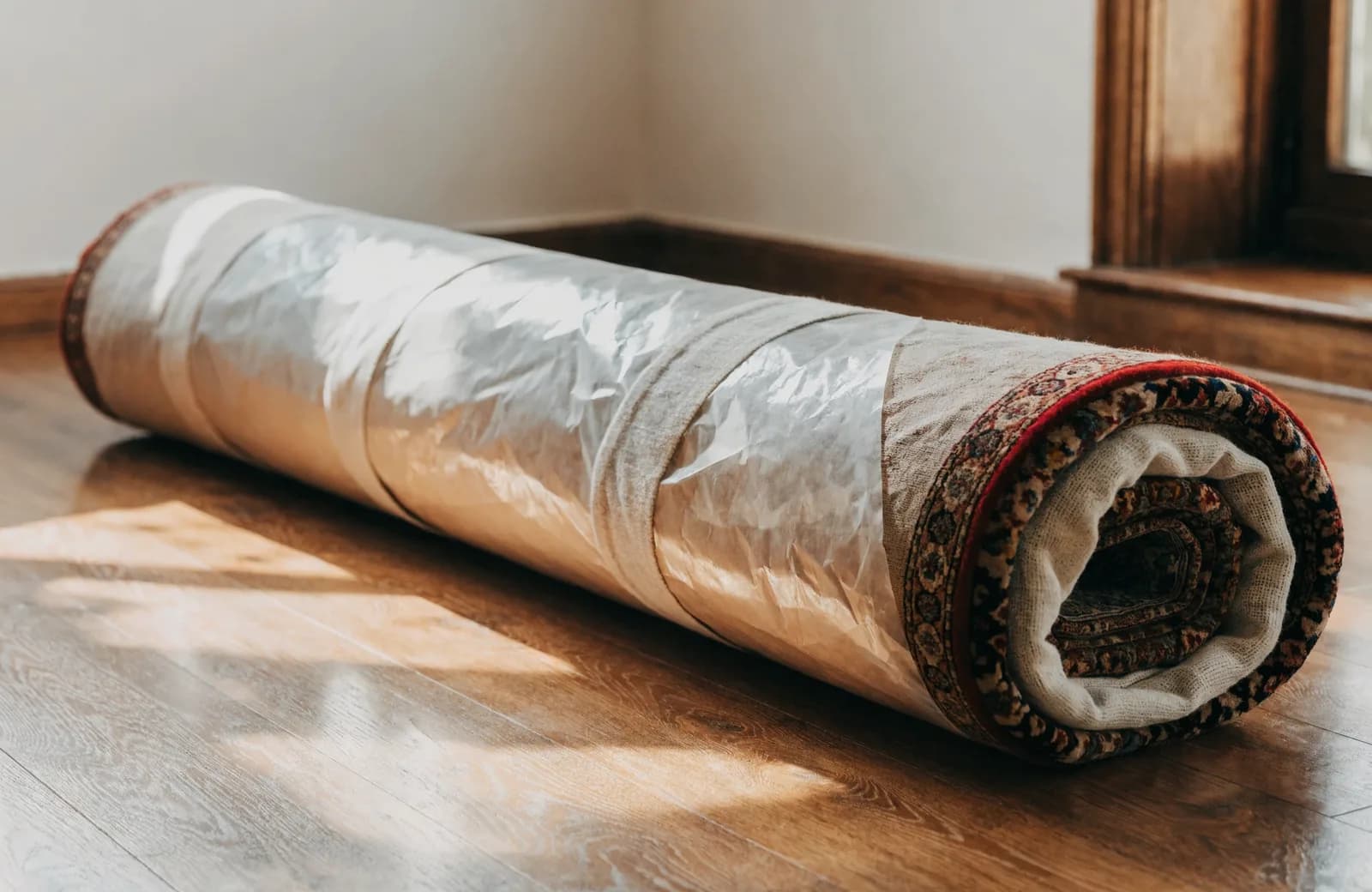
Use breathable natural fabric: a clean cotton sheet, unbleached muslin, or purpose-made acid-free wrapping paper. Wrap the whole cylinder and tuck or loosely tie the ends. The aim is a barrier that excludes moths and dust but allows air — and any trace of residual moisture — to escape rather than condense inside.
Do not wrap a carpet in sealed plastic for long-term storage. Plastic sheeting and shrink-wrap trap humidity against the wool, and in the UAE’s climate that trapped moisture quickly becomes mildew, a musty smell, and dye migration. Plastic is acceptable only as a brief outer layer during a move or transport on a wet day — and it must come off the moment the carpet reaches storage.
Step Four: Choose the Right Location
Where you keep the rolled carpet matters as much as how you wrap it. The enemies are heat, moisture, direct light and weight from above. The ideal spot is cool, dry, dark, and clean, with stable conditions that do not swing through the day.
| Location | Suitability | Why |
|---|---|---|
| Air-conditioned interior room or wardrobe | Best | Stable temperature and humidity; dark; protected from pests and sun. |
| Under a bed (raised, ventilated) | Good | Dark and climate-controlled, provided nothing is stacked on top. |
| Garage or storeroom | Risky | Often hot and humid; check for damp and pests before use. |
| Balcony, attic or outdoor store | Avoid | Extreme heat, UV light and humidity swings; high pest risk. |
| Directly on a concrete or tiled floor | Avoid | Cold, damp can wick up into the foundation; raise the roll instead. |
Store the roll horizontally on a raised surface or on slats — never standing it on one end, which crushes the lower fibres under the whole weight of the carpet, and never directly on bare concrete. Critically, never stack anything heavy on top of a stored carpet. A box of books left on a rolled rug for a season will leave a flattened, crushed band of pile that takes months of use to recover, if it recovers at all.
Managing Humidity and Temperature in the UAE
Indoor humidity is the variable most people underestimate here. Aim for a relative humidity of roughly 45–55% and a stable temperature around 18–22°C — conditions a normally air-conditioned Emirati home already provides, which is exactly why an interior cupboard beats a garage. If you are storing in a space that is switched off for long stretches, or during the most humid months, a small desiccant pack or a plug-in dehumidifier nearby makes a real difference. Because air-conditioning and humidity are such a defining issue for carpets in this region, it is worth reading our dedicated guide on Humidity, AC & Persian Carpets: a UAE Care Guide before committing a valuable piece to long storage.
Step Five: Protect Against Moths and Pests
Carpet moths are the most destructive enemy of stored wool, and they do their worst out of sight — the larvae eat the wool pile from the base, so by the time you see a moth flying you may already have bald patches forming inside the roll. A clean carpet is your first line of defence, because larvae need the organic residue in a dirty rug to thrive.
Beyond cleaning, take these precautions before rolling:
- Tuck natural repellents into the wrap — cedar blocks or lavender sachets are traditional and effective, and unlike mothballs they leave no chemical smell in the wool.
- Inspect the chosen storage space for any existing sign of moths, silverfish or carpet beetles before you put the carpet in.
- Avoid storing alongside other untreated woollens, which can be a source of infestation.
For a full treatment of identifying and preventing infestations, our guide to Protecting Persian Carpets from Moths & Pests in the UAE covers the warning signs and the steps to take if you suspect a problem. If you do unroll a carpet and find live larvae or damage, stop and get professional treatment before re-storing it.
Step Six: Check On It Periodically
Stored does not mean forgotten. Every two to three months, take the carpet out, unroll it, and give it a look. This periodic check does three useful things at once: it lets you spot any early sign of moths or mildew before it spreads, it airs the wool and releases any residual moisture, and it relaxes the fibres so they do not set into a single permanent curve.
While it is open, vacuum it lightly, refresh the cedar or lavender, and — importantly — re-roll it from the opposite end or in a slightly different position so the same point is not always under the tightest part of the curve. Then re-wrap and return it. Ten minutes a season is all it takes to keep a stored carpet in showroom condition.
When to Call a Professional
Some situations are best handed to experienced hands. A very large room-sized carpet, a fragile antique, or a fine silk piece deserves professional cleaning and preparation before long storage — the cost is small against the value of the piece. If you are storing for a year or more, or you have noticed any past pest or damp problem, a professional assessment is worth it.
At Al Malakia we clean, repair and prepare carpets for storage as part of caring for the pieces we sell, and we are always happy to advise on a carpet bought elsewhere. You can learn more about Al Malakia and our second-generation expertise, browse our collection if you are considering a new piece, or simply contact us with a question about a carpet you already own. We offer free door-to-door transfer from Dubai homes and hotels, so bringing a piece in for cleaning before storage is genuinely effortless.
Why Visit Al Malakia Persian Carpets?
- Direct sourcing: Purchased from weavers in Qum, Tabriz, Isfahan, Kashan, and Nain — no intermediaries, transparent provenance.
- Scale of stock: 500+ hand-knotted pieces in the showroom, across sizes from 60×90 cm to 4×6 m.
- Free Dubai transfer: Complimentary door-to-door pick-up from Dubai hotels and homes.
- Family expertise: Founded in 2008 by Eid Al Salam, a second-generation Persian carpet merchant.
- Blue Souk location: Shop 45–48, Central Souq Block 3, King Faisal Road, Sharjah. Open Saturday–Thursday 10:00–22:00, Friday 14:00–22:00.
Contact us or WhatsApp +971 50 537 2997 to arrange your visit or request a consultation.